
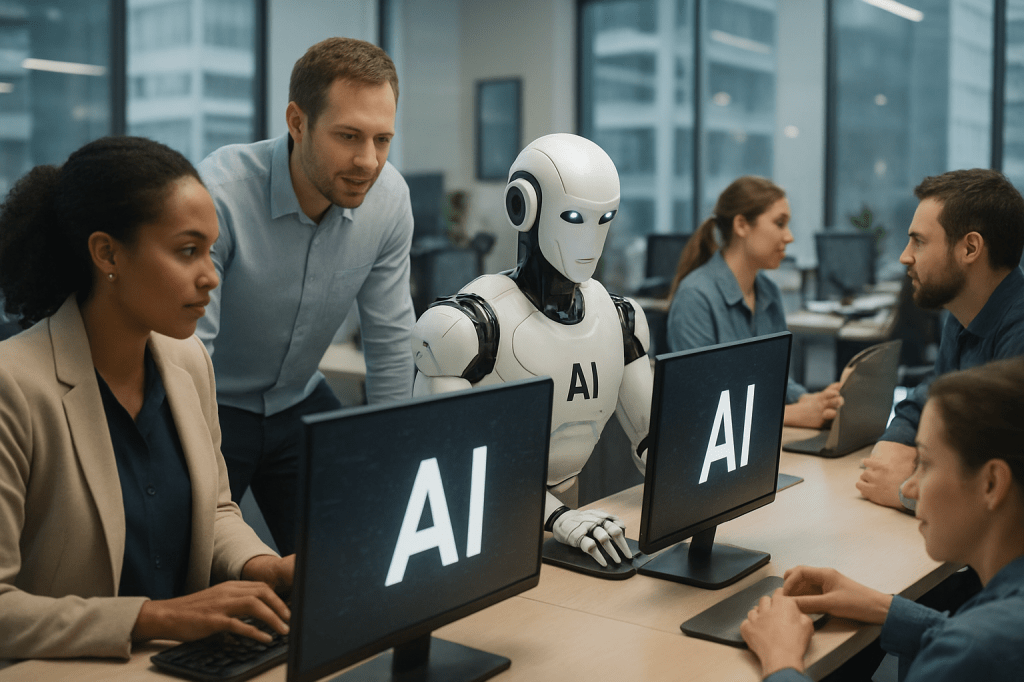
April 25, 2025, might just be marked as the day we collectively leaned back in our ergonomic chairs and asked, “What on earth is happening with jobs?” NewsNation’s latest analysis casts a spotlight on the rapidly shifting landscape of work, thanks to our ever-evolving companion, artificial intelligence. But this isn’t just another tech forecast. It’s a deep dive into the realities and nuances of AI’s impact on our professional lives today. Let’s peel back the layers and see what’s new under the hood.
The New Face of Office Automation
Gone are the days when automation was a looming threat over factory floors alone. The robots have left the assembly line and are now cozying up to office desks. According to NewsNation, nearly 60% of companies have adopted AI-driven tools, with generative AI like ChatGPT and Google Gemini leading the charge.
Why the shift? It’s simple: these tools excel at cognitive tasks—reading, writing, synthesizing information—at a speed and scale that humans can’t match. The implications? White-collar workers, once secure in their swivel chairs, are now facing a future where AI could handle a significant chunk of their duties.
White-Collar Blues
While past automation waves swept through blue-collar roles, today, it’s the administrative positions—bookkeepers, customer service representatives, office clerks—that are feeling the heat. AI’s knack for processing large datasets efficiently means it’s not just about cutting costs; it’s about redefining efficiency.
This isn’t a small ripple; it’s a tidal wave. Goldman Sachs predicts nearly two-thirds of current jobs are exposed to some degree of AI automation. The Brookings Institution echoes this, noting that over 30% of workers could see at least half their tasks disrupted by AI. It’s a brave new world, and we’re all just figuring out how to swim in it.
Beyond Displacement: A New Dawn for Work?
Despite the doom and gloom, there’s a silver lining. The NewsNation piece suggests that AI could free us from mundane tasks. Imagine a world where you’re not bogged down by data entry but instead focusing on creative problem-solving or strategic planning. AI’s rise could indeed be a catalyst for job creation, birthing roles like AI trainers and prompt engineers.
- AI Trainers: Teaching AI systems to better understand and interact with humans.
- Prompt Engineers: Crafting the queries and inputs that help AI generate useful outputs.
It’s a narrative of enhancement rather than replacement, a shift towards more meaningful work. But are we ready to embrace it?
Adapting to the AI Era
For workers, adaptation is key. The article wisely points out that to stay competitive, we need to learn the language of AI. This means getting cozy with platforms like ChatGPT and honing skills that AI can’t replicate—emotional intelligence, teamwork, and other soft skills.
It’s about blending tech-savviness with uniquely human traits. Think of it as a new kind of literacy, one where understanding and collaborating with AI becomes as fundamental as reading and writing.
The Bigger Picture
The real question isn’t whether AI will change the workplace—it’s already doing that. It’s about how we, as a society, choose to navigate this change. Will we see it as a threat, a challenge, or an opportunity?
This story from NewsNation isn’t just another commentary on AI’s potential. It’s a call to action, an invitation to rethink our relationship with work, technology, and each other. The future isn’t a distant horizon; it’s unfolding right now, and we’re all part of the script.
So, as we sit at the crossroads of innovation and employment, perhaps the most important takeaway is this: in the age of AI, the only constant is change, and our ability to adapt will define the future of work.
