
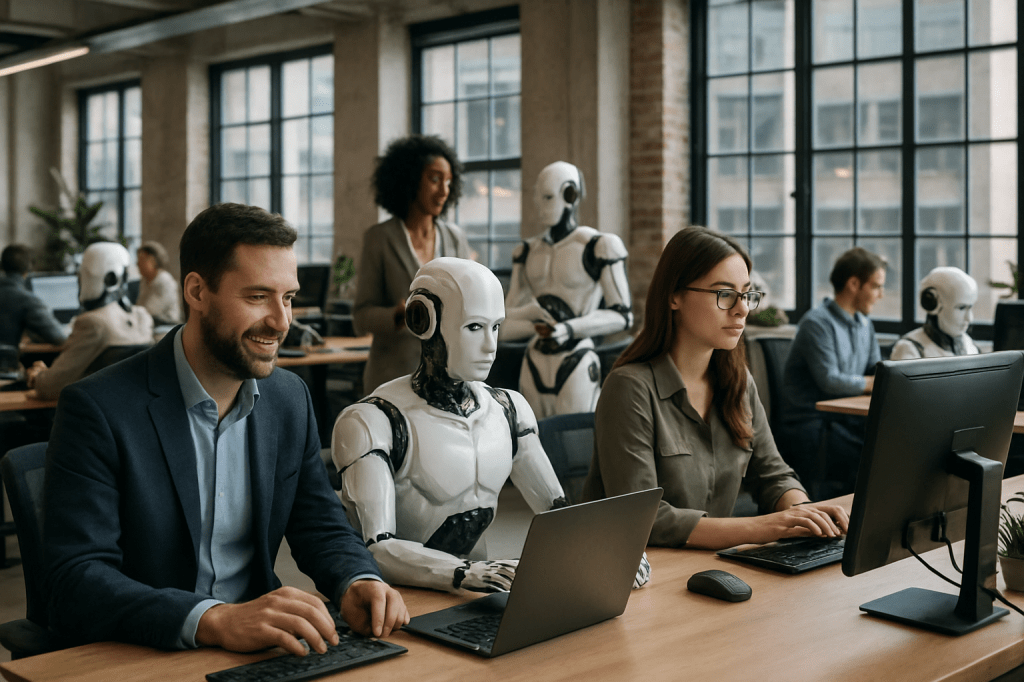
April 27, 2025, marked a moment of reckoning for the labor market, as The Atlantic published a provocative piece titled “Was Sam Altman Right About the Job Market?” making waves across the tech and employment landscapes. If you thought AI was just a buzzword, think again. This is a watershed moment, and Sam Altman, CEO of OpenAI, might just be the Cassandra of our times.
The Autonomous AI Wave: What’s Truly New?
It’s not just about improving algorithms anymore—it’s about AI agents stepping into roles traditionally held by humans. Recent weeks have seen OpenAI, Anthropic, Google, Amazon, and Microsoft unleashing AI products that perform complex tasks autonomously. This isn’t a mere upgrade; it’s a paradigm shift. These AI agents are designed to replicate human reasoning, marking a significant leap in AI’s capabilities and potential applications.
While past models like ChatGPT faced criticism for inaccuracies and biases, the new breed of AI is more sophisticated, albeit not flawless. But here’s the kicker: they’re already making tangible impacts across professional fields. We’re seeing AI’s potential to enhance productivity, but at what cost?
Sam Altman: A Modern Oracle?
Altman has been vocal about AI’s potential to disrupt the labor market. His predictions are not just speculative; they’re rapidly becoming reality. He has long advocated for exploring new economic models such as universal basic income (UBI) to cushion the societal impacts of widespread automation. With these recent developments, his foresight seems more prescient than ever.
But why should we care now? Because the deployment of autonomous AI agents is not a distant future—it’s happening today. The conversation has shifted from “if” to “how” we adapt to this new landscape.
Implications: Winners, Losers, and the Great Unknown
The rise of autonomous AI agents brings both opportunities and challenges. Here’s the nuanced breakdown:
- Winners: Businesses that adopt AI early may see increased efficiency and reduced costs. Industries like finance, healthcare, and logistics stand to benefit from AI’s ability to handle complex data and streamline operations.
- Losers: Workers in roles that AI can automate are at risk. This includes tasks that require routine decision-making or data processing—think customer service, administrative roles, and even certain creative tasks.
- The Great Unknown: How will society navigate the ethical and economic challenges of this transition? The call for reskilling programs and policy interventions is louder than ever, but are we acting fast enough?
Deeper Questions and Future Trajectories
As we stand on the brink of this automated future, deeper questions emerge. Are we prepared to handle the ethical dilemmas of AI decision-making? How do we ensure equitable distribution of AI’s benefits? The discussion around UBI and workforce adaptation is crucial, but it’s only the tip of the iceberg.
Moreover, the notion of AI enhancing human capabilities rather than replacing them opens a new frontier. Could we see a future where humans and AI coexist in synergistic harmony, or are we destined for a more dystopian outcome?
The Call to Action: Strategic Planning and Adaptation
The Atlantic’s article underscores a critical takeaway: proactive measures are non-negotiable. Reskilling programs, policy innovations, and a reimagining of economic models like UBI are essential to navigate this brave new world. The time to act is now, not when the dust has settled.
In conclusion, as AI continues to transform the job market, Altman’s predictions remind us that strategic foresight is key. Whether you’re a business leader, policy maker, or worker, the message is clear: adapt, innovate, and prepare for the seismic shifts ahead. Because the future of work is not just coming—it’s already here.
