
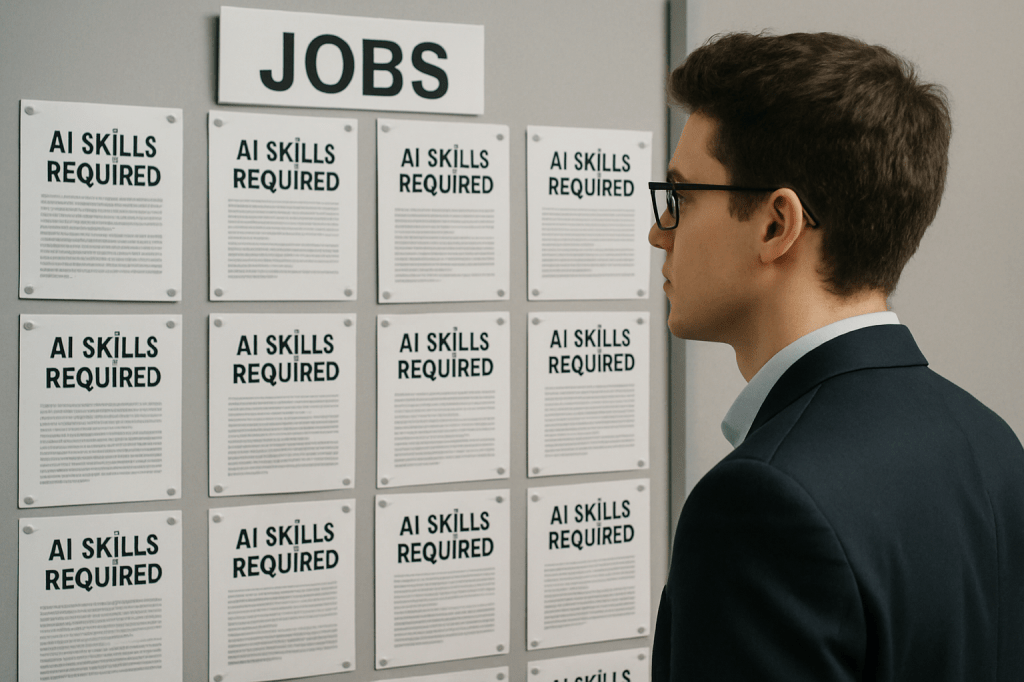
Remember that scene in “Office Space” where Peter Gibbons realizes his job is utterly pointless? Turns out, that existential dread might be hitting even *before* you land the gig these days. The latest data suggests that young, educated workers – the very demographic promised a golden ticket by the higher education industrial complex – are facing a surprisingly tough job market. And while economic cycles and the perceived “value” of a degree are always in flux, there’s a new player on the field: Generative AI.
The Atlantic recently sounded the alarm with a piece titled “Something Alarming Is Happening to the Job Market,” reporting a 5.8% unemployment rate among young, educated workers. That’s not Great Depression levels, but it’s eyebrow-raisingly high, particularly when you consider the supposed shield a college degree provides. Even MBA grads from *elite* programs are struggling. Let’s dig into what makes this different from your run-of-the-mill economic downturn.
Beyond the Usual Suspects: Why This Feels Different
Sure, we’ve seen this movie before. Economic downturns hit the fresh-faced grads hardest. They lack experience, networks, and often, the specific skills companies need right now. But blaming it all on a slow recovery feels… incomplete. Here’s why:
- The “Degree Dividend” is Diminishing: Since 2010, the wage premium for degree holders has stagnated. This isn’t just about student loan debt; it’s about the perceived *value* employers place on that piece of paper.
- Fewer Postings Require a Degree: This is the kicker. It’s not just that degrees aren’t guaranteeing higher salaries; they’re becoming *optional* for roles that once demanded them. Think about that for a second.
These two points, combined with the very recent rise of generative AI, paint a picture that’s more nuanced than a simple cyclical downturn. The article rightly points out the skepticism around quantifying AI’s impact, citing a lack of significant productivity growth and limited employer survey data. But that skepticism might be a bit too comforting.
The AI “Maybe”: A Stealth Disruptor?
Here’s the thing: AI’s impact might not be immediately visible in broad productivity numbers. It’s more like a silent efficiency upgrade, subtly reshaping workflows and eliminating the *need* for certain entry-level tasks. Think about it: tasks like initial research, report drafting, and basic data analysis, traditionally given to recent grads, are now prime targets for AI automation. The *Atlantic* piece highlights this, but the implications are worth hammering home.
We’re talking about a potential “stealth layoff” scenario. Companies aren’t necessarily firing legions of graduates, but they’re simply not *hiring* as many to begin with. This creates a bottleneck at the entry level, forcing young professionals to compete for a shrinking pool of opportunities.
Who Wins, Who Loses? The New Labor Market Reality
This isn’t just about “AI taking jobs.” It’s about a fundamental shift in the skills that are valued in the labor market. Here’s a breakdown:
- Winners: Individuals who can effectively *use* and *manage* AI tools. Think prompt engineers, AI trainers, and those who can bridge the gap between AI outputs and human needs. As reported by Axios, Utah employers are increasingly requiring AI skills, a trend that’s likely to spread.
- Losers (Potentially): Graduates with “generalist” degrees and a lack of specific, in-demand technical skills. This doesn’t mean a liberal arts education is worthless, but it *does* mean those graduates need to be incredibly proactive in developing skills that complement and leverage AI.
- The Education System: The pressure is on universities to adapt their curricula to reflect the changing demands of the job market. Will they be able to move fast enough?
The UK’s Bold Move: Investing in AI Instead of People
Adding fuel to the fire, a recent Financial Times article reveals that UK companies are planning to invest in AI instead of hiring staff due to rising costs. This isn’t just about efficiency; it’s a strategic decision to prioritize automation over human capital. That’s a cold calculus, but it’s a real one. This is not to say that UK is the only country where this is happening.
The implications are significant. If companies are actively choosing AI over entry-level employees, the “entry-level” job as we know it might be disappearing altogether. The ladder to success is getting shorter, and you might need a jetpack to reach the next rung.
The Path Forward: Adapt or Be Automated
So, what’s the solution? There’s no magic bullet, but the answer lies in proactive adaptation. Here are a few key takeaways:
- Embrace Lifelong Learning: The skills you learn in college are no longer sufficient for a lifetime career. Continuous learning and upskilling are essential.
- Develop “AI-Proof” Skills: Focus on skills that are difficult for AI to replicate, such as critical thinking, creativity, complex problem-solving, and emotional intelligence.
- Become an AI “Whisperer”: Learn how to effectively use and manage AI tools. This doesn’t mean becoming a data scientist, but it does mean understanding how AI can augment your work.
The rise in unemployment among young, educated workers is a warning sign. It’s not just about a slow economic recovery; it’s about a fundamental shift in the labor market driven by the rise of AI. Those who adapt and embrace the new reality will thrive. Those who don’t risk becoming the next generation of “Office Space” casualties, only this time, their jobs won’t just be pointless; they’ll be gone.
