
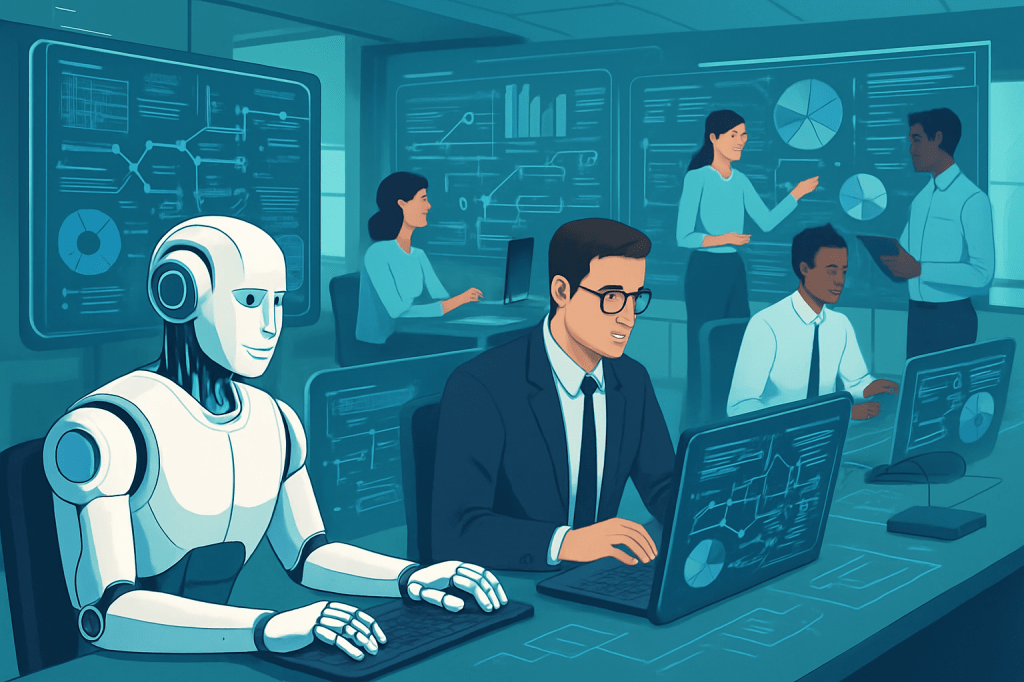
AI Impact on the Job Market – News (April 26, 2025 to May 3, 2025)
Ever noticed how the “smartest” people in the room are often the ones asking the dumbest questions? This week, as AI continues its relentless march into the job market, that’s a good thing to keep in mind. The “obvious” answers about AI replacing jobs are often the least helpful. The real insights come from questioning our assumptions about work, skills, and even what constitutes “productivity” in the first place. Because, let’s face it, the AI revolution isn’t just about automation; it’s about a fundamental re-evaluation of everything we thought we knew about careers.
The WEF Weighs In: Transformation, Not Just Threat
The World Economic Forum (WEF) dropped its Future of Jobs Report 2025 this week, and the headline isn’t quite as bleak as you might expect. Sure, 40% of employers anticipate reducing their workforce thanks to AI automation – which sounds like a lot of pink slips headed our way. But here’s the kicker: the WEF also projects that technology trends, particularly AI and information processing, will *create* 11 million jobs while displacing 9 million.
Why is this important? It’s a reminder that AI isn’t a monolithic job-killing machine. It’s a disruptive force, yes, but one that’s also creating new opportunities. The key is understanding where those opportunities lie and preparing to seize them.
That said, the WEF report also highlights a growing concern: entry-level roles are increasingly at risk. AI is reshaping the career ladder, potentially impacting salary expectations for remaining hires who will work alongside AI. Estimates suggest AI could affect nearly 50 million US jobs in the coming years. This reinforces the necessity for constant adaptation to the new reality.
The Microsoft View: AI as a Full Participant
Microsoft’s 2025 Annual Work Trend Index Report takes a bolder stance, suggesting AI is moving from being an assistant to a full participant in the workplace. They’re comparing this shift to historical changes like the Industrial Revolution. Think about that for a second. It’s not just about AI automating tasks; it’s about AI fundamentally changing the way we work, collaborate, and even think about our roles. This integration is expected to automate workflows and redefine efficiency. In short, if you’re not thinking about how AI integrates into your daily workflow, you are already behind.
The Danish Disconnect: AI’s Impact on Wages (So Far)
Now, for a dose of reality. A recent working paper analyzing the Danish labor market in 2023-2024 found that generative AI chatbots (like ChatGPT) have had minimal significant impact on wages or recorded work hours across 11 occupations studied so far, despite rapid adoption by workers. This is the data that makes you go “hmmm.”
Why is this important? It challenges the narrative of immediate economic doom. It suggests that the impact of AI on wages and overall employment might be more gradual and nuanced than some predictions suggest. It also raises questions about the immediate economic returns on large AI investments. After all, if everyone’s using AI chatbots but no one’s seeing a significant boost in productivity or pay, are we just collectively spinning our wheels? It’s worth noting, though, that the study did find AI chatbots created new job tasks for about 8.4% of workers, indicating a shift in job responsibilities even if not overall economic impact.
The Crypto Influencer’s Claim: One Prompter to Rule Them All
Crypto influencer Miles Deutscher asserted this week that the adoption of AI automation is significantly reducing administrative roles, suggesting one skilled AI prompter could replace multiple administrative workers. This highlights a focus on operational efficiency driven by AI prompting skills.
Why is this important? While the Danish study suggests minimal immediate impact, anecdotes like this are a reminder that the effects of AI are likely to be unevenly distributed. Certain roles, particularly those involving routine administrative tasks, are clearly more vulnerable. Mastering the art of prompt engineering – i.e., knowing how to effectively communicate with AI – is becoming an increasingly valuable skill. Think of it as the new Excel.
Layoffs Continue: The Tech Sector Streamlines
The tech industry continued its layoff spree in April, with 19 companies letting go of over 23,400 employees globally, a significant increase from March. While not all are explicitly tied *only* to AI, AI, cost-cutting, and restructuring are frequently cited drivers. Expedia, for instance, laid off approximately 3% of its global workforce despite strong recent financial performance, a move seen as part of a broader tech trend where companies streamline operations, with analysts linking this trend partially to the integration of AI for efficiency.
Several Bay Area tech companies also announced job cuts, including Stem (an AI software provider for the energy sector), SambaNova Systems (software), Boston Scientific, Building Robotics, and Cruise. Even Gupshup, a conversational AI company, laid off around 200 employees as part of a restructuring exercise aimed at improving efficiency and profitability.
Why is this important? It’s a reality check. The tech industry, which has long been a source of job growth, is now grappling with the need to optimize its workforce in the face of AI advancements. This means that even companies developing AI technologies aren’t immune to the disruptive effects of their own creations. And, as Intel CEO Lip-Bu Tan emphasized: “the best leaders get the most done with the fewest people”.
AI Job Market is Booming
Despite the layoffs, AI-related job postings are surging, accounting for over 9.5% of all software development roles as of April 2025. Hiring for AI roles has diversified beyond traditional tech hubs, with significant increases seen in sectors like insurance (+74% in April), non-profits (+56%), and marketing (+52%). Major banks like JPMorgan, Wells Fargo, and Citigroup increased their AI headcount by 13% in the six months leading up to May 2025.
Why is this important? It reinforces the idea that AI is creating new opportunities, even as it displaces others. The demand for AI skills is growing across various industries, not just in tech. This means that individuals with the right skills and training can find opportunities in unexpected places.
Demand is also growing for new roles such as AI Engineers, Prompt Engineers, AI Ethics Leads, and Trust and Safety Specialists focused on responsible AI deployment. It’s not just about building the technology; it’s about ensuring it’s used ethically and responsibly.
The Government Rethinks AI
In a surprising move, the Trump administration dismissed over 200 AI experts hired during the prior administration’s “National AI Talent Surge.” This decision raises concerns about the future of AI policy in the U.S. and the government’s ability to leverage AI for public services.
Why is this important? It highlights the political dimension of AI. Government support and investment are crucial for fostering innovation and ensuring that AI benefits society as a whole. The dismissal of these experts could slow down the development and implementation of AI-powered solutions in the public sector.
The College Grad Conundrum: Is the Degree Losing Its Luster?
A recent article in The Atlantic highlighted a concerning trend: the unemployment rate for recent college graduates has surged to 5.8%, echoing the times of the Great Recession. This raises questions about the value of a college degree in an AI-driven economy.
Why is this important? It challenges the traditional notion that a college degree is a guaranteed path to success. As AI continues to automate routine tasks, the skills once honed in entry-level roles are becoming obsolete. The economic return on a college education is plateauing, and employers are increasingly indifferent to diplomas when a bot can do the job.
MIT economist David Autor suggests that AI’s impact is more of a gradual infiltrator than the China shock, quietly transforming tasks across various industries. If left unchecked, AI could become a catalyst for even greater economic inequality, which is why it’s important to empower individuals with the right skills and knowledge to thrive in the new landscape.
The article also references a Financial Times piece that poses a critical question: are junior roles disappearing? If so, how do young professionals gain the experience and skills necessary to advance in their careers? The traditional career ladder is being dismantled, and we need to find new ways to provide on-the-job training and mentorship.
AI Interns Get Promoted
A Financial Times article, “Your pushy AI intern is ready for a promotion,” highlights how AI is driving revenue, making strategic decisions, and becoming indispensable. Microsoft’s Azure cloud services saw a 33% revenue increase, with half of that attributed to AI services. Meta’s AI systems are reportedly approaching the capabilities of mid-level software engineers and boosting ad engagement and user retention on Instagram.
Why is this important? It shows that AI is not just about cost savings; it’s about generating new revenue streams and improving business performance. As AI becomes more sophisticated, it’s taking on tasks that were once the domain of highly skilled professionals. This means that individuals need to constantly upskill and adapt to stay ahead of the curve.
The Bottom Line: Adapt or Be Automated
The rise in unemployment among young, educated workers is a warning sign. It’s not just about a slow economic recovery; it’s about a fundamental shift in the labor market driven by the rise of AI. Those who adapt and embrace the new reality will thrive. Those who don’t risk becoming the next generation of “Office Space” casualties, only this time, their jobs won’t just be pointless; they’ll be gone.
