
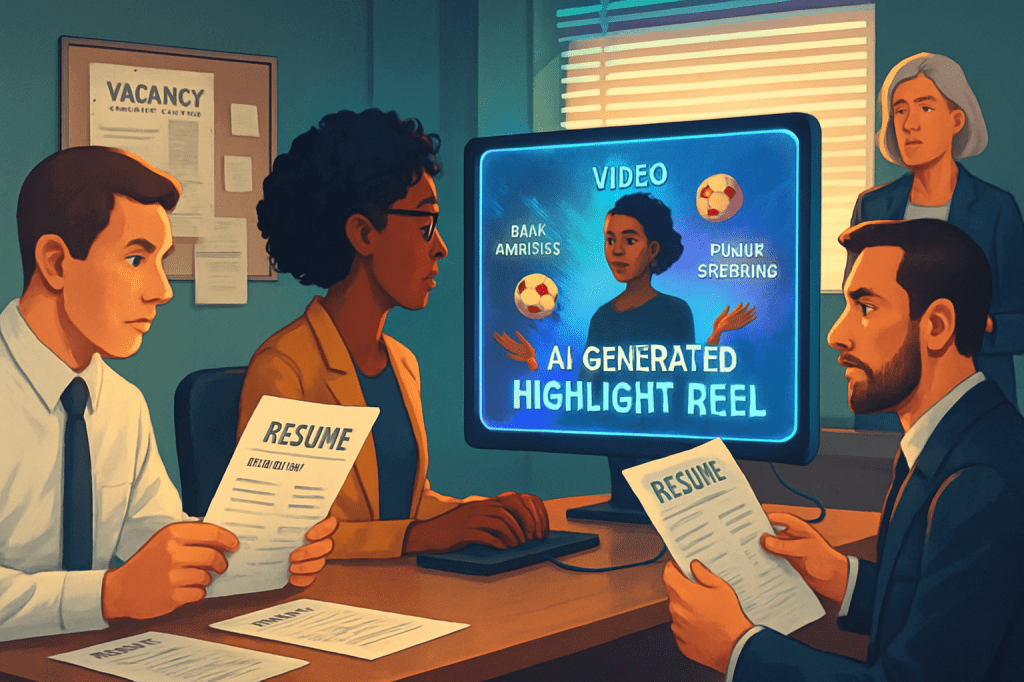
Here’s a fun thought experiment: Imagine a world where LinkedIn profiles are replaced with AI-generated highlight reels, showcasing your “best” professional self. Sounds dystopian? Maybe. Inevitable? Increasingly likely, and that’s precisely the paradox TestGorilla CEO Wouter Durville highlights in a recent Financial Times letter. The crux? Employers are rapidly adopting AI to sift through candidates, but many still frown upon applicants using similar tools to sharpen their own applications. It’s like bringing a Gatling gun to a knife fight, then complaining when the other guy shows up with a shield.
Durville’s letter isn’t just another “AI is changing everything” pronouncement. We *know* that. What’s interesting is the specific hypocrisy he calls out and the solutions he proposes, particularly his emphasis on skills-based assessments.
The CV: A Resume of Failures?
Durville argues that the traditional CV is, frankly, a relic. He doesn’t mince words, calling it “outdated and ineffective.” Ouch. But he’s not wrong. How many of us have embellished a resume, strategically omitting less-than-stellar experiences, or inflating skills we barely possess? The CV, in its current form, is ripe for manipulation, AI-assisted or otherwise. It’s a highlight reel curated for maximum appeal, not necessarily an accurate reflection of competence.
Key Takeaway: The problem isn’t *just* AI. It’s that AI is exposing the inherent flaws in existing recruitment processes, processes that were already struggling to accurately gauge candidate abilities. Think of it like this: AI isn’t creating the problem; it’s amplifying the signal of a problem that’s been there all along.
Skills-Based Assessments: The Great Equalizer?
Durville’s proposed solution? A shift to skills-based assessments powered by AI. Instead of relying on potentially inflated claims on a CV, candidates are evaluated on their actual abilities. Imagine a coding test for a software engineer role, or a marketing campaign simulation for a marketing manager position. It’s about *doing*, not just *saying*.
He claims that this shift could “improve productivity and promote social mobility by focusing on candidates’ actual abilities rather than their credentials.”
This sounds promising but let’s pump the brakes. While skills-based assessments offer a more objective measure of competence, they aren’t without their own challenges. How do you ensure fairness and prevent cheating? How do you assess soft skills like teamwork and communication, which are crucial in many roles?
Durville acknowledges these concerns, recommending “cheat prevention tools and structured, multi-method evaluations” combined with human judgment. It’s a hybrid approach, blending the efficiency of AI with the nuanced understanding of human recruiters. Think of it as AI handling the initial screening, weeding out the obviously unqualified, and then humans stepping in to assess the more subjective aspects of a candidate’s suitability.
The Algorithmic Arms Race: A Winner-Take-All Scenario?
Here’s where things get really interesting. We’re essentially entering an algorithmic arms race. Employers use AI to screen candidates; candidates use AI to optimize their applications. Who wins? The answer, as usual, is “it depends.”
- The Winners: Candidates with genuine skills who can leverage AI to showcase their abilities effectively. Companies that embrace skills-based assessments and use AI to identify hidden talent.
- The Losers: Candidates who rely on inflated credentials and lack demonstrable skills. Companies that cling to outdated recruitment practices and fail to adapt to the changing landscape.
But there’s a deeper, more concerning possibility: the potential for a feedback loop that exacerbates existing inequalities. What if access to sophisticated AI-powered application tools becomes a privilege reserved for the wealthy and well-connected? We could end up in a situation where AI reinforces existing biases, further disadvantaging marginalized groups.
Food for thought: Remember the college admissions scandal where wealthy parents bribed their children’s way into elite universities? Imagine that, but with AI. Instead of paying for fake athletic achievements, they’re paying for AI-optimized resumes and interview simulations. The playing field isn’t leveled; it’s tilted even further.
Durville’s letter is a wake-up call. AI in recruitment isn’t just a trend; it’s a fundamental shift. We need to have a serious conversation about fairness, transparency, and access. Otherwise, we risk creating a system where the algorithms decide our fate, and the human element gets lost in the code.
The future of work isn’t about “AI vs. humans.” It’s about how we choose to use AI, and whether we can create a system that benefits everyone, not just a select few. As Uncle Ben famously said, “With great power comes great responsibility.” Let’s hope we can live up to it.
