
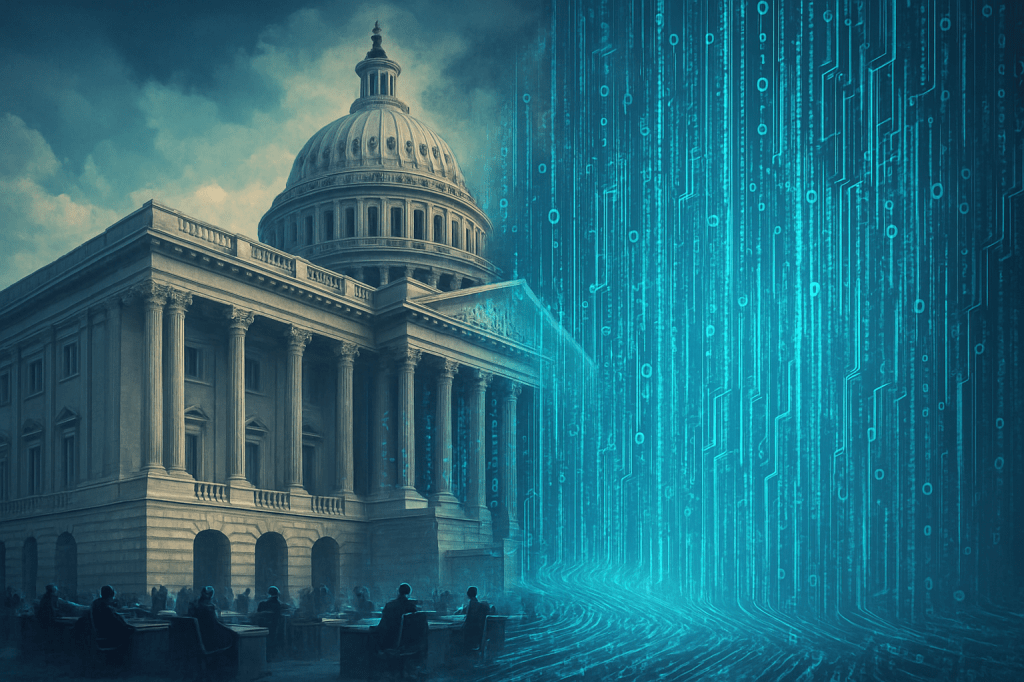
Remember when everyone was worried about truck drivers being replaced by self-driving vehicles? Turns out, the quiet revolution is happening in cubicles, and its first major victim isn’t in the private sector, but within the hallowed halls of the U.S. federal government. The early May 2025 announcement of mass layoffs, impacting approximately 40,000 federal employees, isn’t just another headline about AI disrupting the job market. It’s a neon sign pointing to a fundamental shift in how we perceive the very nature of “government work.”
The AI Paperclip Maximizer Comes to Washington
We’ve all heard the hypothetical thought experiment: an AI tasked with maximizing paperclip production that ultimately consumes the entire planet to achieve its goal. While no AI is (yet) turning the National Archives into a giant paperclip, the focus on efficiency and cost reduction, driven by the allure of AI, is having a similar, if less dramatic, effect on the human landscape of government. The layoffs, spanning USAID (projected to lose 10,000 employees through integration with the State Department), the Department of Agriculture, and HHS, are presented as a streamlining effort. But peel back the PR spin, and you see a clear prioritization of algorithmic efficiency over human employment.
The novel takeaway here isn’t *that* AI is replacing jobs, but *where* it’s happening first. The federal government, often seen as a bastion of stability and (let’s be honest) sometimes bureaucratic inefficiency, is now leading the charge in AI-driven workforce reduction. This is not some Silicon Valley startup shedding redundant engineers; this is the *government* deciding that algorithms can do it better (and cheaper).
Beyond the Spreadsheet: The Real Cost of Algorithmic Governance
The immediate economic implications are obvious: 40,000 people out of work, potentially straining local economies dependent on federal employment. The government’s response – retraining programs – is the standard playbook. But let’s be real: how many displaced USAID workers are going to become AI prompt engineers? The skills gap is vast, and while retraining is a necessary gesture, it’s unlikely to fully offset the disruption. Some will find new roles, but not all, and the transition will be far from seamless.
However, the more profound consequences are less about economics and more about the very fabric of governance. Consider this:
- Loss of Institutional Knowledge: Government agencies are repositories of accumulated experience and expertise. Replacing long-term employees with algorithms risks losing invaluable context and historical understanding. You can’t simply upload decades of institutional memory into a neural network.
- Algorithmic Bias in Policy: AI algorithms are trained on data, and data often reflects existing biases. Automating decision-making processes without careful consideration can perpetuate and amplify these biases, leading to unfair or discriminatory outcomes. Remember the COMPAS recidivism algorithm fiasco? Now imagine that applied to decisions about international aid or public health.
- Erosion of Public Trust: When government services are increasingly managed by opaque algorithms, it can erode public trust. Who’s accountable when an AI makes a mistake? How do citizens challenge decisions made by a black box? Transparency and accountability are cornerstones of democracy, and AI risks undermining them.
This isn’t about “AI taking over.” It’s about humans making choices *about* how AI is deployed, and those choices have consequences. The government’s decision to prioritize efficiency over employment raises fundamental questions about the role of government in the 21st century. Is its primary purpose to be as lean and efficient as possible, even if it means sacrificing jobs and potentially undermining democratic values? Or does it have a broader responsibility to provide employment and ensure equitable outcomes?
The “Skynet” Scenario? Not Quite, But…
We’re not suggesting that Skynet is about to launch the nukes. But the federal layoffs serve as a stark reminder that AI is not a neutral technology. It’s a tool, and like any tool, it can be used for good or ill. The challenge is not to stop AI, but to shape its development and deployment in a way that aligns with our values. That requires a serious conversation about the ethical and social implications of AI, and it requires proactive policies to mitigate the risks. The government’s investment in retraining programs is a start, but it’s not enough. We need to rethink our education system, invest in lifelong learning, and explore alternative economic models that are less dependent on traditional employment. Because if the government, the supposed safety net, is leading the charge in AI-driven job displacement, who’s going to catch us when we fall?
The real question isn’t whether AI will replace jobs. It’s what we do *after* it does. And the answer, as always, is up to us.
