
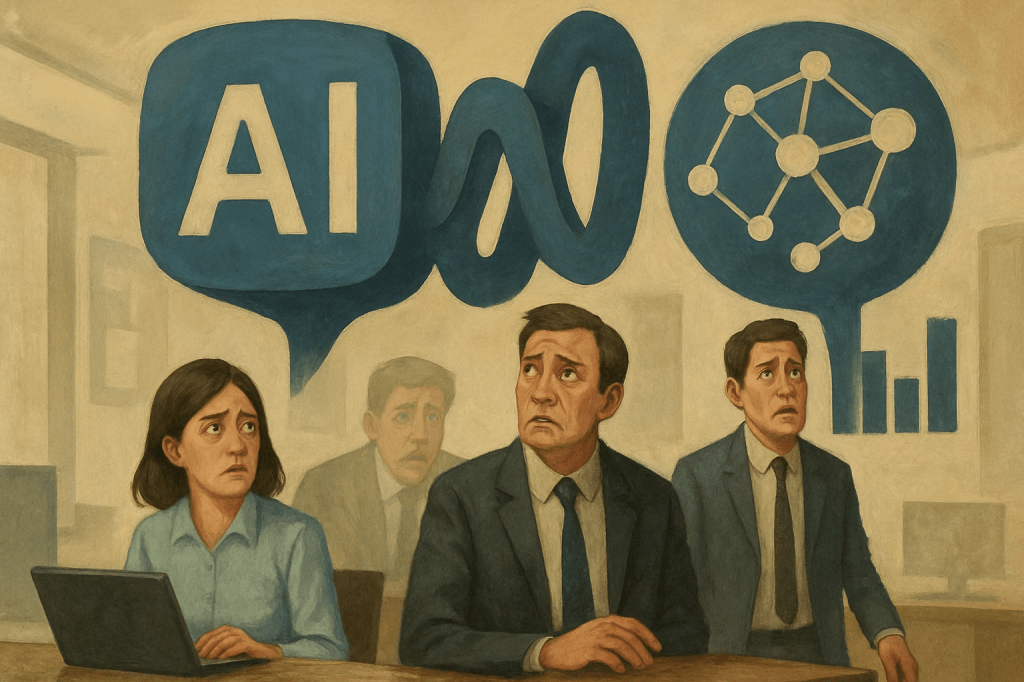
Remember the old saw about the cobbler’s children having no shoes? Turns out, the same principle applies to tech giants and their HR departments. While they’re busy selling us on the transformative power of AI, they’re quietly using it to transform themselves—sometimes in ways that leave a few hundred HR professionals out in the cold.
IBM and CrowdStrike: The AI Realignment Playbook
Yesterday’s news of job cuts at IBM and CrowdStrike, reported by TechRadar, isn’t just another “AI is taking our jobs!” headline. It’s a glimpse into the messy, often contradictory reality of AI adoption within major corporations. Here’s what makes this specific case noteworthy:
- It’s not just about automation; it’s about reallocation (allegedly). IBM’s CEO, Arvind Krishna, is singing the familiar tune of AI enabling resource reallocation. Hundreds of HR positions gone, yes, but supposedly offset by new roles in programming and sales. The key question: are these new roles accessible to those displaced, or are we looking at a “creative destruction” scenario where one set of skills is rendered obsolete and replaced by a completely different (and often higher-barrier) skillset?
- Cybersecurity is feeling the heat. CrowdStrike, a cybersecurity firm, laying off 5% of its staff (500 jobs) is particularly interesting. You’d think cybersecurity would be a safe haven in the AI revolution, but CEO George Kurtz is clear: AI is now foundational to their operations, enabling faster innovation, improved customer service, and, crucially, reduced hiring needs. This suggests AI is not just augmenting cybersecurity professionals but actively replacing some of their tasks, potentially impacting entry-level and more routine roles.
The “Reallocation” Mirage: Who Actually Benefits?
IBM’s Krishna wants more federal funding for AI R&D. This is where things get tricky. While increased investment might lead to innovation and economic growth, the immediate impact of AI implementation is often job displacement. The promise of reallocation rings hollow if the skills gap remains unaddressed. Are companies truly investing in comprehensive retraining programs for displaced workers, or are they simply hiring new talent with the required AI expertise?
Consider this: IBM’s revenue dipped in the first quarter of 2024, reported by Reuters, before rebounding later in the year. Workforce changes are often tied to financial performance. While AI might be the stated reason, the underlying motivation could be cost-cutting disguised as innovation.
The CrowdStrike Conundrum: AI Eating Its Own?
The CrowdStrike situation raises a more profound question: is AI starting to cannibalize its own support ecosystem? Cybersecurity, after all, is increasingly about defending against AI-powered attacks. If AI is now also reducing the need for human cybersecurity analysts, are we creating a self-reinforcing cycle where AI both creates and solves problems, ultimately shrinking the human role?
Think of it like Skynet, but instead of launching nukes, it’s just optimizing staffing levels. Okay, maybe that’s a bit dramatic, but the point is that even in seemingly “future-proof” industries like cybersecurity, AI is disrupting the status quo.
Beyond the Headlines: The Long-Term Implications
These job cuts are a microcosm of a larger trend. The integration of AI into business operations is accelerating, and the consequences are far-reaching:
- The devaluation of experience. AI can automate tasks previously requiring years of experience, potentially devaluing the expertise of seasoned professionals. This is particularly concerning for older workers who may find it difficult to reskill or adapt to the new AI-driven landscape.
- The rise of the “AI-whisperer.” The demand for individuals who can effectively manage and interpret AI-generated insights will likely increase. This creates a new class of “AI-whisperers” who bridge the gap between algorithms and human decision-making. The question is, how do we ensure these roles are accessible to a diverse range of individuals, and not just those with advanced technical degrees?
- The shifting social contract. As AI takes on more tasks, the traditional employer-employee relationship may need to evolve. We may see a rise in freelance work, project-based employment, and alternative compensation models. This requires a fundamental rethinking of social safety nets and worker protections.
The IBM and CrowdStrike stories aren’t just about job losses; they’re about a fundamental shift in the nature of work. It’s a reminder that we need to move beyond simplistic narratives of “AI vs. humans” and grapple with the complex, nuanced realities of AI adoption. We need to ask tough questions about who benefits from this technological revolution and how we can ensure a more equitable and sustainable future for all.
