
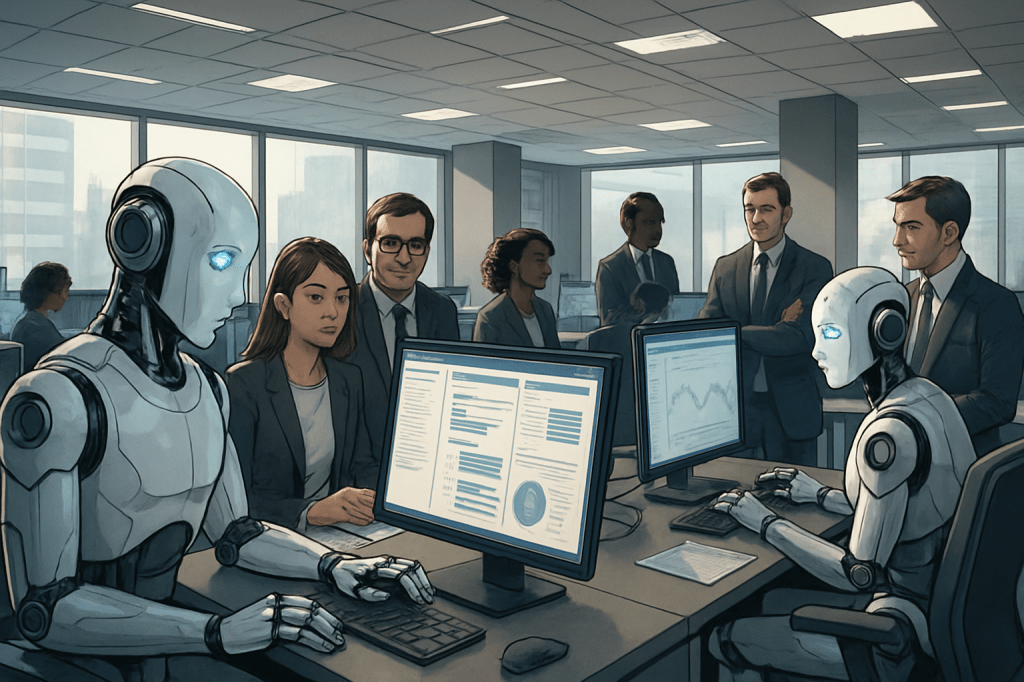
Remember when “having an app for that” was the height of technological convenience? Now, it’s about to be “having an AI agent for that” – and it’s hitting the workplace *hard*. Forget chatbots that parrot back FAQs; we’re talking autonomous systems that handle multi-step tasks without needing a human babysitter. The Financial Times’ “Working It” newsletter just dropped a bombshell on May 15, 2025, focusing on the rise of “agentic AI,” and the implications are far more profound than just a few replaced spreadsheet jockeys.
The Autonomous Onslaught: Beyond Automation 1.0
We’ve been warned about automation for years, but agentic AI is different. It’s not just about automating repetitive tasks; it’s about automating *processes*. Think employee onboarding handled entirely by AI, from background checks to initial training. Expense approvals processed without a human eye. Project collaboration orchestrated by algorithms. This isn’t your grandfather’s assembly line robot; this is a digital executive assistant with the potential to make entire departments redundant.
Key takeaway: Agentic AI isn’t just automating tasks; it’s automating *decision-making* within those tasks. That’s a whole new ballgame.
Benioff’s Bold Claim: Productivity Without People?
Salesforce CEO Marc Benioff, never one to shy away from hyperbole, claims agentic AI can “significantly boost productivity without necessitating an increase in human staffing.” Which, let’s be honest, is code for “we’re going to do more with fewer people.” But here’s the nuance: it’s not just about cutting headcount. It’s about fundamentally rethinking organizational structure. Are those middle management layers really necessary when an AI can coordinate workflows and track progress more efficiently?
The scary part? Benioff’s not alone. This sentiment is echoing across industries, signaling a potential restructuring of the entire corporate landscape.
The Executive Reality Gap: They Don’t Know What They Don’t Know
Here’s where things get really interesting. McKinsey & Company’s report reveals a massive disconnect between what executives *think* is happening with AI and the *actual* AI usage within their organizations. Turns out, employees are already using AI tools more extensively than their bosses realize. Think of it as the shadow IT department, but with algorithms. This suggests:
- A lack of top-down AI strategy: Companies are implementing AI piecemeal, without a coherent vision.
- Underestimation of employee capabilities: Workers are finding creative ways to leverage AI to improve their efficiency, often without official sanction.
- Potential for chaos: Uncoordinated AI adoption can lead to data silos, security vulnerabilities, and inconsistent processes.
The implication? Executives need to get their heads out of the sand and understand how AI is *really* being used within their organizations. Otherwise, they’re flying blind into a future they don’t understand.
Hybrid Teams and the 19% Operational Cost Cut: Where Do We Fit In?
HR leaders are predicting a future of “hybrid teams” composed of humans and AI. Sounds nice, right? Kumbaya around the digital campfire? The reality, however, is a projected 19% reduction in operational costs. That’s not just about streamlining processes; that’s about eliminating entire roles. While HR leaders anticipate that 61% of current workers will retain their roles, the question remains: What will those roles *look* like? Will humans become glorified AI supervisors, constantly monitoring algorithms and intervening only when things go haywire? Or will new, unforeseen roles emerge that leverage uniquely human skills like creativity, empathy, and critical thinking?
The million-dollar question: What skills will be truly *irreplaceable* in a world of increasingly sophisticated AI agents?
AI-Native Startups: The Future is Now (and it’s Lean)
Perhaps the most disruptive trend highlighted by the FT is the emergence of AI-native startups. These aren’t just companies that *use* AI; they’re companies *built* on AI, operating with minimal human staff and fluid, almost non-existent hierarchical structures. Think of it as the “lean startup” model on steroids. These companies are not just augmenting existing businesses, but redefining the very concept of organizational design.
Consider this: If a startup can achieve rapid growth and scale with a fraction of the human capital of a traditional company, what does that mean for established businesses? It means they either adapt or die. And adaptation requires a radical rethinking of everything from hiring practices to organizational structure to the very definition of “work” itself.
The rise of agentic AI isn’t a distant threat; it’s a present reality. And while the potential benefits are undeniable, the risks are equally significant. The key to navigating this new landscape isn’t to resist change, but to understand it, adapt to it, and find new ways to contribute value in a world increasingly shaped by intelligent machines. Or, as Morpheus might say, “Buckle up, Dorothy, because Kansas is going bye-bye.”
