
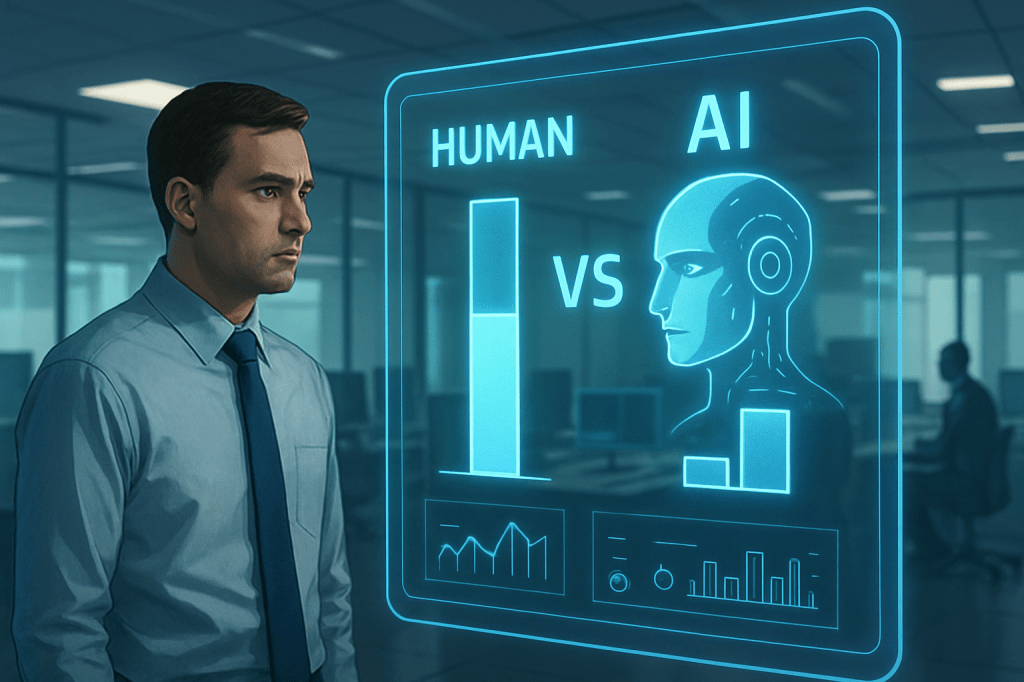
Remember the old joke about HR departments mainly existing to protect the company, not the employee? Well, in 2025, it seems like that protection racket’s expanding to include silicon-based lifeforms. Or, at least, the possibility of silicon-based lifeforms taking your job. The Financial Times is reporting that a growing number of U.S. companies are now running potential hires through the “Can AI do this?” filter before even considering a human candidate. It’s not just about replacing existing employees anymore; it’s about preemptively eliminating the need for them in the first place.
We’ve been hearing about AI’s impact on the job market for years, but this feels like a distinct escalation. It’s one thing to automate repetitive tasks; it’s another to fundamentally alter the hiring process with AI as the default baseline. Think of it like this: the burden of proof has shifted. Instead of companies needing to justify replacing a human with AI, they now need to justify hiring a human at all.
The “Can AI Do This?” Pre-Screen: More Than Just Cost-Cutting
The obvious driver here is cost. AI, in the long run, is often cheaper than a salaried employee with benefits, vacation time, and the occasional existential crisis. But let’s dig deeper. This pre-screen suggests a shift in how companies perceive risk and value. They’re prioritizing:
- Consistency: AI provides predictable output, free from human error (assuming the data it’s trained on is clean, which, let’s be honest, is a big assumption).
- Scalability: An AI system can often handle increased workloads without needing additional headcount.
- Data-Driven Decisions: AI can generate metrics and insights that inform decision-making, appealing to data-obsessed management styles.
Consider the implications for entry-level positions. Once a training ground for new graduates, these roles are now increasingly vulnerable. If a company can use AI to handle basic tasks, the incentive to invest in human development diminishes. This could create a bottleneck, making it harder for young professionals to gain the experience they need to advance. We risk creating a generation of “digital NEETs” – Not in Education, Employment, or Training – but this time, because the jobs themselves vanished before they even had a chance.
“Tang Ping” to “AI-Ping”: The Global Exhaustion Equation
The FT also touches on global workplace trends like “tang ping” (lying flat), “996” (the brutal 9 a.m. to 9 p.m., six-day work week), and “neijuan” (involuntary overwork without progress). These terms reflect a growing sense of burnout and disillusionment, particularly in hyper-competitive economies. While these originated in China, the sentiment is increasingly mirrored in the West, exacerbated by wage stagnation and job insecurity.
Now, factor in the “Can AI Do This?” pre-screen. It’s not just about replacing jobs; it’s about accelerating the pressure on those who remain. If companies are constantly evaluating whether AI can take over a role, employees are forced to justify their existence, to prove their “unique” value. This creates a culture of constant anxiety and performance pressure, pushing people closer to the edge of burnout. It’s the “AI-Ping” era, where the pressure to compete with machines leads to widespread disengagement.
Who Really Wins (and Loses) in the AI Hiring Revolution?
The immediate winners are clear: companies that successfully implement AI solutions, potentially boosting profits and streamlining operations. Early investors in AI technology also stand to benefit. But let’s look at the less obvious consequences:
- Highly Specialized AI Trainers and Developers: Demand for these roles will skyrocket, creating a skills gap that drives up salaries. The AI elite will thrive, while others struggle to adapt.
- “Human-Only” Niches: Ironically, the rise of AI may create new opportunities in areas where human interaction and empathy are paramount. Think therapists, coaches, and artisanal craftspeople. The very things AI can’t replicate will become increasingly valuable.
- The Gig Economy 2.0: As traditional employment becomes less secure, more people may turn to freelance work, creating a “gig economy on steroids” where individuals compete for short-term projects against both humans and AI.
The biggest losers? Potentially a large swath of the middle class whose jobs are susceptible to automation. The FT article, while not explicitly stating numbers, implies the scope of this impact is growing, and growing fast. This necessitates a serious conversation about retraining programs, universal basic income, and other social safety nets. The alternative is a society increasingly divided between the AI haves and the have-nots.
Ultimately, the “Can AI Do This?” question isn’t just about technology; it’s about values. What kind of society do we want to create? One where efficiency trumps all else, or one where human potential is nurtured and valued? As companies increasingly turn to AI as the default solution, we need to ensure that the human element isn’t lost in the equation. Otherwise, we might find ourselves living in a world where even HR is obsolete.
