
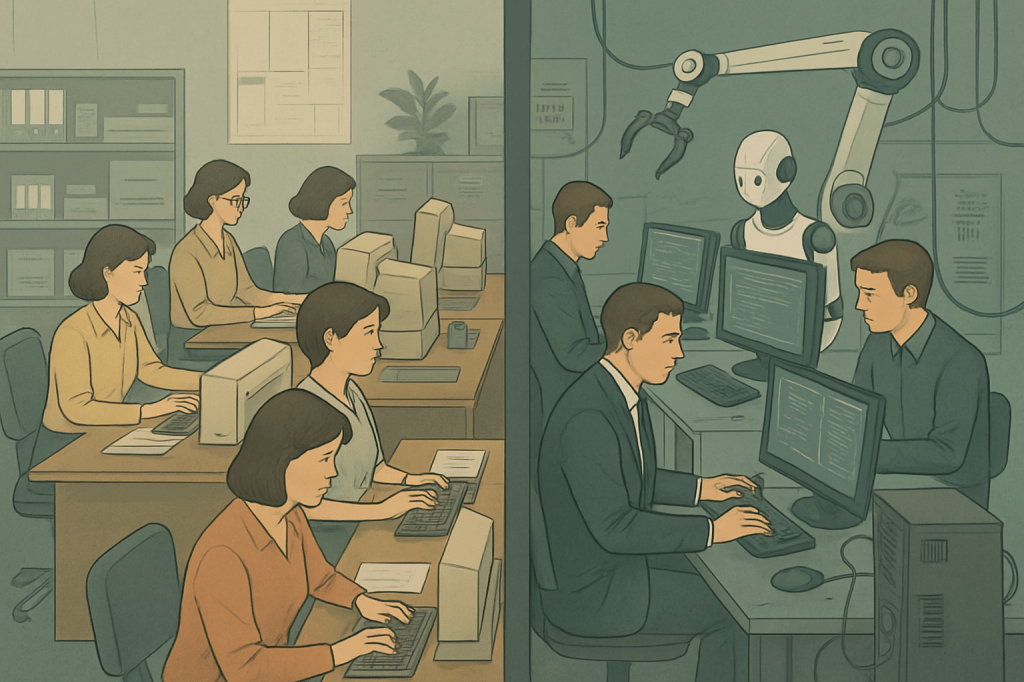
Remember those early internet days when we were all warned about the “digital divide?” Turns out, the real divide might not be about access, but about who gets disrupted first. The latest ILO report throws a stark light on this, suggesting AI isn’t an equal-opportunity job disruptor. It’s apparently got a gender bias – or, more accurately, a sector bias that disproportionately impacts women.
The Numbers Don’t Lie (But They Do Tell a Story)
The headline grabber is this: 9.6% of female-dominated jobs are likely to be transformed by AI, compared to just 3.5% of male-dominated roles. On its face, this looks like a simple disparity, but digging deeper reveals a more complex (and frankly, predictable) story. It’s not that AI prefers male coders over female administrators. It’s that the types of tasks currently automated – think data entry, scheduling, basic customer service – are heavily concentrated in roles traditionally held by women.
Administrative Roles: The Canary in the Coal Mine?
The report specifically calls out administrative and clerical tasks, including secretarial work, as particularly vulnerable. This isn’t exactly breaking news. We’ve seen the rise of robotic process automation (RPA) for years, slowly chipping away at these roles. But the ILO report highlights the scale and acceleration of this trend, thanks to increasingly sophisticated AI. Think of it like this: RPA was the dial-up modem of automation; generative AI is the fiber optic connection.
The real question isn’t whether these jobs will change, but how. Will they evolve into higher-value roles requiring new skills, or will they simply vanish, leaving a gap in the workforce and exacerbating existing gender pay gaps? This is where the ILO’s recommendations come in – proactively using AI to *enhance* jobs, not just eliminate them. Easier said than done, of course. Who’s going to be the one proactively reskilling millions of administrative professionals?
Beyond the Obvious: A Generational Shift?
While the focus is on immediate job displacement, consider the long-term implications. What message does this send to younger generations? Will young women be less likely to pursue careers in fields perceived as “AI-vulnerable?” Will this further entrench existing gender imbalances in STEM fields, creating a self-fulfilling prophecy where AI development continues to be dominated by one demographic, potentially perpetuating existing biases in algorithms?
This isn’t just about individual jobs; it’s about societal structures. If AI disproportionately displaces women in certain sectors, what impact will that have on family dynamics, economic empowerment, and even political representation? These are questions that require a much broader conversation than just “how do we retrain displaced workers?”
Media, Software, and Finance: No One is Safe (But Some Are Safer Than Others)
The report also mentions significant changes coming to media, software, and finance thanks to generative AI. These are sectors typically associated with higher-paying, male-dominated roles. So, is this a sign that the AI disruption is finally becoming more “equal?” Maybe. But let’s not get ahead of ourselves.
Consider this: While generative AI might automate some coding tasks, it also creates new opportunities for specialized AI engineers (a field currently dominated by men). Similarly, while AI might automate some financial analysis, it also creates a demand for AI-savvy financial strategists. The point is, even in these “high-tech” sectors, the benefits of AI adoption may not be evenly distributed.
The Call to Action (and a Dose of Reality)
The ILO’s call for proactive action is admirable, but let’s be realistic. Successfully navigating this transition requires:
- Significant investment in retraining programs: And not just any programs. We need targeted, effective programs that equip workers with the skills needed to thrive in an AI-driven economy.
- A fundamental rethinking of education: Our education system needs to adapt to prepare students for a future where adaptability and lifelong learning are paramount.
- A commitment to addressing algorithmic bias: We need to ensure that AI systems are fair and equitable, and that they don’t perpetuate existing societal inequalities.
The ILO report isn’t just a warning; it’s a wake-up call. The AI revolution is here, and it’s not playing fair. We need to act now to ensure that its benefits are shared by all, and that no one is left behind. Otherwise, we risk creating a future where the digital divide isn’t just about access to technology, but about access to opportunity itself.
