
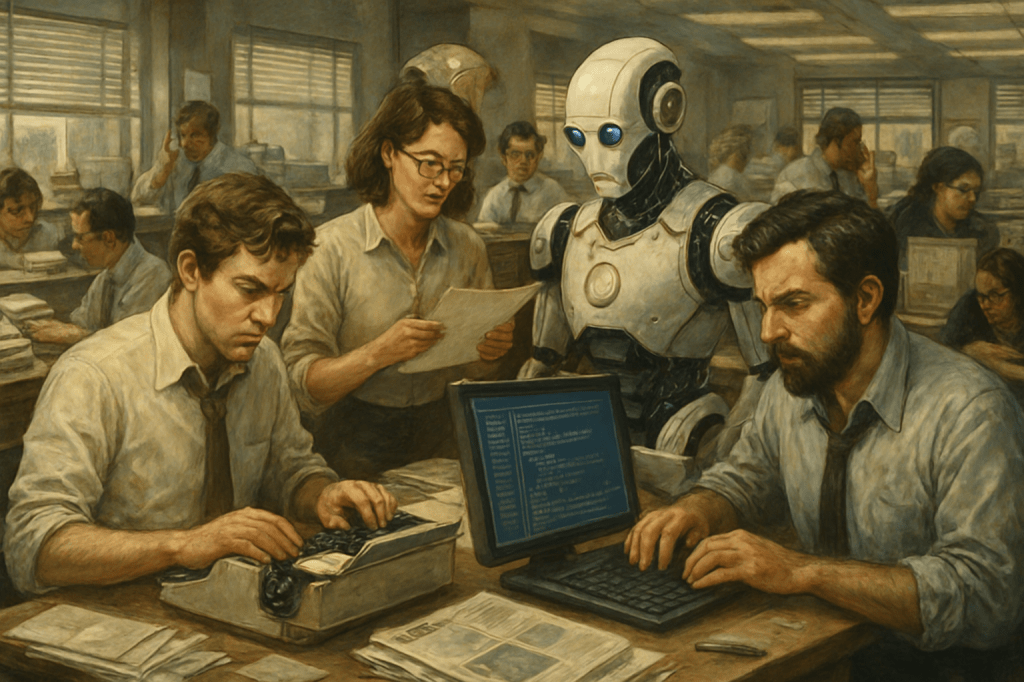
Remember that feeling when Napster hit, and suddenly everyone was a music pirate, and the entire music industry went into a tailspin? Well, hold that thought, because what’s happening now with generative AI and content creation is like Napster on steroids, but instead of just music, it’s coming for everything. This isn’t a theoretical “AI taking jobs” scenario; it’s happening *now*, and Business Insider’s recent announcement is just the latest, starkest example.
Yesterday, Business Insider revealed it’s slashing its workforce by roughly 21% (reuters.com). The reason? A double whammy of declining web traffic *and* the rise of AI tools like ChatGPT being used for news consumption. Let’s break down why this isn’t just another media layoff story, but a genuine inflection point.
The “Traffic is King” Illusion Shattered
For years, the mantra has been “content is king, but traffic is queen.” Media companies chased clicks, optimized for SEO, and built empires on pageviews. But BI’s CEO, Barbara Peng, dropped a truth bomb in her memo: they’re making twice as much revenue per site visit compared to two years ago. That sounds good, right? Wrong. Peng admits that 70% of their business is still vulnerable to traffic fluctuations. This is a crucial admission: even higher revenue per visit can’t compensate for a collapse in overall traffic, especially when AI can deliver similar (or arguably “good enough”) information directly to consumers. Think about it: why click through to an article when ChatGPT can summarize the key points in seconds?
The Generative AI “Convenience Tax”
This situation introduces a new kind of tax: the “convenience tax.” Readers are opting for the *convenience* of AI-generated summaries and answers, even if the quality isn’t always perfect, and that convenience is costing media companies their audience (and therefore, jobs). This is a huge shift. It’s not just about better or cheaper content; it’s about *frictionless* content. And that friction is killing traditional media models.
Beyond the Headlines: The Real Job Casualties
While “21% workforce reduction” sounds bad, the devil’s in the details. What roles are *actually* being eliminated? We can infer a few things:
- Lower-level reporting and writing positions: AI is already surprisingly adept at churning out basic news reports, summaries, and even some types of analysis. These roles are the most immediately vulnerable.
- SEO and traffic optimization specialists: If traffic itself is becoming less valuable, the need for people dedicated to chasing clicks diminishes.
- Potentially, even some editorial roles: As AI becomes more sophisticated, it could take on tasks like copyediting, fact-checking, and even generating headlines.
The good news? High-value journalism – investigative reporting, in-depth analysis, and original thought leadership – is likely more secure, at least for now. AI can’t (yet) replicate human creativity, critical thinking, and the ability to build trust and relationships with sources. But the bar is being raised: journalists need to offer something that AI *cannot* provide.
The Pivot: Events and AI-Assisted Content
BI’s response is telling: they’re doubling down on AI internally (Enterprise ChatGPT, etc.) to “improve efficiency and enhance the reader experience” (read: do more with fewer people) and launching “BI Live,” an events-based business. This highlights a key trend: media companies are desperately searching for revenue streams that AI can’t easily disrupt. Events, with their emphasis on human interaction and unique experiences, are one such avenue. But even here, AI will likely play a role in marketing, logistics, and content creation related to those events.
The Washington Post and the AP: A Chorus of Layoffs
BI isn’t alone. The article correctly points out that the Washington Post and the Associated Press have also implemented layoffs and strategic shifts. This is not an isolated incident; it’s a systemic shockwave rippling through the entire media landscape. It’s like watching Blockbuster Video try to compete with Netflix – the underlying business model is fundamentally challenged.
What Does This Mean for You?
If you’re in the media industry, this is a wake-up call. But the implications extend far beyond journalism. Any job that involves routine content creation, data analysis, or information processing is potentially vulnerable. The key is to focus on skills that are difficult for AI to replicate: creativity, critical thinking, emotional intelligence, and the ability to build relationships. Think less “content creator” and more “strategic problem solver.”
Ultimately, Business Insider’s story isn’t just about layoffs; it’s about the accelerating pace of AI disruption and the urgent need for individuals and organizations to adapt. We’re not just talking about “the future of work” anymore; we’re talking about the *present* of work. And if you’re not prepared to adapt, you might find yourself on the wrong side of that 21%.
