AI Impact on the Job Market – News (May 30, 2025 to June 6, 2025)
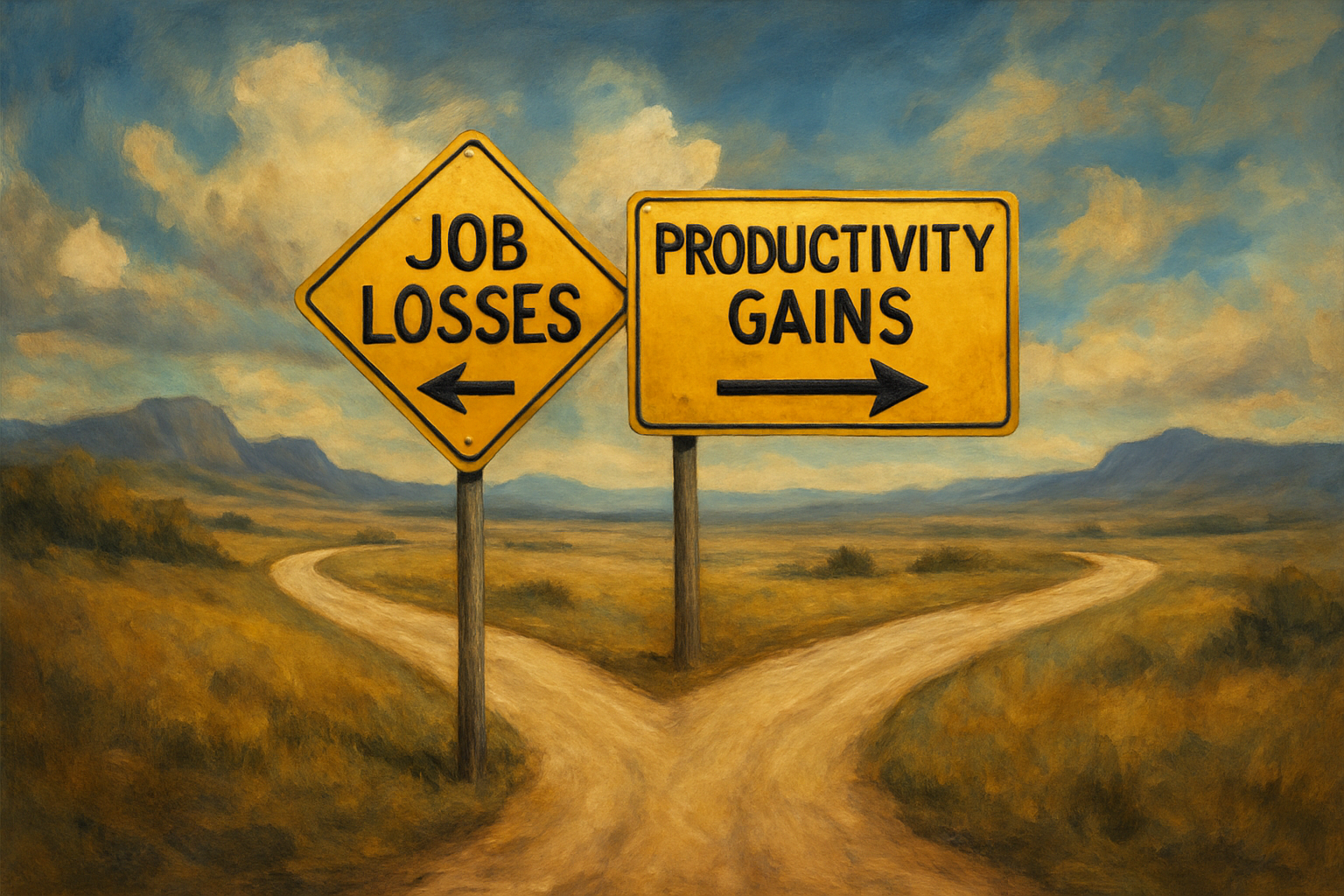
Remember that old “Choose Your Own Adventure” book series? That’s kind of where we are with AI and the job market right now. Except instead of a friendly forest, the options are things like “cataclysmic job losses” or “unprecedented productivity gains.” Buckle up, because this week’s news felt like flipping through one of those books at warp speed.
The Layoff Tsunami: Is AI the Tide or Just a Really Big Wave?
The numbers are starting to feel less like abstract statistics and more like, well, actual job losses. Business Insider took a big swing, axing 21% of its staff and declaring they’re going “all-in on AI.” CEO Barbara Peng sounds like she’s ordering a new office coffee machine, not firing a fifth of her workforce. She said they’re going to “harness AI first” to reduce their dependence on “traffic-sensitive” parts of the business. Ouch.
And it’s not just media. Meta is quietly phasing out thousands of human content moderators, handing the reins to the AI overlords…err, models. According to “Trueup,” AI’s already contributed to 76,440 tech job losses in 2025 alone. That’s a lot of empty desks and LinkedIn updates. Let’s not forget earlier cuts from giants like Microsoft (6,000 jobs) and IBM (8,000 in HR). It’s starting to look like a trend, not a blip.
Why is this important?
Because these aren’t just isolated incidents. They represent a fundamental shift in how companies are approaching labor. AI isn’t just automating tasks; it’s reshaping entire departments and business models. It’s also a wake-up call. No one is immune, no matter how specialized or “safe” your job seems. The “quiet exodus” is happening now.
The Oracle Pool: What the Big Brains are Saying
If you’re feeling whiplash from all the conflicting predictions, you’re not alone. This week, the big brains were out in force, each with their own crystal ball (or, you know, complex AI model).
- Dario Amodei (Anthropic): The doom-and-gloom guy. He’s forecasting a “cataclysmic reduction of jobs,” potentially affecting 20% of the workforce. He even coined the term “white collar bloodbath” to describe the potential impact on entry-level positions. He thinks half could vanish in five years, potentially spiking unemployment to 10-20%. Not exactly a ray of sunshine.
- Jensen Huang (Nvidia): The “learn to love AI” guru. He thinks “every job will be affected, and immediately,” but in a good way (sort of). His mantra? “You’re not going to lose your job to an AI, but you’re going to lose your job to someone who uses AI.” He also suggests AI could bring millions *back* into the workforce by boosting productivity. So, learn Python or perish?
- Sam Altman (OpenAI): The “AI is just an intern” guy. He sees AI as currently capable of “intern-level work,” but envisions it evolving into an “experienced software engineer that can work for a couple of days.” He also thinks AI will soon be discovering new knowledge and solving complex business problems on its own. Sounds like it’s time to ask your boss for a raise before your AI colleague steals your job.
- Steve Bannon (Former White House Chief Strategist): The political spin doctor. He’s worried AI will “eviscerate” administrative, managerial, and tech jobs, especially for those under 30. He thinks AI-driven job loss will be a major issue in upcoming presidential campaigns. Get ready for the AI debate, folks.
- Micha Kaufman (Fiverr): The brutally honest CEO. In a company email that probably caused a few heart attacks, he wrote, “AI is coming for your jobs. Heck, it’s coming for my job too. This is a wake-up call.” He’s not just talking about low-skill gigs; he’s talking programmers, designers, lawyers – the whole shebang.
Why is this important?
Because these are the people shaping the future of AI. Their predictions, whether optimistic or dire, influence investment, policy, and corporate strategy. The sheer range of opinions highlights the uncertainty surrounding AI’s impact. Are we on the cusp of a technological utopia or a jobless dystopia? The jury’s still out, but these are the voices shaping the conversation.
The Job Market Rollercoaster: Ups, Downs, and Loop-de-Loops
Okay, so what’s *actually* happening on the ground? The data paints a mixed picture, as always.
- Hiring Slowdown: Aura Intelligence’s Job Market Report shows a decrease in overall hiring in many sectors. That’s not exactly comforting. North America saw a significant 6.7% drop in job postings in May. U.S. hiring also slowed, adding only 139,000 jobs. Initial jobless claims are spiking, too.
- AI Job Boom: But wait, there’s a twist! AI job postings make up a hefty 14% of all software roles. Employers are scrambling for people who can build and integrate AI, especially in hospitality, healthcare, and HR. So, if you know your way around Python and TensorFlow, you might be in luck.
- New Skills, New Roles: PwC’s Global AI Jobs Barometer says AI is actually making workers *more* valuable and productive. Job numbers are even increasing in highly automatable roles, with a 38% growth in job availability. Workers with AI skills are commanding a sweet wage premium – 56% higher than those without, up from 25% last year. The skills sought by employers are changing at breakneck speed, 66% faster in AI-exposed jobs.
- AI Governance is the New Black: Winssolutions says a new wave of jobs is emerging in fields like AI governance, science, education, cybersecurity, and sustainability. The World Economic Forum projects 5 million AI governance roles by 2030. Someone needs to keep these AI systems in check, right?
Why is this important?
Because it shows that the job market isn’t just shrinking; it’s *morphing*. Jobs are being automated, yes, but new ones are being created – ones that require very different skillsets. The key takeaway? Adaptation is not optional; it’s essential. If you’re not learning new skills, you’re falling behind.
The Human Factor: Gen Z, Unions, and the Future of Work
It’s not just about numbers and algorithms; it’s about people. How are workers reacting to this AI revolution?
- Gen Z’s Chill Vibe: A survey shows that 51% of Gen Z workers see generative AI as a “co-worker or friend.” Maybe they’re just trying to stay on its good side.
- Union Backlash: The Insider Union isn’t buying the “AI as friend” narrative. They slammed the layoffs at Business Insider as a “brazen pivot away from journalism toward greed,” arguing that “no AI tool or technology should – or can – take the place of human beings.” Expect more pushback from unions as AI encroachment continues.
- The Algorithmic Alienation: There are growing concerns that AI-powered hiring processes, like AI interviewers, are alienating job applicants. No one wants to be judged by a robot, apparently.
Why is this important?
Because worker sentiment matters. If people feel threatened and alienated by AI, they’re less likely to embrace it. This could lead to resistance, slower adoption, and even political instability. The human factor can’t be ignored in this equation.
The Gender Divide: AI’s Unequal Impact
The International Labour Organization (ILO) released a report this week with a sobering insight: AI’s impact on the workforce is profoundly gendered, with women disproportionately at risk. The ILO report highlights that a staggering 9.6% of jobs predominantly held by women are identified as highly susceptible to AI transformation, compared to just 3.5% of male-dominated roles. The disparity is largely attributed to the prevalence of women in administrative and clerical tasks, prime targets for AI automation.
Why is this important?
This isn’t merely a statistical curiosity. The gendered nature of this disruption carries profound implications for economic equality and societal stability. If a significant portion of jobs traditionally held by women are disproportionately impacted, it risks exacerbating existing gender pay gaps, undermining financial independence, and creating new layers of economic vulnerability.
The Bottom Line: Adapt or Be Automated
This week’s news confirms what we already suspected: AI is here, it’s changing everything, and it’s not going away. There’s no magic bullet, no easy answer. But there are strategies for navigating this transition:
- Upskill and Reskill: Learn AI-related skills. Python, SQL, TensorFlow – these are the new hot commodities.
- Embrace Augmentation: Don’t see AI as a threat; see it as a tool. Learn how to use it to enhance your productivity and creativity.
- Focus on Human Skills: Critical thinking, complex problem-solving, emotional intelligence – these are the skills that AI can’t replicate (yet).
- Stay Informed: Keep up with the latest trends and predictions. Knowledge is power.
The future of work is uncertain, but one thing is clear: the future belongs to those who adapt. So, choose your own adventure wisely.