
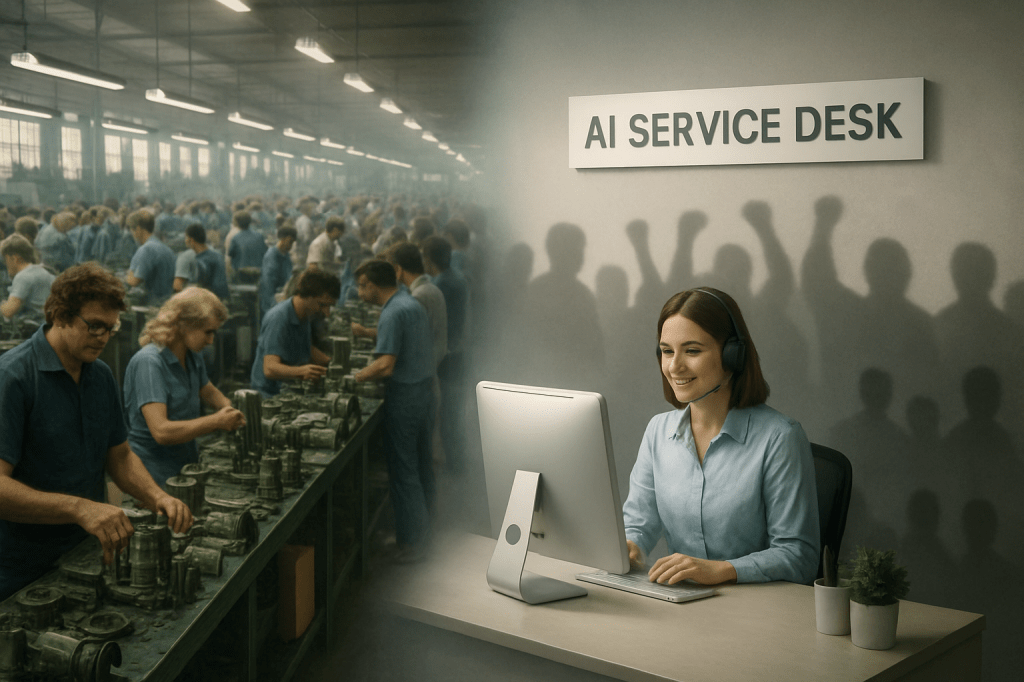
Echoes of Disruption: What 1995 Tells Us About AI’s Workforce Future
The promise of AI-driven productivity often overshadows a crucial question: where do the displaced workers go? Yesterday, a letter in the Financial Times from Alberto Chies offered a sobering answer, not by gazing into a speculative future, but by drawing a sharp, unsettling parallel to our recent past.
Chies directs our attention to the U.S. productivity surge between 1995 and 2005. This period, fueled by significant IT advancements, saw remarkable efficiency gains. But, as Chies meticulously details, this prosperity had a hidden cost.
The Ghost of Productivity Past
The IT revolution of the late 20th century, while boosting overall productivity, simultaneously triggered substantial job losses in manufacturing through automation. This wasn’t just a sectoral shift; it was a fundamental reordering of the workforce. Many of those displaced found themselves transitioning into the burgeoning service sectors. However, these new roles often came with a critical caveat:
- They were frequently in lower-productivity segments.
- This shift contributed to an overall stagnation in national productivity post-boom.
- It led to widespread wage depression.
- And, perhaps most insidiously, it significantly increased economic inequality.
The narrative of progress, for many, became one of diminished prospects.
AI’s Unsettling Mirror Image
Chies posits that we may be witnessing a similar dynamic unfold with artificial intelligence, particularly within the very service industries that absorbed the previous wave of displaced workers. The initial productivity spikes and cost savings generated by AI automation, he warns, could prove temporary. As AI infiltrates service roles, we risk a repeat of the manufacturing exodus, but this time, the options for re-employment might be even more constrained.
Displaced workers, Chies suggests, could be shunted into low-value positions that offer little in the way of economic advancement or social contribution. This isn’t just about jobs; it’s about the erosion of meaningful work, a silent degradation of the social contract.
Beyond the Bottom Line: Societal Fallout
The implications extend far beyond mere economic metrics. If history repeats, this pattern of displacement without meaningful re-engagement will:
- Exacerbate existing inequalities, creating deeper fissures in society.
- Fuel widespread economic dissatisfaction, eroding trust in institutions and the system itself.
- Potentially ignite significant societal backlash, as large segments of the population feel left behind and disenfranchised.
Chies’ most potent warning is that such widespread discontent becomes fertile ground for exploitation by populist figures, further destabilizing the political landscape.
The Imperative for Intervention
This historical lens isn’t offered as a deterministic prophecy, but as a stark caution. Chies underscores the urgent need for deliberate public policy and robust oversight to guide AI’s integration into the workforce. Without such proactive measures, he argues, we risk not just economic stagnation and inequality, but profound social unrest. The choice, it seems, is not whether AI will transform work, but whether we will consciously steer that transformation towards shared prosperity or allow it to replicate the pitfalls of the past.
