
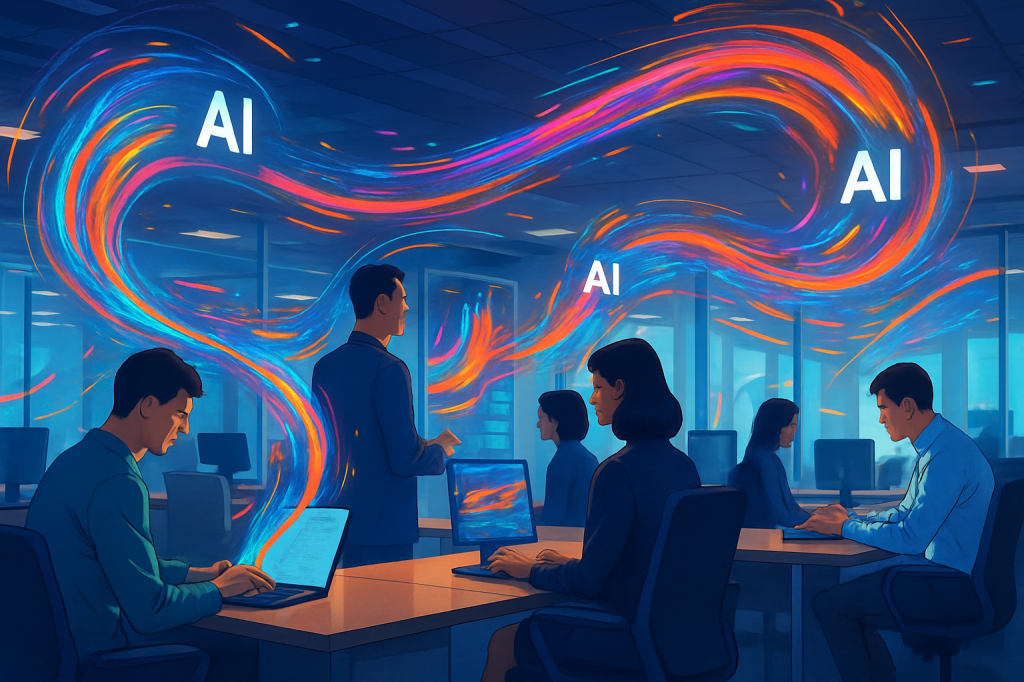
AI Impact on the Job Market – News (June 13, 2025 to June 20, 2025)
Ever notice how history rhymes, not repeats? This week, the echoes of past technological shifts are getting louder as AI’s impact on jobs becomes clearer. It’s not just about robots taking over factories anymore; it’s about algorithms reshaping entire industries and redefining the very nature of work. Buckle up, because this week’s news is a wild ride.
New York Demands AI Disclosure: The Beginning of Regulatory Scrutiny?
New York has officially become the first state in the US to require companies to disclose if AI played a role in mass layoffs. Governor Hochul’s addition to the WARN system, effective since March, is a landmark move. Companies now have to specify if “technological innovation or automation” was a factor, naming the tech involved (AI, robotics, etc.).
Why is this important? It signals a growing awareness among regulators about AI’s potential to displace workers. While no companies have yet cited AI as the reason for layoffs in New York, this move adds a layer of transparency and accountability. It also sets a precedent. Could other states follow suit? Absolutely. This could be the start of a wave of regulations designed to manage AI’s impact on the workforce.
Amazon and the “Scrappier Teams”: AI-Driven Job Cuts Emerge
Amazon CEO Andy Jassy recently stated that AI would lead to job cuts at the e-commerce giant. He told employees to find ways to “get more done with scrappier teams” as the company develops over 1,000 generative AI applications. This aligns with broader trend of tech companies restructuring for the AI era.
What does this *really* mean? Jassy’s comments are a stark admission that AI isn’t just about boosting productivity; it’s about doing more with less *human* capital. It’s the corporate world’s equivalent of saying, “We love you, but AI can do your job cheaper and faster.” It also highlights the pressure on companies to show a return on their massive AI investments. Amazon is pouring billions into AI infrastructure, and it needs to justify that expense to shareholders. That justification? Fewer employees.
The Ghost of Productivity Past: Learning from 1995
Remember the IT revolution of the late 90s? Alberto Chies, in a letter to the Financial Times, draws a concerning parallel. The productivity surge from 1995-2005, fueled by IT advancements, led to significant manufacturing job losses. Displaced workers shifted to service sectors, often in lower-productivity roles, contributing to wage stagnation and increased inequality.
Why is this important? Chies argues that we risk repeating this pattern with AI. As AI infiltrates service roles, displaced workers could be shunted into low-value positions, eroding meaningful work and exacerbating inequality. This isn’t just about economics; it’s about social stability. Widespread discontent can fuel populism and destabilize the political landscape. The key takeaway? We need proactive public policy and oversight to ensure AI’s integration leads to shared prosperity, not just concentrated gains.
The Entry-Level Extinction Event: Amodei’s Dire Prediction
Anthropic CEO Dario Amodei predicts that AI could eliminate half of all entry-level white-collar jobs within five years. This isn’t some distant, theoretical threat; it’s a near-term forecast with serious implications for current students and recent graduates.
What impact could this have? It could create a bottleneck in career pipelines. If entry-level jobs vanish, how do individuals gain the experience needed for more senior roles? This isn’t just about automating mundane tasks; it’s about fundamentally altering how human capital develops within industries. The consequences could include increased unemployment among new grads, companies bypassing entry-level hires, and a widening skills gap.
The Unfolding Conflict: AI, Value, and Fair Pay
It’s not just about job losses; it’s about fair compensation for the jobs that remain. Payscale Inc.’s 2025 Compensation Best Practice Report reveals a growing tension: while only 18% of companies are actively replacing workers with AI, many are reducing pay increases and offering lower salaries to new hires.
Why is this important? This isn’t just cost-cutting; it’s a recalibration of perceived human value in an AI-augmented environment. Employees are increasingly feeling undervalued, leading to a talent exodus. Companies are losing talent due to perceptions of unfair pay. An environment where employees feel undervalued breeds disengagement, reduces innovation, and ultimately hinders retention. If AI makes a company more productive, who truly benefits?
The Gendered Impact of AI: Women at Greater Risk?
An International Labour Organization (ILO) report reveals that 9.6% of jobs predominantly held by women are highly susceptible to AI-driven transformation, compared to just 3.5% of male-dominated roles. This disparity is driven by the automation of administrative and clerical functions, sectors where women have historically formed the backbone of the workforce.
What does this *really* mean? The gendered impact isn’t accidental; it’s a consequence of historical labor market segmentation. Roles often feminized are now precisely the ones most exposed to AI’s disruptive capabilities. This highlights how technological progress, if unchecked, can amplify existing societal inequalities. We need targeted reskilling programs, a redefinition of how we value human contributions, and policies that promote equity.
Amazon’s Unvarnished Truth: AI is Coming for Corporate Jobs
Amazon CEO Andy Jassy explicitly linked AI investments to an anticipated shrinkage in the company’s corporate headcount. This isn’t just about blue-collar jobs; it’s about AI replacing routine and repetitive tasks in white-collar cubicles.
Why is this important? Jassy’s announcement is a bellwether for the broader corporate landscape. The narrative of AI replacing jobs is extending to “corporate” positions. While new roles in AI development are promised, are these new roles accessible to those whose existing positions are being phased out? The skills gap is a major concern. The primary beneficiary of AI, in the short term, is often the balance sheet. Jassy’s bluntness forces a more urgent and realistic conversation about economic transitions.
Microsoft’s Sales Shift: AI Reimagines the Sales Process
Microsoft is laying off thousands of employees, predominantly in sales, as it invests $80 billion in AI infrastructure. This isn’t just belt-tightening; it’s a fundamental re-evaluation of where value is created in the sales pipeline.
What does this *really* mean? AI can now automate lead qualification, personalize outreach, predict customer needs, and optimize CRM. The role of the human salesperson is evolving from a primary information conveyor to a strategic advisor or even an AI system manager. This highlights that even roles traditionally considered immune to automation are being reshaped by AI.
ILO’s 2025 Update: Task Transformation, Not Total Replacement
The ILO’s updated research brief emphasizes task transformation over outright replacement. Roughly 25% of the global workforce operates in occupations with some degree of GenAI exposure, but human input remains essential in most roles.
Why is this important? While the mean automation score has slightly decreased, the variability has decreased significantly. This suggests that GenAI’s influence is becoming more consistent and widespread across different occupations. It’s less about a few jobs facing total overhaul and more about a pervasive reshaping of tasks across a broader spectrum of roles. The key takeaway? We need social dialogue and proactive strategies to ensure the integration of AI leads to equitable and beneficial outcomes for all.
This week’s news reinforces a crucial point: AI’s impact on the job market is complex, multifaceted, and rapidly evolving. It’s not just about robots stealing jobs; it’s about algorithms reshaping industries, redefining skills, and challenging our very notions of work and value. Staying informed, adaptable, and proactive is no longer optional; it’s essential.
