
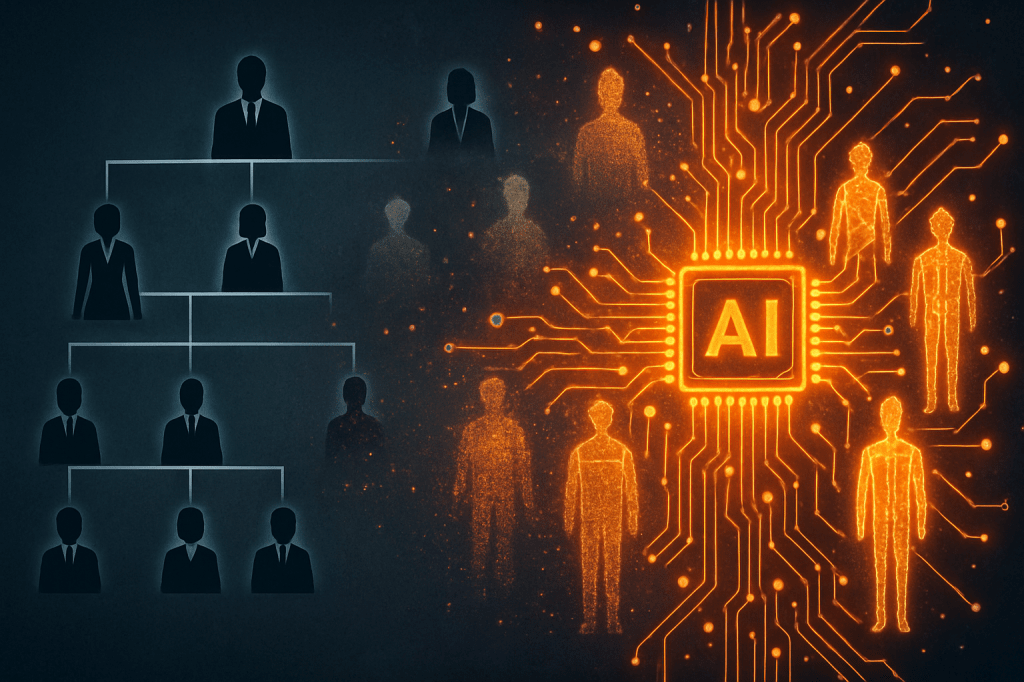
The abstract discussions about AI’s impact on white-collar work just received a very tangible data point. On June 27, Amazon CEO Andy Jassy articulated what many have theorized but few major employers have so explicitly declared: AI will lead to corporate workforce reductions.
The Amazon Declaration: Beyond Efficiency Gains
Jassy’s internal memo, dated June 17, wasn’t couched in the usual corporate euphemisms. He stated, “As we roll out more Generative AI and agents, it should change the way our work is done. We will need fewer people doing some of the jobs that are being done today, and more people doing other types of jobs.” This isn’t merely about augmenting existing roles or boosting productivity; it’s a direct acknowledgment that certain corporate functions, currently performed by humans, are slated for deprecation by AI.
For a company of Amazon’s scale and influence, this isn’t just a ripple; it’s a significant marker. It signals a shift from AI as a tool for marginal gains to AI as a fundamental reorganizer of organizational structure, especially within the knowledge worker realm. The implications extend far beyond logistics centers or customer service bots. This is about the strategic deployment of AI to reshape the very definition of corporate overhead.
The Broader Currents: A Confirmed Trajectory
This move by Amazon isn’t isolated. It aligns with a trajectory we’ve been tracking, though often articulated in more general terms. A recent World Economic Forum report highlighted that nearly half—48%—of U.S. employers anticipate reducing their workforce due to AI adoption. Amazon’s announcement effectively pulls that statistic out of a survey and places it squarely in the real-world operational plans of a global titan.
What’s particularly salient here is the explicit link between Generative AI and agent technology and the need for “fewer people.” This isn’t about simple automation of repetitive tasks; it’s about AI performing cognitive work, synthesizing information, generating content, and making decisions that previously required human input and oversight.
The “Upskilling” Conundrum: A Closer Look
The standard counter-narrative, often championed by experts like Kate Lister of Global Workplace Analytics, is that while AI’s threat is “inevitable,” it also creates opportunities for higher-level responsibilities. Lister suggests it will “make us a whole lot more intelligent, a whole lot more efficient, and allow us to do the jobs that we as humans are good at.”
While this perspective offers a measure of optimism, it warrants a critical eye, especially from the vantage point of “AI Replaced Me.”
- The “Fewer People” Equation: If AI enables “fewer people” to accomplish the same or more work, what happens to the displaced? The promise of “more people doing other types of jobs” doesn’t necessarily translate to a one-to-one transfer, nor does it guarantee that these “other types of jobs” will be accessible or desirable for everyone currently employed.
- Defining “What Humans Are Good At”: The goalposts for “human-centric” work are constantly shifting. As GenAI becomes more sophisticated, its capabilities encroach on areas once considered uniquely human – creativity, complex problem-solving, strategic analysis. The question isn’t just about upskilling, but about the shrinking pool of tasks that remain exclusively human domains, and whether the market can absorb all those displaced into these new, higher-level roles.
- The Corporate Tier Impact: This isn’t just about factory floor workers or call center agents. Jassy’s comments explicitly target the “corporate workforce.” This means analysts, project managers, content creators, and even mid-level strategists are now squarely in AI’s crosshairs, pushing the disruption further up the organizational chart.
The Path Forward: Adaptation, Not Just Optimism
Amazon’s announcement is a stark reminder that the integration of AI is not a hypothetical future, but an active, strategic initiative reshaping corporate structures right now. It underscores an urgent need for both employers and employees to move beyond abstract discussions of “inevitability” and into concrete strategies for adaptation. This means a proactive, continuous investment in understanding AI’s evolving capabilities, identifying the roles most vulnerable, and rigorously evaluating what truly constitutes indispensable human contribution in an increasingly automated enterprise. The future of work isn’t just changing; for many, it’s already here, and it looks a lot like Amazon’s organizational chart.
