
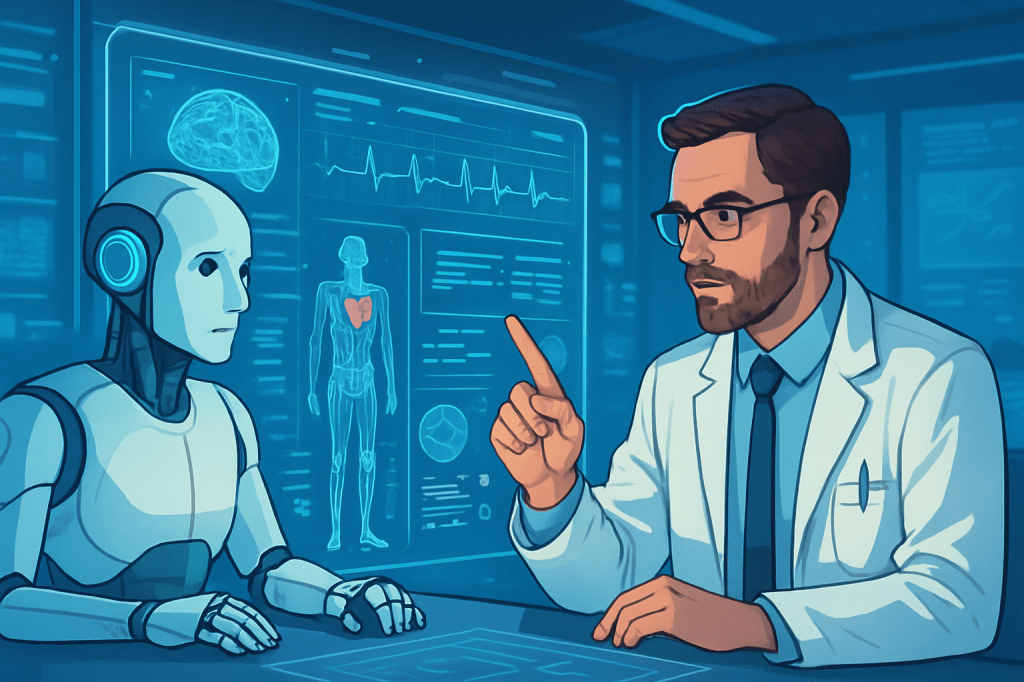
In a world where AI is often seen as an assistant, Microsoft’s latest revelation might just turn that perception on its head. Enter the Microsoft AI Diagnostic Orchestrator (MAI-DxO), an AI-powered tool that not only matches, but significantly outshines human doctors in the realm of complex diagnoses. This isn’t your average tech upgrade; it’s a seismic shift in healthcare diagnostics, and it’s sending ripples through the medical community.
The Game-Changing Introduction
MAI-DxO, unveiled on June 30, 2025, is the brainchild of Microsoft’s AI health division, spearheaded by Mustafa Suleyman. This isn’t just another AI; it’s a cohesive unit of five AI agents, each playing a unique role in the diagnostic process. Picture a well-oiled machine where each cog performs its function flawlessly, resulting in an outcome that is four times more accurate than seasoned physicians tackling the same cases.
A Head-to-Head with Human Expertise
Using 304 challenging case studies from the New England Journal of Medicine, the MAI-DxO achieved an 85.5% success rate. When you pit this against the 20% success rate of human doctors under similar conditions, the difference is stark. This isn’t just a slight edge; it’s a chasm. The implications? Profound, especially when considering that even the best human performers couldn’t match up. The promise here isn’t just about accuracy; it’s about redefining what’s possible in medical diagnostics.
Beyond Just Accuracy: Efficiency and Transparency
But wait, there’s more. Cost-effectiveness is another feather in MAI-DxO’s cap. By reducing unnecessary diagnostic tests, the AI not only cuts costs but also streamlines the entire process. This efficiency is coupled with a “chain of debate” methodology, a novel approach ensuring transparency in AI decision-making. Think of it as opening up the AI’s thought process for scrutiny—because who trusts a black box with their health?
The Broader Implications
This development isn’t just a technological triumph; it’s a potential panacea for some of the healthcare sector’s most pressing issues. Consider the current landscape—staff shortages, long wait times, and an ever-growing patient load. MAI-DxO offers a glimpse into a future where these challenges could be mitigated. And while it’s not ready for immediate clinical deployment, the groundwork is being laid for a transformation that could redefine patient care.
Who Wins, Who Loses?
As with any major innovation, there are winners and losers. On the winning side, we have patients who stand to benefit from faster, more accurate diagnoses. Healthcare providers, too, could see improved efficiencies and reduced workloads. But what about the doctors? The very professionals who have dedicated years to mastering their craft?
While some may see this as a threat, it’s more of an opportunity to redefine roles. Doctors could transition from primary diagnosticians to overseers of AI systems, focusing more on patient interaction and complex decision-making that requires a human touch. It’s a shift, but not necessarily a displacement.
The Ethical and Societal Questions
This development raises a plethora of ethical and societal questions. How do we ensure equitable access to such technology? What about the data privacy concerns inherent in AI systems? And perhaps most importantly, how do we maintain the human element in healthcare, ensuring that patients remain more than just data points?
As MAI-DxO continues its journey towards clinical readiness, these questions will need to be addressed. But one thing is clear: the future of healthcare, with AI at its helm, is not just promising—it’s inevitable.
The announcement of MAI-DxO is more than just a tech update; it’s a herald of change. As we stand on the brink of this new era, the only certainty is that the landscape of healthcare will never be the same again.
