
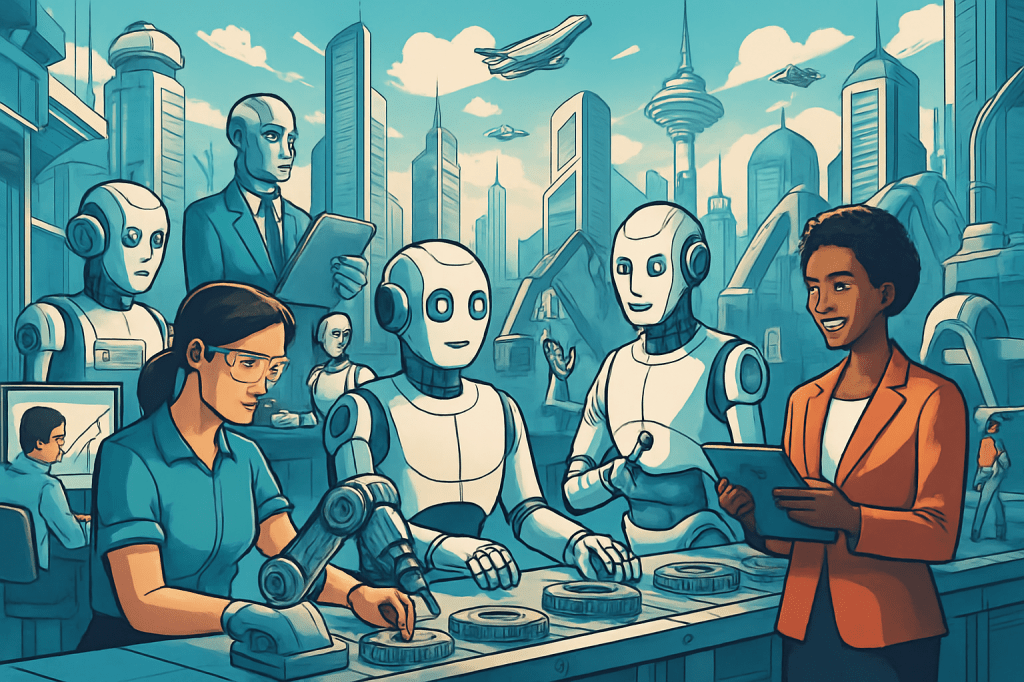
In the latest episode of Uncapped with Jack Altman, Silicon Valley investor Vinod Khosla dropped a bombshell prediction: by 2030, AI will be performing 80% of tasks across all economically valuable jobs, leaving the Fortune 500 companies scrambling to keep up or face extinction. Khosla’s vision is not just about job displacement; it’s about a seismic shift in how we understand work, value, and economic success.
The Looming Jobquake
Imagine a world where 80% of today’s jobs are obsolete. It’s not a dystopian fiction but a scenario Khosla sees unfolding in less than a decade. While the buzz surrounding AI’s role in the workplace is not new, Khosla’s timeframe and scope are jaw-dropping. In five years, he suggests, AI will handle most tasks in any job that holds economic value. This isn’t just about replacing assembly line workers; we’re talking about AI taking over complex roles traditionally deemed safe from automation.
Yet, who wins in this scenario? The obvious answer might be the tech companies behind AI development. However, the real winners could be those who strategically pivot their skills and roles to leverage AI as a tool rather than compete against it. The losers? Potentially, anyone clinging to traditional job structures without adapting.
Corporate Carnage or Reinvention?
Khosla’s prediction for the Fortune 500 is equally audacious. He foresees an unprecedented decline among these corporate giants. Why? Because AI doesn’t just replace jobs; it can also revolutionize industries, creating opportunities for new players to emerge and redefine sectors. Established companies, often bogged down by legacy systems and resistance to change, may find themselves unable to pivot quickly enough.
Consider the emergence of startups like Stripe or SpaceX, which have already disrupted traditional sectors. In Khosla’s AI-driven future, these new entities might not just disrupt but entirely replace the titans of today. The challenge for existing companies is clear: adapt or be left behind.
An Economic Paradigm Shift
Beyond jobs and corporations, Khosla predicts a hugely deflationary impact on the economy. Traditional metrics like GDP may lose relevance as AI-driven efficiencies lead to an abundance of goods and services. This abundance could lower costs and shift the economic focus from scarcity to accessibility.
Such a shift raises profound questions: How do we measure economic health in a world where traditional indicators no longer apply? What new metrics will emerge to capture the value created by AI? These are not just academic questions but practical concerns for policymakers and businesses navigating an AI-saturated landscape.
Beyond the Horizon: Preparing for 2030
The implications of Khosla’s predictions are vast. They challenge us to rethink the future of work, the resilience of our economic structures, and the adaptability of our corporate giants. While the pace and scale of these changes might seem daunting, they also present opportunities for innovation and growth.
As Khosla’s track record suggests, his predictions are not mere speculation. His early investments in OpenAI and other tech ventures have demonstrated a keen foresight into technological advancements. For individuals and businesses alike, the key takeaway is clear: embracing AI and its potential could be the difference between thriving in the new economy or becoming a relic of the past.
As we edge closer to 2030, the challenge is not to resist AI’s march forward but to harness its potential to redefine what’s possible. In this brave new world, those who innovate will not just survive—they’ll redefine the landscape.
