
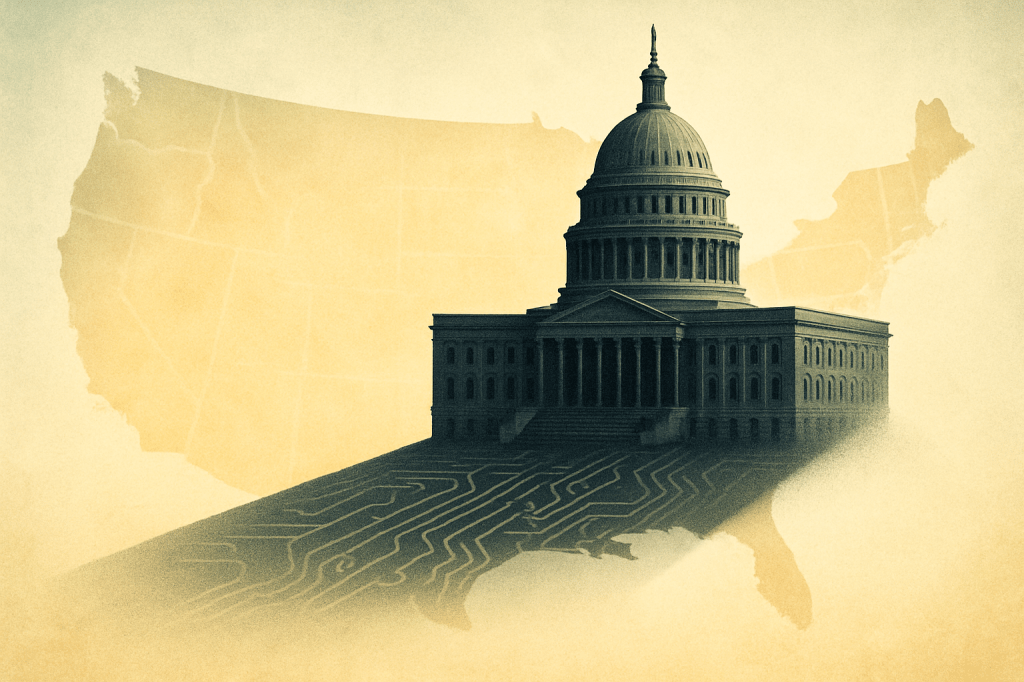
For years, we’ve debated the ethics and implications of AI’s unchecked expansion, often looking to individual states to pioneer regulatory frameworks where federal action lagged. That dynamic just hit an unexpected legislative wall. A provision quietly inserted into a proposed federal funding reconciliation bill seeks to impose a sweeping 10-year moratorium on all state-level artificial intelligence regulations within the United States.
The Unseen Front: Who Gets to Rule AI?
The core of this legislative maneuver, highlighted yesterday by the Society for Human Resource Management (SHRM), isn’t about a new AI breakthrough, but about the fundamental rules of engagement. Proponents of the moratorium argue for a unified national approach, or rather, a significant pause on state-level intervention. Their rationale is straightforward: prevent a chaotic patchwork of diverse state laws that could stifle innovation and disproportionately burden smaller enterprises navigating a complex compliance landscape. The argument posits that a unified federal approach, or a decade without fragmented state oversight, would allow the industry to mature and innovate unencumbered.
Yet, this isn’t a universally welcomed simplification. The proposal has ignited bipartisan opposition, raising serious alarms about federal overreach and the erosion of states’ rights to protect their citizens and local economies. Critics are voicing deep concerns that this moratorium could grant the burgeoning AI industry an unprecedented period of unchecked influence, effectively sidelining public input and local accountability in favor of rapid, unhindered development.
A Moratorium’s Double Edge for the Workforce
What does a decade-long federal freeze on state AI regulation truly mean for a workforce already navigating unprecedented disruption? This isn’t merely a bureaucratic squabble; it’s a foundational shift in how AI will be deployed and managed across crucial sectors like hiring, performance evaluation, and compliance. Consider the profound ramifications:
- The ‘Wild West’ Narrative Reinvigorated: Without state-level guardrails, the development and application of AI tools, particularly those impacting employment decisions, could proceed with fewer immediate checks. This might accelerate adoption but also amplify existing risks associated with bias, transparency, and accountability in algorithmic decision-making.
- Centralization of Power: This move effectively centralizes AI policy-making, or rather, AI *non-policy-making* at the federal level. It creates a vacuum that the industry might eagerly fill, shaping norms and practices in the absence of diverse legislative input from states and municipalities.
- Impact on Workforce Safeguards: Many progressive AI regulations, such as those in New York City addressing algorithmic bias in hiring, originated at the state or municipal level. A moratorium could halt the spread of such protections, leaving workers more vulnerable to opaque algorithmic decisions and potentially exacerbating existing inequalities.
- Innovation vs. Responsibility: While proponents tout innovation as the primary benefit, the question arises whether innovation without robust, localized oversight is truly beneficial. Will a decade of unbridled development lead to more equitable and responsible AI, or simply faster, more pervasive deployment that prioritizes efficiency over human considerations?
This legislative maneuver isn’t just a footnote in a funding bill; it’s a strategic gambit for control over AI’s future trajectory. It foregrounds a critical tension: the desire for national consistency versus the need for localized, responsive governance in a rapidly evolving technological landscape. The outcome will shape not just the tech industry, but the very fabric of our working lives for years to come, dictating the terms under which AI continues its march into every corner of the human enterprise.
