
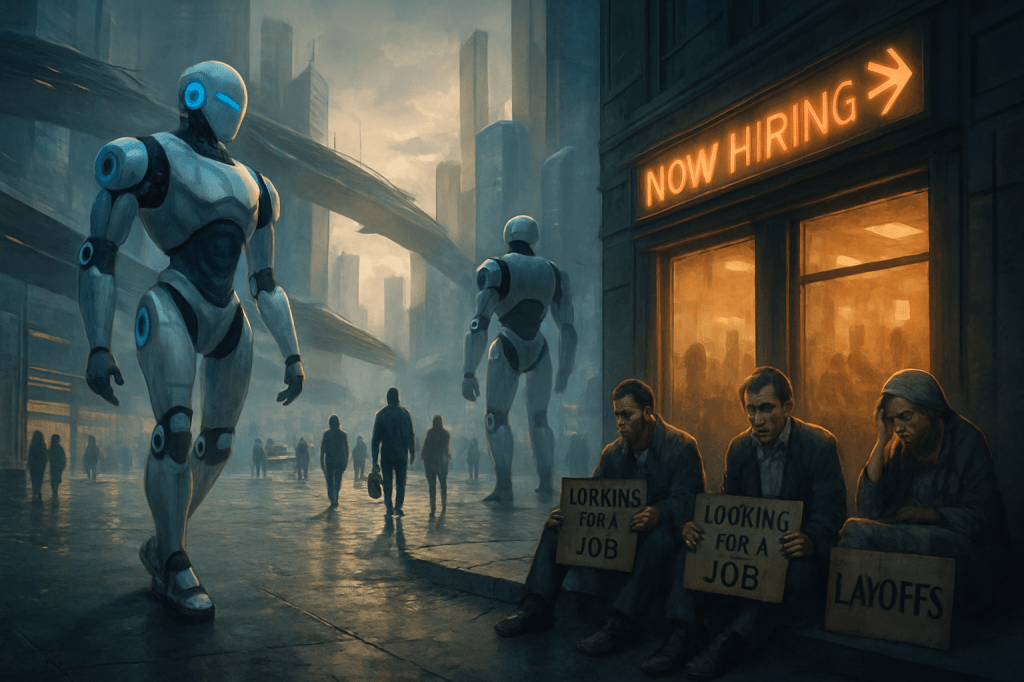
AI Impact on the Job Market – News (June 27, 2025 to July 4, 2025)
Ever notice how the future always seems to arrive in waves? One minute we’re marveling at AI’s potential, the next we’re bracing for the aftershocks of its actual implementation. This week’s news feels less like a gentle tide and more like a tsunami hitting the job market, with some areas getting completely submerged while others are left surprisingly dry.
The Great AI Reckoning: Layoffs and Leaders Speak Out
The whispers have turned into a roar. This week, the reality of AI-driven job displacement became impossible to ignore. Major tech players are making moves that send a clear message: AI isn’t just a shiny new toy; it’s a fundamental restructuring force. Let’s break down the key developments:
Microsoft’s Double-Edged Sword
Microsoft’s announcement of 9,100 layoffs in July 2025 (on top of the 6,000 earlier this year) isn’t a simple case of robots taking over. It’s a far more complex equation. While some roles will undoubtedly be automated, the layoffs are largely fueled by the massive capital expenditure required to build out Microsoft’s AI infrastructure. We’re talking an unprecedented $80 billion! That kind of investment demands sacrifices, and unfortunately, those sacrifices are coming in the form of human jobs in Xbox, sales, and legal departments. The company is consolidating roles, cutting organizational layers, and streamlining operations to free up capital for servers, GPUs, and AI talent. It’s a brutal reminder that even the most innovative companies face tough choices in this AI-driven landscape.
Why is this important? It highlights the hidden costs of AI adoption. The narrative often focuses on direct job displacement through automation, but Microsoft’s move reveals that the cost of *enabling* AI can be just as disruptive. It’s a re-prioritization, where human jobs are sacrificed to finance the very technology that promises to redefine (and potentially reduce) the need for human labor in the long run.
Amazon’s Explicit Admission
Adding fuel to the fire, Amazon CEO Andy Jassy didn’t mince words in a recent memo. He explicitly stated that AI will lead to corporate workforce reductions, saying, “We will need fewer people doing some of the jobs that are being done today, and more people doing other types of jobs.” This isn’t corporate-speak; it’s a direct acknowledgment that AI is slated to *deprecate* certain corporate functions currently performed by humans. The company has already eliminated roles within its Books division as it streamlines operations.
Why is this important? For a company of Amazon’s scale and influence, this isn’t just a ripple; it’s a significant marker. It signals a shift from AI as a tool for marginal gains to AI as a fundamental reorganizer of organizational structure, especially within the knowledge worker realm. Analysts, project managers, content creators, and even mid-level strategists are now squarely in AI’s crosshairs, pushing the disruption further up the organizational chart.
Leaders Sound the Alarm
The message isn’t just coming from within the tech industry. Ford CEO Jim Farley dropped a bombshell at the Aspen Ideas Festival, predicting that AI will replace “literally half of all white-collar workers in the US.” Meanwhile, Anthropic CEO Dario Amodei warned that half of all entry-level jobs could vanish within one to five years, potentially sending unemployment soaring. And Marianne Lake, head of consumer and community banking at JPMorgan Chase, anticipates a 10% reduction in operations headcount due to AI integration.
Why is this important? These aren’t just hypothetical scenarios; they’re concrete warnings from leaders who are actively grappling with the implications of AI in their respective industries. They highlight the potential for widespread disruption across various sectors, not just tech. And that last point about JPMorgan Chase? It’s a reminder that AI isn’t just about automating physical tasks; it’s coming for cognitive work too.
The Upskilling Myth: A Reality Check
The standard response to these dire predictions is the promise of “upskilling” – that displaced workers will simply transition to higher-level, more fulfilling roles. But is it that simple? Amazon’s admission of needing “fewer people” throws a wrench in that narrative. If AI enables fewer people to accomplish the same or more work, what happens to the displaced? The promise of “more people doing other types of jobs” doesn’t necessarily translate to a one-to-one transfer, nor does it guarantee that these “other types of jobs” will be accessible or desirable for everyone currently employed.
Moreover, the goalposts for “human-centric” work are constantly shifting. As GenAI becomes more sophisticated, its capabilities encroach on areas once considered uniquely human – creativity, complex problem-solving, strategic analysis. The question isn’t just about upskilling, but about the shrinking pool of tasks that remain exclusively human domains, and whether the market can absorb all those displaced into these new, higher-level roles.
The ILO’s Nuanced Take: Transformation, Not Annihilation (Mostly)
Amidst the doom and gloom, the International Labour Organization (ILO) offered a slightly more tempered perspective. Their latest report suggests that the overall potential for job automation has actually *ticked down* slightly. This isn’t a retraction of AI’s power, but rather a more sophisticated recalibration of its immediate, broad-stroke impact. The ILO emphasizes that the emphasis remains on job *transformation* rather than outright *elimination*.
However, the report also highlights that advancements in generative AI, particularly in voice, image, and video generation, have demonstrably heightened automation scores for tasks within traditionally human-centric creative and media-related occupations. This isn’t just about AI assisting; it’s about AI performing core functions that previously defined these roles. So, while the overall picture may be less apocalyptic than some predict, the creative class is now squarely in the crosshairs.
The Uneven Distribution of AI’s Impact: A Growing Divide
Ford CEO Jim Farley also made a crucial point about the uneven distribution of AI’s impact. While AI tools are demonstrably enhancing productivity and transforming white-collar roles, their presence in the manufacturing and skilled trades sectors is painting a different picture. It’s not necessarily about direct job replacement in these areas, but rather a chilling stagnation or decline in their relative economic value and future prospects.
This creates a significant risk to the foundational economy. As the digital and augmented sectors accelerate, the physical and manual sectors, vital as they are, could see their employment opportunities dwindle or their compensation stagnate, leading to a widening chasm of socioeconomic disparity. Farley’s call for immediate, substantial investment in vocational training is a recognition that the future economy requires a deliberate rebalancing act.
Upwork’s Perspective: Augmentation Over Annihilation (for Some)
Adding another layer to the story, Upwork’s latest findings suggest that AI is serving more as an enabler than a universal job killer. The report highlights a significant uplift in opportunities, particularly for experienced freelancers who have adeptly integrated AI into their workflows. Freelance earnings from AI-related jobs have surged by an impressive 25% year over year.
This trend underscores a critical shift: AI is not just about doing more with less; it’s about doing *more valuable* work with greater efficiency, creating a premium on human expertise amplified by technological fluency. However, this benefit is not universal. While the demand for basic coding work has declined, the need for complex development tasks remains steadfast. This highlights the importance of continuous skill development and adaptation in the AI era.
California’s AI Hiring Law: A Step Towards Accountability
Amidst all the disruption, there’s a glimmer of hope for greater accountability. California’s Senate Bill 979 (SB 979) officially came into effect, introducing a robust framework of regulations for the use of automated decision tools in hiring and employment practices. This isn’t merely a nudge towards best practices; it’s a stark legal mandate designed to confront the inherent opacity and potential for bias in AI-driven employment decisions head-on.
SB 979 introduces mandatory bias audits, comprehensive impact assessments, and candidate notifications. This legislation is a strategic inflection point for AI development and adoption in the workplace, pushing AI developers to prioritize fairness, transparency, and auditability from the design phase. It also offers a tangible layer of protection for the workforce, aiming to ensure that the *process* of selection and evaluation is as fair and transparent as possible.
Federal Intervention: A Moratorium on State AI Regulations?
But just as California is stepping up, a proposed federal funding reconciliation bill seeks to impose a sweeping 10-year moratorium on all state-level artificial intelligence regulations within the United States. This move has ignited bipartisan opposition, raising serious alarms about federal overreach and the erosion of states’ rights to protect their citizens and local economies.
Critics argue that this moratorium could grant the burgeoning AI industry an unprecedented period of unchecked influence, effectively sidelining public input and local accountability in favor of rapid, unhindered development. Without state-level guardrails, the development and application of AI tools, particularly those impacting employment decisions, could proceed with fewer immediate checks, potentially exacerbating existing inequalities.
The Bottom Line: Adapt or Be Displaced
This week’s news paints a complex and often unsettling picture of AI’s impact on the job market. While the narrative of complete job annihilation may be overstated, the reality of significant disruption, transformation, and inequality is undeniable. The key takeaway? Adaptability is no longer a virtue; it’s the fundamental currency of survival. We need to proactively invest in understanding AI’s evolving capabilities, identifying the roles most vulnerable, and rigorously evaluating what truly constitutes indispensable human contribution in an increasingly automated enterprise. The future of work isn’t just changing; for many, it’s already here, and it demands a proactive response.
