
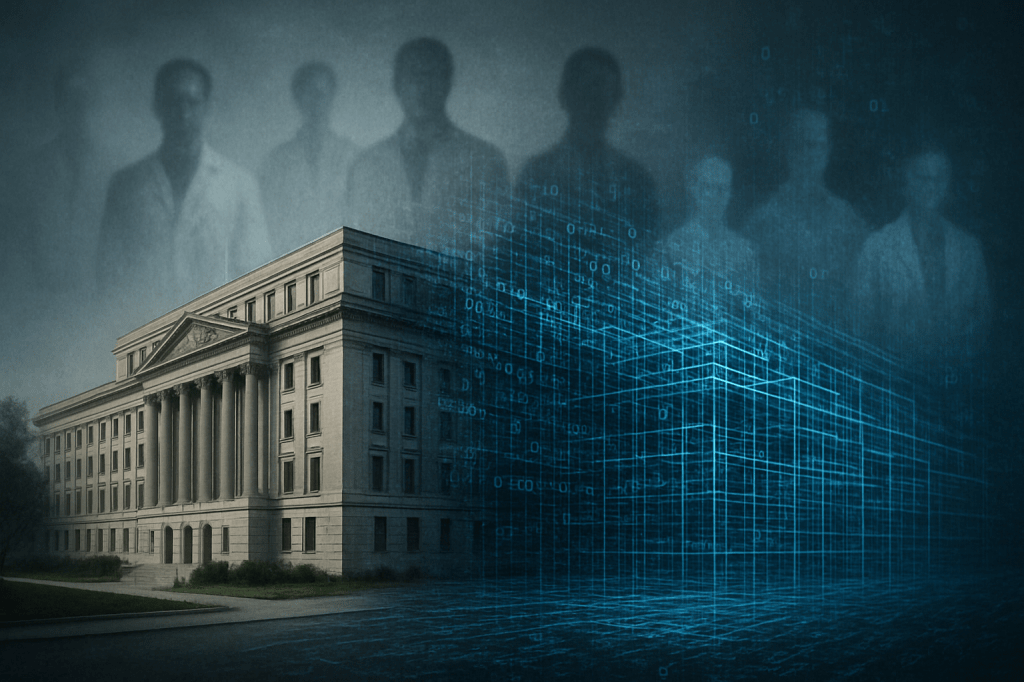
The latest wave of federal workforce reductions, headlined by significant cuts at the U.S. Department of Veterans Affairs, hints at a deeper, less visible shift in how large organizations are re-evaluating human capital in the age of advanced computing. This isn’t merely a budgetary exercise; it’s a profound re-scoping of essential public services, prompting us to consider the nuanced and often indirect ways AI’s influence manifests in the job market.
The Numbers: A Federal Footprint Shrinks
On July 7, 2025, the U.S. Department of Veterans Affairs announced plans to slash approximately 30,000 positions by September of the same year. This drastic reduction follows an earlier purge of over 1,000 probationary employees, a cohort that notably included specialists in critical research fields: mental health, cancer treatments, addiction recovery, prosthetics, and burn pit exposure. By July, the VA had already seen its workforce dwindle by roughly 17,000 employees, illustrating a rapid and substantial contraction.
Beyond the VA: A Coordinated Downsizing?
This trend isn’t isolated to veteran services. The Department of Health and Human Services (HHS) is undertaking similar measures, terminating approximately 5,200 probationary employees. This includes around 1,300 from the Centers for Disease Control and Prevention (CDC) and others from the National Institutes of Health (NIH). The pattern suggests a coordinated, or at least parallel, effort across federal agencies to streamline operations.
The Unseen Algorithm: Implications for Expertise and Public Good
The immediate concern voiced by lawmakers like Senator Patty Murray and Representative Debbie Wasserman Schultz centers on potential staffing shortages and the inevitable impact on veteran care. Critics of the broader federal cuts argue that these actions could significantly impede critical advancements in medical research and jeopardize ongoing clinical trials. But for those watching the algorithmic reshaping of the labor market, these cuts raise more complex questions than simple budget austerity.
The dismissal of researchers in highly specialized fields is particularly telling. These aren’t roles typically automated wholesale by current AI. Instead, their reduction suggests a different kind of AI-driven efficiency: perhaps AI tools are augmenting the remaining staff to such an extent that fewer human experts are deemed necessary. Or, perhaps AI is being leveraged to analyze organizational structures, identifying perceived redundancies or areas where future automation is anticipated, leading to pre-emptive workforce reductions.
This “complex interplay between AI integration and employment” within federal agencies is less about direct replacement and more about a strategic re-evaluation of human capital under the promise of technological efficiency. The implications are deep:
- Erosion of Institutional Memory: Cutting experienced or even early-career researchers means a loss of specialized knowledge and ongoing project continuity that AI, despite its capabilities, cannot fully replicate.
- Risk to Long-Term Public Health: Slowing medical research and jeopardizing clinical trials has tangible, long-term consequences for public health and national well-being. The immediate savings might come at a far greater future cost.
- The “Efficiency” Justification: Is AI truly enabling these cuts by making existing roles redundant, or is it providing a convenient, forward-looking rationale for budget reductions that might otherwise be politically unpalatable?
- Precedent for Public Sector Automation: These federal agency cuts could set a precedent for how governments globally approach workforce management, prioritizing perceived algorithmic efficiency over the preservation of diverse human expertise.
The narrative here isn’t just about jobs lost; it’s about the subtle, systemic redefinition of what constitutes “essential” human work when AI enters the equation. We are witnessing a quiet, yet profound, shift in how foundational public services are staffed and delivered, with AI’s invisible hand potentially guiding decisions that have life-altering consequences for millions.
