
AI Impact on the Job Market – News (July 4, 2025 to July 11, 2025)
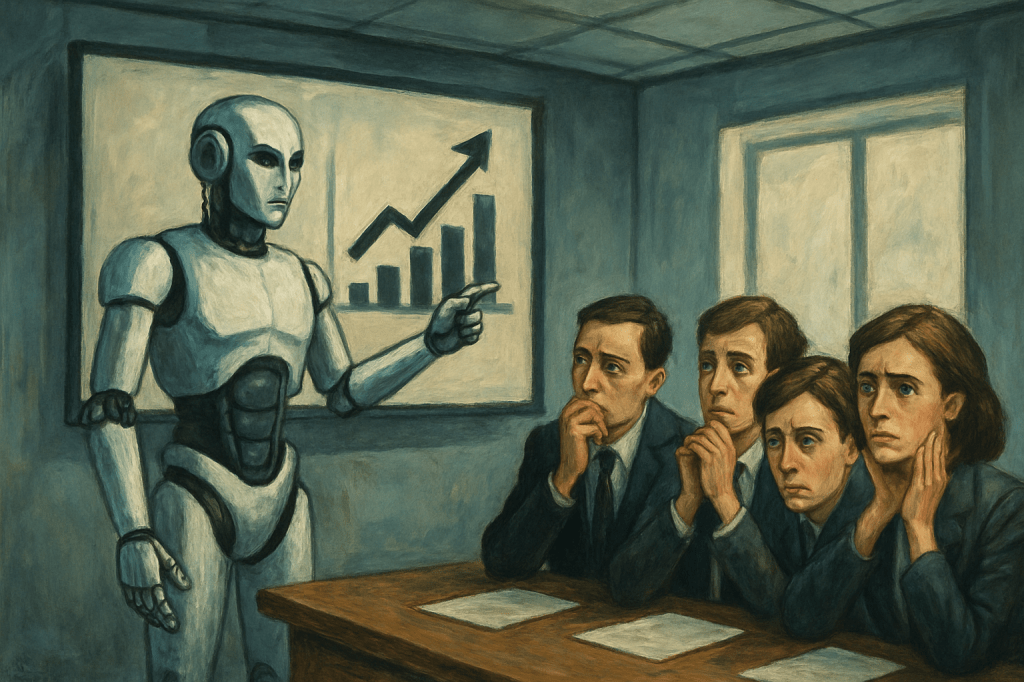
Ever notice how even in a crowded room, you can suddenly *feel* like everyone’s looking at you? That’s kind of how the AI job market feels this week. The vague sense of unease has solidified into a full-on spotlight, and it’s not just in tech anymore. It’s like AI went from being a cool new gadget to the office manager making “efficiency suggestions” – and those suggestions usually involve fewer humans.
Indeed and Glassdoor Layoffs: The Irony is Thicker Than the Resumes
The biggest eyebrow-raiser this week? Layoffs at Indeed and Glassdoor, two titans of the *job search* industry. A combined 1,300 employees – roughly 6% of their workforce – are getting the boot, and the parent company, Recruit Holdings, is straight-up blaming AI. Talk about a self-aware robot apocalypse. CEO Hisayuki “Deko” Idekoba even mentioned the HR industry’s “60% or 65% of human labor manual cost” ripe for AI disruption at a recent JPMorgan Chase conference. Ouch.
Why is this important? It’s not just about those 1,300 people (though, obviously, that’s a big deal). It’s about the signal this sends. If the platforms *built* to connect people with jobs are turning to AI to cut costs, it’s a flashing neon sign that no sector is safe. Expect other HR tech companies to follow suit. The role of recruiters, resume screeners, and even HR generalists is being fundamentally reshaped *right now*.
- The Impact: Expect to see more AI-powered resume parsing, automated interview scheduling, and even AI-driven candidate assessments. If you’re in HR, it’s time to upskill – learn how to *manage* these AI tools, not be replaced by them.
Microsoft’s AI Pivot: Saving Millions, Losing Employees
Microsoft’s not exactly being subtle either. They’re continuing their 2025 layoff spree, bringing the total to over 15,000. While they’re not *explicitly* saying AI is the *sole* reason, the timing is sus. They’ve reportedly saved over $500 million by deploying their own AI tools internally, which coincides nicely with all those pink slips. It’s like they’re saying, “We love you, but our new AI can do your job for a fraction of the price.”
Why is this important? Microsoft is a trendsetter. Their actions ripple across the tech landscape. If they’re aggressively cutting roles and investing in AI, expect other tech giants to follow suit. This also highlights a key point: AI isn’t just about replacing low-skill jobs. It’s coming for knowledge workers, engineers, and even some management roles.
- The Impact: We’re likely to see a continued consolidation of tech talent at the very top (the “AI talent war” is *real*, with Meta reportedly offering $300 million packages to poach top AI researchers) while mid-level and entry-level roles get increasingly automated.
Ford and NVIDIA CEOs: A Tale of Two Futures
The executive commentary this week was… polarizing. Ford CEO Jim Farley dropped a truth bomb, stating that AI will “literally replace half of all white-collar workers in the U.S.” Yikes. Other execs echoed this sentiment, predicting deep cuts in finance, HR, and admin. On the flip side, NVIDIA CEO Jensen Huang offered a sunnier outlook, claiming AI will “create more jobs than it displaces” and enable entirely new industries. Microsoft President Brad Smith is trying to walk the line, announcing a $4 billion initiative to train people in AI skills.
Why is this important? These conflicting viewpoints highlight the uncertainty surrounding AI’s long-term impact. Farley’s warning is a wake-up call. Huang’s optimism is a reminder that innovation can create opportunities. The truth likely lies somewhere in the middle, but one thing is clear: *doing nothing is not an option.*
- The Impact: We need massive investment in retraining and upskilling programs. The skills gap is widening, and if we don’t bridge it, we’re looking at a future with increased inequality and social unrest. Microsoft’s initiative is a good start, but it needs to be scaled up significantly.
The Regulatory Reckoning: NYC’s AI Hiring Law
Speaking of action, New York City is officially enforcing Local Law 144, which mandates independent bias audits for AI hiring tools and requires companies to notify candidates when AI is being used to evaluate them. This is a big deal.
Why is this important? It’s the first major piece of legislation designed to hold AI accountable in the workplace. It’s not perfect, but it sets a precedent for other cities and states (and potentially countries) to follow. Expect to see a surge in demand for “AI auditors” – a brand new profession.
- The Impact: This law could force AI developers to build fairer, more transparent systems. It also gives job seekers a little more agency, letting them know when they’re being judged by an algorithm. The big questions now are how “bias” will be defined and measured, and who will oversee the auditors themselves.
The Government’s Algorithmic Overhaul: Efficiency vs. Expertise
The federal government is also feeling the AI pressure, with significant workforce reductions at the Department of Veterans Affairs (VA) and the Department of Health and Human Services (HHS). The stated goal is “restructuring” and “efficiency,” but the cuts are hitting highly specialized roles, including researchers in mental health, cancer treatment, and addiction recovery. And with SCOTUS giving the green light for the administration’s AI-driven restructuring, it seems that nothing can stop the algorithmic bureaucracy.
Why is this important? This raises serious questions about the long-term impact on public health and veteran care. Is AI really ready to replace human expertise in these critical areas? Or are we sacrificing quality and institutional knowledge in the name of cost savings?
- The Impact: We could see a decline in the quality of services provided to veterans and a slowdown in medical research. It also sets a dangerous precedent for how governments approach workforce management, prioritizing perceived algorithmic efficiency over human expertise.
SAG-AFTRA’s Victory: A Blueprint for Protecting Digital Labor
There’s a ray of hope this week! SAG-AFTRA, the actors’ union, ratified a new agreement with video game companies after a nearly year-long strike. The core issue? AI. The agreement doesn’t ban AI, but it requires explicit consent and fair compensation for the use of actors’ voices and likenesses for AI replication.
Why is this important? It’s a landmark victory for digital labor rights. It shows that even in the face of powerful AI technology, human workers can assert their value and control over their own digital identities.
- The Impact: This agreement could serve as a blueprint for other creative industries facing similar challenges from AI. It signals the end of “free” data grabs and forces companies to internalize the cost of using digital replicas.
The Speed of Disruption: Are We Ready?
Finally, a recent report highlighted the sheer *velocity* of AI’s impact. ChatGPT reached a million users in just five days. A majority of U.S. managers are now using AI for hiring and firing decisions. Education is being fundamentally reshaped. The question isn’t if AI is coming; it’s how we adapt to its rapid arrival.
Why is this important? We need to move faster. We need to invest in education and retraining. We need to regulate AI to ensure fairness and transparency. The future of work is being written *right now*, and we need to make sure it’s a future that benefits everyone, not just a select few.
