
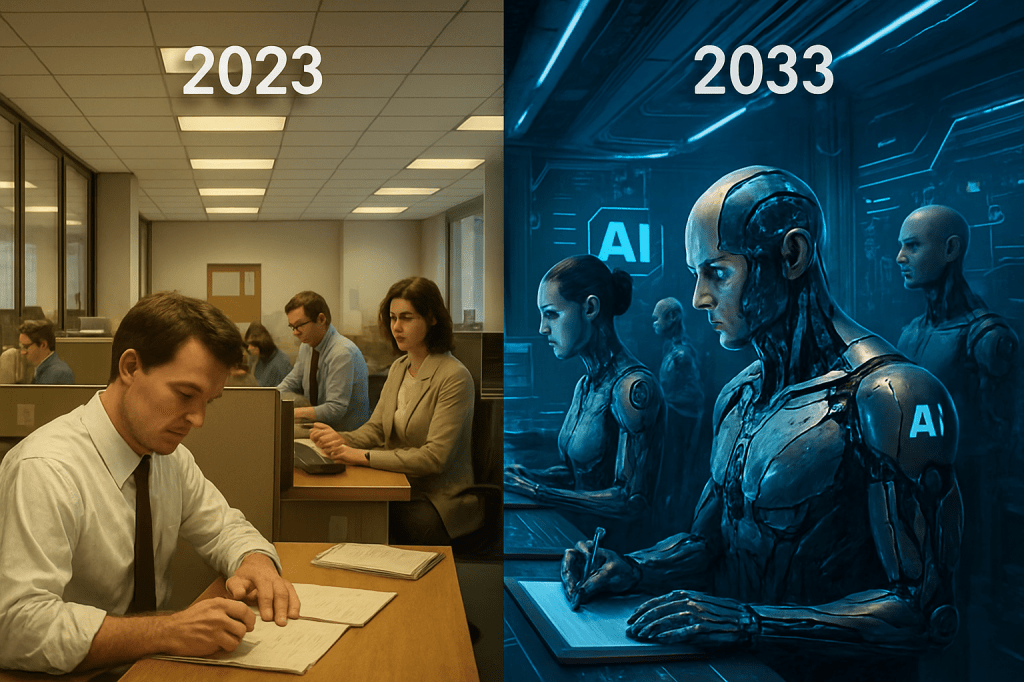
The Bureau of Labor Statistics, a body typically associated with historical data and dispassionate economic indicators, just dropped a future shock. Their July 13, 2025 report isn’t a speculative white paper from a tech giant; it’s a cold, hard projection from the very institution tasked with charting our national workforce. This official forecast, covering the 2023–2033 period, offers the clearest government-backed glimpse yet into how AI is actively reshaping the job market.
It’s one thing for industry pundits to forecast disruption; it’s another entirely when the data keepers of the US economy publish precise numbers on which jobs are set for growth and which face imminent contraction, explicitly citing AI as the catalyst. This report moves the conversation from abstract “future of work” discussions to concrete, quantifiable shifts.
The Architects and the Navigators: Where Growth Is Projected
Unsurprisingly, the BLS identifies significant expansion in roles directly involved with building, maintaining, or strategically leveraging AI. These aren’t just jobs that tolerate AI; they are jobs that are either creating it or becoming indispensable in an AI-saturated world.
- Software Developers: A robust 17.9% increase, translating to over 300,000 new positions. These are the engineers crafting the very algorithms and systems that are automating other roles. Their role shifts from general programming to specialized AI development and integration.
- Computer Occupations (Broadly): An 11.7% surge, adding nearly 600,000 jobs. This category likely encompasses AI engineers, data scientists, cybersecurity specialists (crucial in an AI-driven landscape), and IT professionals who manage complex AI infrastructures.
- Personal Financial Advisors: A notable 17.1% jump. While AI can process vast amounts of financial data, the human element of trust, complex scenario planning, and emotional intelligence in advising individuals remains highly valued. These advisors will increasingly use AI tools to augment their capabilities, rather than be replaced by them.
The pattern here is clear: jobs that either build the AI, manage its underlying infrastructure, or provide complex, nuanced human-centric services leveraging AI are slated for growth. This is augmentation and creation, not mere task execution.
The Algorithmic Crosshairs: Occupations Facing Decline
The BLS report is stark in its identification of roles where current generative AI capabilities are already proving disruptive. These are positions characterized by repetitive data analysis, pattern recognition, and rule-based decision-making – tasks where AI offers efficiency gains that directly impact human employment.
- Credit Analysts: A 3.9% decline, losing 2,800 jobs. AI’s ability to rapidly assess creditworthiness based on vast datasets and complex algorithms makes human oversight in routine cases less necessary.
- Claims Adjusters, Examiners, and Investigators: A 4.4% reduction, shedding over 15,000 positions. AI can automate initial claim processing, fraud detection, and even some aspects of damage assessment, streamlining what were once labor-intensive processes.
- Insurance Appraisers (Auto Damage): The sharpest decline at 9.2%, losing 1,000 jobs. Computer vision and AI-driven assessment tools can quickly and accurately evaluate vehicle damage from images or scans, reducing the need for human appraisers.
The common thread across these declining roles is their susceptibility to replication by generative AI “in its current form.” This isn’t about AI reaching some distant superintelligence; it’s about the practical application of today’s AI tools to automate core functions that were previously human domains.
The Unspoken Uncertainty and What It Means
While the BLS provides numbers, their report subtly hints at a deeper truth: these projections are inherently dynamic. They underscore that “employment trajectories for these occupations remain uncertain as AI continues to evolve.” This isn’t just a disclaimer; it’s the core of the AI disruption narrative. The “growth” jobs of today could become the “decline” jobs of tomorrow as AI capabilities advance.
For those of us already immersed in the reality of AI’s impact, this BLS report serves as a formal validation of what we’ve observed anecdotally. It’s a call to move beyond simply “adapting” and toward a proactive reimagining of skills and career paths. The era of stable, predictable career ladders is officially over, replaced by a landscape where continuous reinvention isn’t a competitive advantage, but a basic requirement for survival.
The question is no longer if AI will change your job, but how rapidly, and whether you’re building the skills to be an architect of the new economy, a navigator within it, or if your core tasks are already in the algorithmic crosshairs.
