
AI Impact on the Job Market – News (July 11, 2025 to July 18, 2025)
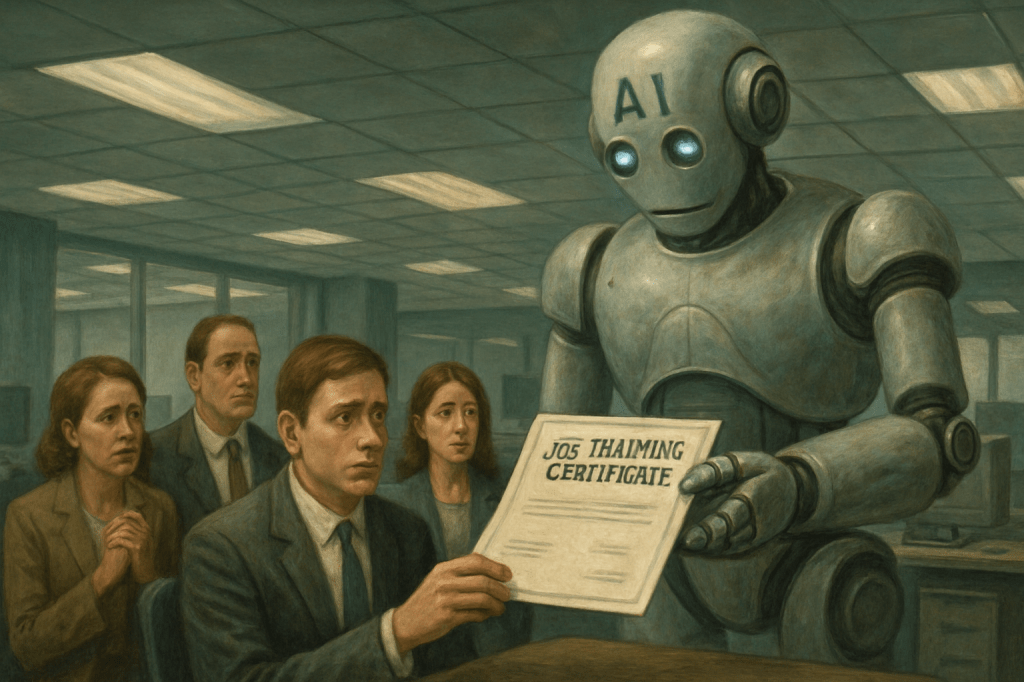
Ever notice how the same tech companies that are automating jobs are suddenly offering AI training programs? It’s like a pyromaniac selling fire extinguishers – a fascinating, if unsettling, paradox that perfectly encapsulates this week’s AI-job market news.
The Layoff Landscape: AI’s Cutting Edge
This week, the reality of AI-driven job displacement hit hard, moving beyond speculation into concrete corporate action. Recruit Holdings, parent company of Glassdoor and Indeed, is slashing 1,300 jobs, a hefty 6% of its HR Technology workforce. The reason? CEO Hisayuki “Deko” Idekoba put it bluntly: “AI is changing the world, and we must adapt.” This echoes similar moves from tech giants like Microsoft (over 15,000 layoffs this year, with $80 billion earmarked for AI in 2025) and Intel (shedding over 5,000 roles). Even Scale AI, a *data annotation* company (yes, even AI needs to be trained!), is cutting 14% of its staff. What’s the throughline? A strategic pivot, often ruthless, towards AI-powered efficiency.
Why is this important?
These aren’t just isolated incidents. They represent a fundamental shift in how companies are structuring themselves for the future. The “leaner, faster, more efficient” mantra is being weaponized by AI, and human workers are, unfortunately, often the casualty. This is happening *now*, not in some distant sci-fi future. It’s also important to note that these cuts are happening across various sectors and even within the AI industry itself, indicating that even AI-adjacent roles are not immune.
Executive Alarms: The Future is… Less People?
Top executives are increasingly vocal about AI’s transformative (and potentially disruptive) impact. Amazon CEO Andy Jassy anticipates needing fewer people as AI agents roll out. Ford CEO Jim Farley went further, declaring that AI will “literally replace half of all white-collar workers in the U.S.” These aren’t just off-the-cuff remarks; they’re strategic assessments from leaders grappling with the realities of AI adoption. Futurists like Vinod Khosla predict AI will automate 80% of jobs by 2030, while Anthropic CEO Dario Amodei (a voice we’ll hear more from shortly) warns that AI could eliminate up to half of all entry-level white-collar jobs within 1-5 years. The “disappearance of entry-level jobs” is becoming a very real concern.
What does this *really* mean?
The stark warnings from CEOs and futurists highlight a growing unease about the potential for widespread job displacement. The fact that these sentiments are coming from the top suggests that companies are actively planning for a future with a significantly smaller human workforce. It also signals a potential crisis for recent graduates and those entering the workforce, as traditional entry-level roles disappear. This could widen existing inequalities and create a two-tiered job market: those who can leverage AI and those who are replaced by it.
Government Gets Gutted: AI Comes for Public Service
For years, the narrative focused on the private sector. But this week brought a jarring update: the U.S. federal government is also feeling the AI pinch. The Department of State initiated termination proceedings for over 1,300 civil and foreign service employees. This isn’t an isolated case. The Department of Veterans Affairs (VA) dismissed over 1,000 probationary employees, including critical researchers. The Department of Health and Human Services (HHS) terminated approximately 5,200 probationary employees. Even the IRS is reducing its workforce by 6,000-7,000 employees. This is a coordinated push to integrate AI at the expense of human roles.
Why is this important?
The federal sector, once seen as a bastion of job security, is now a frontline in the AI disruption. This raises concerns about the loss of institutional knowledge, the potential for errors in critical services, and the erosion of public trust. The speed of these layoffs outpaces the development of policies to manage the transition for affected workers or understand the long-term societal implications. The question of accountability becomes paramount when AI makes critical errors in areas like veteran care, public health, and tax enforcement.
The Great Divide: Skill Up or Fall Behind
Amidst the anxiety, there’s a glimmer of hope: the demand for AI-skilled professionals is surging. A report from Naukri, an Indian employment website, found a 38% year-on-year growth in AI and machine learning job postings, significantly outpacing the 8% growth in non-AI tech jobs. These roles command a 53% higher median salary. Similarly, Magnit reported that AI/Automation role fills have doubled year-on-year. Federal Reserve Governor Lisa D. Cook commented that AI is “poised to reshape our labor market,” making some jobs obsolete while enhancing productivity and changing the tasks associated with many roles.
What does this *really* mean?
The job market is diverging between those who can leverage AI and those whose roles are susceptible to automation. While AI is causing layoffs and anxiety, it’s also creating a demand for new skills and roles. This reinforces the need for continuous learning and adaptation. However, it also raises concerns about access to training and opportunities, potentially exacerbating existing inequalities. The wage premium for AI skills suggests that those who acquire these skills will be in high demand, while those who don’t may face limited opportunities and lower wages.
The Altman-Huang Debate: Two Visions of the Future
This week also saw a clash of visions between two AI titans: Anthropic CEO Dario Amodei and Nvidia CEO Jensen Huang. Amodei warns that AI could displace up to half of all entry-level white-collar jobs within five years, potentially leading to a 20% unemployment rate. Huang, on the other hand, believes AI will create “better” jobs, drawing parallels to past technological shifts. He advises workers to adapt and leverage AI as a tool for augmentation. The core tension is speed versus adaptation: Amodei sees a tidal wave, while Huang sees a rising tide if you can learn to sail.
Why is this important?
The debate between Amodei and Huang highlights the uncertainty surrounding AI’s impact on employment. Their diverging predictions underscore the need for proactive measures to mitigate potential job displacement and ensure that workers have the skills to adapt to the changing job market. Amodei’s warning about a potential 20% unemployment rate is a stark reminder of the potential for widespread social and economic disruption, while Huang’s optimism suggests that AI could ultimately create new opportunities and improve the quality of work.
Google’s “Rescue”: Training the Disrupted
In a fascinating twist, Google announced “AI Works for America,” a nationwide initiative to offer free and low-cost AI certification. This comes as Virginia Governor Glenn Youngkin highlights increased unemployment, including layoffs of federal workers. The irony? Google, a major driver of AI disruption, is now offering the “antidote” in the form of training. This underscores the emerging dynamic where the disruptor becomes the de facto educator for the disrupted. But can these programs truly keep pace with AI’s rapid evolution? Are we training for a moving target, and who bears the cost of continuous adaptation?
What does this *really* mean?
Google’s training programs are an implicit admission of AI’s profound societal shifts. However, they also raise questions about the effectiveness of these programs in addressing the root causes of job displacement. The rapid obsolescence cycle of AI tools makes long-term skill acquisition precarious. Moreover, the focus on using existing AI tools risks training for the past, not the future. While these initiatives are framed as solutions, they also establish a new market for AI education and certification, potentially creating a self-perpetuating cycle of disruption and training.
Microsoft’s Bottom Line: AI = Savings (and Layoffs?)
Microsoft announced approximately $500 million in savings due to AI integration in its call center operations. This coincided with over 15,300 layoffs. AI now writes 30% of Microsoft’s code. While not directly correlated, the timing is compelling. This is a tangible manifestation of how AI’s efficiencies are translating into altered employment landscapes. While Bill Gates remains optimistic, other executives acknowledge the potential for substantial white-collar job reductions.
Why is this important?
Microsoft’s experience demonstrates how rapidly AI’s promised efficiencies are translating into altered employment landscapes. The combination of AI-driven savings and workforce reductions challenges the assumption that human roles are inherently indispensable. It also underscores the need for companies to be transparent about the impact of AI on their workforce and to invest in programs to support displaced workers.
The Political Reckoning: AI and Social Stability
Finally, the Financial Times published a piece titled “Politics faces its own AI reckoning,” highlighting the potential for AI-driven job displacement to erode the middle class, destabilize democratic institutions, and fuel populism. The article warns that if current economic “winners” become “losers” due to AI, the political consequences could be severe. The urgent need for effective policy is not just about protecting jobs; it’s about safeguarding the very foundations of our social and political order.
What does this *really* mean?
The FT’s analysis serves as a critical warning that ignoring the social fallout of AI’s economic benefits is an invitation to widespread political upheaval. The stability of our societies hinges on the ability of our political systems to adapt to profound economic shifts. The “AI reckoning” for politics has begun, and the stakes could not be higher. Governments need to proactively address the potential for job displacement and ensure that the benefits of AI are shared more equitably.
So, what’s the takeaway? AI is here, it’s changing the game, and it’s impacting jobs across sectors and skill levels. The key is to stay informed, adapt quickly, and advocate for policies that support workers in this rapidly evolving landscape. Because, let’s face it, we’re all living in constant beta mode now.
