
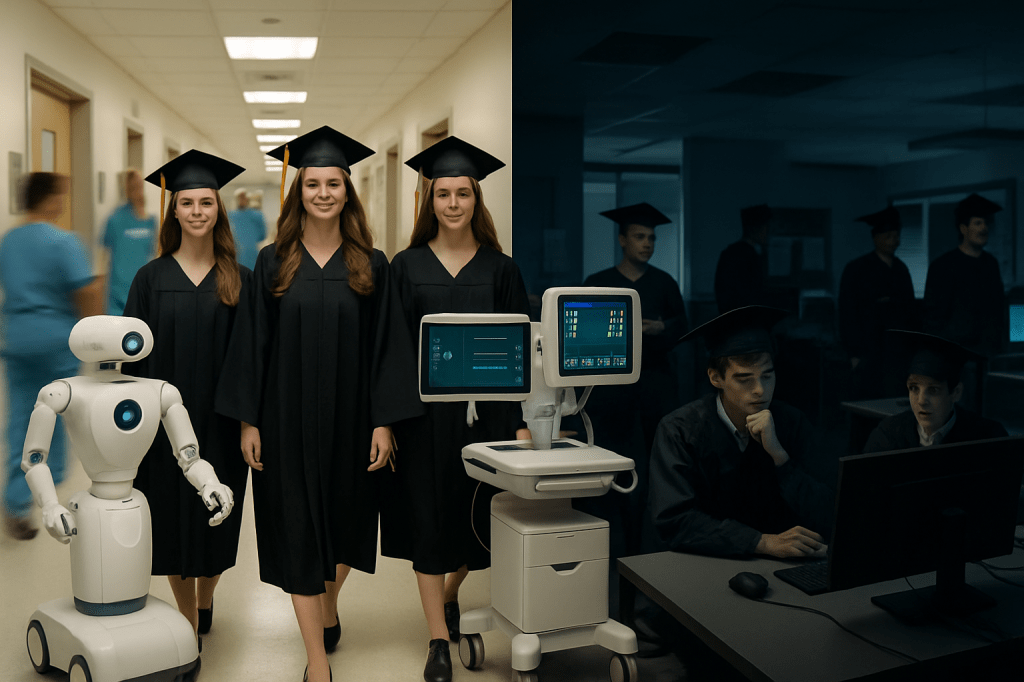
A curious reversal is unfolding in the U.S. graduate job market, one that challenges common assumptions about who is most vulnerable to economic shifts and technological disruption. For generations, a college degree offered a distinct shield against joblessness, particularly for young men entering the workforce. That shield, it appears, is now dissolving.
The Unseen Shift in Graduate Employment
New analysis reveals a significant and unexpected surge in unemployment among young male graduates. Over the past year, their joblessness rate jumped from under 5% to 7%. This isn’t just a statistical blip; it has effectively erased the long-held employment advantage college-educated men traditionally enjoyed, bringing their unemployment rate squarely in line with their non-graduate peers.
In stark contrast, young female graduates have largely maintained their employment stability, with their jobless rate remaining flat or even slightly declining over the same period. This divergence paints a picture far more nuanced than the broad strokes often used to describe AI’s impact on employment.
Deconstructing the AI Narrative (and its Limits)
The immediate reflex is often to attribute any market disruption to AI, especially given its profound influence on tech and knowledge work. However, this particular trend confounds a simplistic AI-centric explanation:
- While AI’s influence on specific tech roles is undeniable, recent hiring data shows a rebound in coding and development positions. This suggests that AI, at least in its current iteration, isn’t unilaterally decimating the very tech roles often associated with male graduates.
- The growth in demand for skills directly augmented or created by AI might be absorbing some of what was once considered “AI-vulnerable” work.
So, if AI isn’t the sole culprit, what else is at play in this unexpected rebalancing of graduate prospects?
Healthcare: An Unsung Economic Anchor
The data points towards a sector traditionally considered resilient to automation and economic downturns: healthcare. This field has emerged as a crucial employment engine for young female graduates.
- Of the 135,000 new jobs secured by young female graduates, nearly 50,000 were in healthcare. This isn’t a marginal gain; it represents a substantial and concentrated absorption of talent.
- Male graduates, conversely, saw only modest gains, dispersed across various sectors, without a single dominant growth area to match healthcare’s surge.
This highlights a critical point: while we often focus on AI’s disruptive potential, the underlying shifts in economic demand and sector growth can be equally, if not more, impactful in the short term. The enduring human need for care services creates a buffer that AI, for now, struggles to penetrate.
Beyond Gender: Anticipating the Next Wave of Disruption
While the current trends present a gender-specific disparity, the deeper implication for those of us tracking AI’s march is far broader. This isn’t merely a “men vs. women” story; it’s a canary in the coal mine for the evolving nature of graduate employment itself.
Policymakers and individuals alike must look beyond the immediate gender lens and recognize these dynamics as indicators of a fundamental re-architecture of the graduate job market. The roles that once guaranteed stability are shifting, and the skills valued are changing.
Furthermore, the current resilience of certain roles doesn’t guarantee future immunity. The report wisely cautions that future AI advancements could very well shift employment risks, particularly towards junior white-collar roles—positions where women are currently prevalent. The AI disruption isn’t static; it’s a moving target, constantly redefining what constitutes a “safe” career path. Understanding these early tremors is crucial for navigating the seismic shifts yet to come.
