
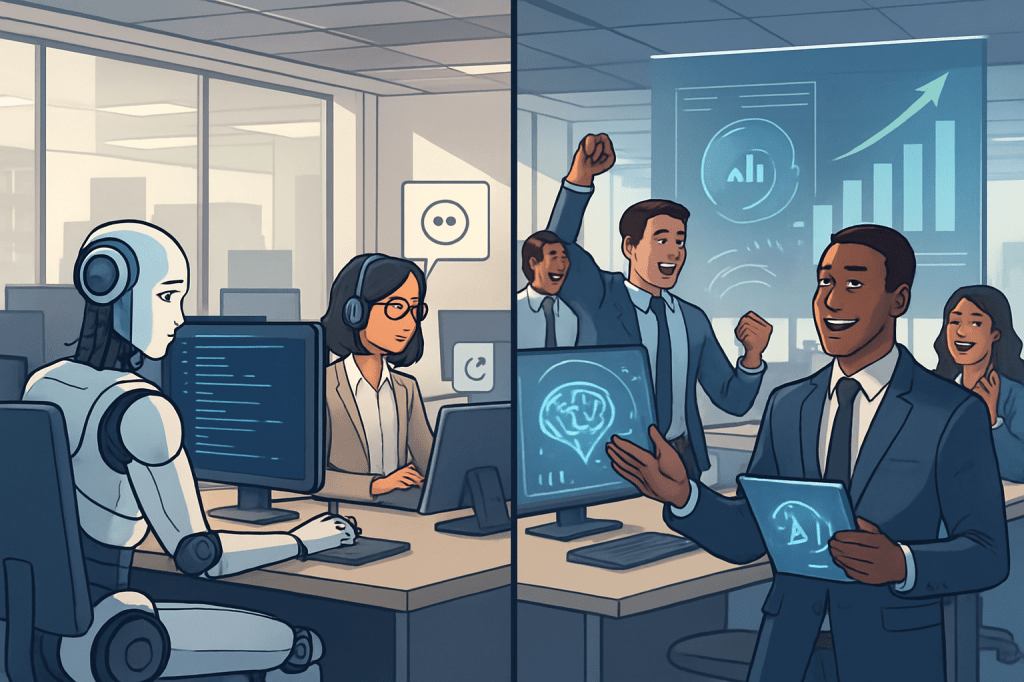
The persistent narrative of AI as an inevitable job destroyer took a surprising turn recently, with a prominent tech leader offering a counter-perspective rooted in real-world corporate experience. At the AI for Good Global Summit on July 19, 2025, Salesforce CEO Marc Benioff shared a vision where artificial intelligence augments, rather than eliminates, the human workforce.
Salesforce’s Lived AI Experience: A Different Blueprint?
Benioff’s stance directly challenges the prevailing anxieties, asserting that within Salesforce, AI has been a force for enhancement, not redundancy. He pointed to Agentforce, their AI tool, which has facilitated over a million interactions, significantly boosting productivity without leading to a single layoff. This isn’t just a philosophical position; it’s presented as an operational reality for a major enterprise grappling with AI integration.
The Nuance of Workforce Rebalancing
While Benioff confidently stated that AI hasn’t triggered layoffs, the fine print of Salesforce’s strategy reveals a more complex picture of workforce evolution. The company has indeed paused hiring for certain roles, specifically software engineers and customer service staff, as AI technologies are integrated to handle tasks traditionally performed by these segments. This isn’t job loss, but it represents a significant recalibration of where human capital is most critically needed.
Conversely, Salesforce is actively accelerating hiring in its sales division. This isn’t merely a pivot; it’s a direct response to the burgeoning market demand for AI solutions. The very technology that prompts a hiring pause in one area simultaneously fuels a hiring surge in another, creating a fascinating dynamic where AI becomes both a task absorber and a market driver.
Beyond the Hype: Deeper Implications
Benioff’s insights from the AI for Good Global Summit offer several critical takeaways for those tracking AI’s impact on employment:
- The “Pause” as Strategic Recalibration: A hiring freeze isn’t a layoff, but it signifies a corporate strategy to optimize existing human resources with AI tools. It suggests companies are not just cutting costs, but rethinking the fundamental composition of teams.
- AI as a Demand Generator: The most significant revelation might be that AI isn’t just an internal efficiency tool; it’s a product creating new economic activity. The ramp-up in sales hiring demonstrates that the AI economy generates its own adjacent job categories, often in less obvious sectors.
- Shifting Skill Value: The roles impacted by a hiring pause (engineering, customer service) are often considered core. This indicates that even highly skilled technical and service roles are undergoing a redefinition, requiring workers to adapt their value proposition in an AI-augmented environment.
- The Augmentation-Replacement Spectrum: Benioff’s experience reinforces that AI’s impact isn’t binary. It exists on a spectrum from full replacement of tasks to profound augmentation of human capabilities. Salesforce appears to be leaning heavily into the latter, but the rebalancing act is undeniable.
This perspective from a CEO at the helm of a major tech enterprise offers a concrete, albeit singular, counter-narrative to the widespread predictions of AI-driven unemployment. It suggests that the future of work might be less about humans being replaced, and more about a continuous, dynamic re-sculpting of organizational structures and the emergence of entirely new demands for human expertise, particularly in the realm of selling and implementing the AI itself.
