
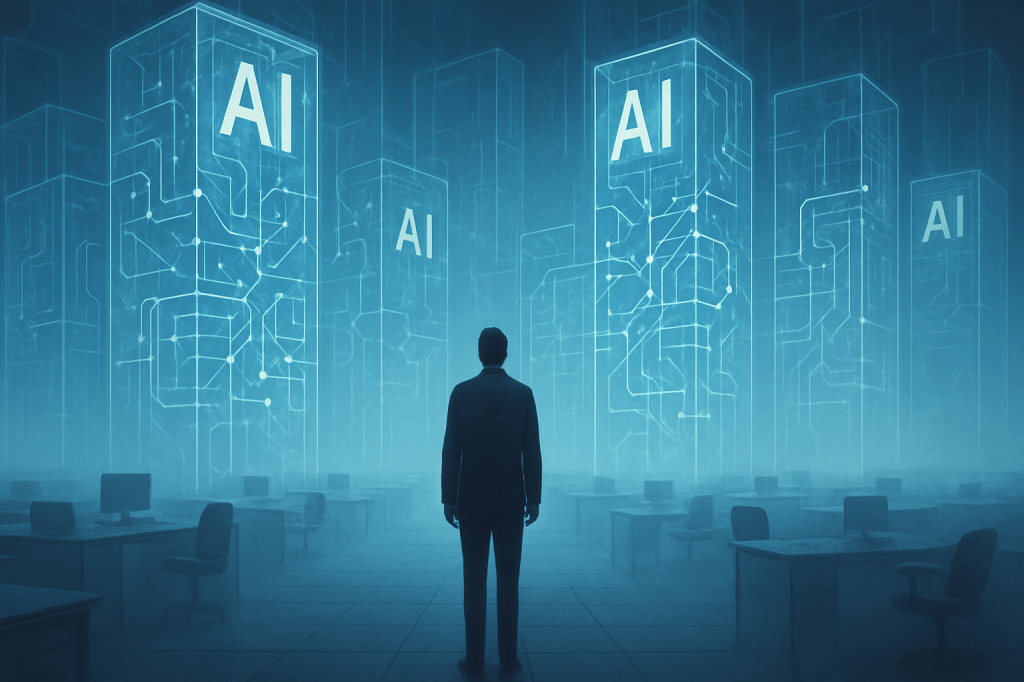
The latest Financial Times analysis cuts straight to the core of our evolving employment reality. It’s no longer a question of if AI will reshape jobs, but rather the speed and nature of its ongoing redefinition of the entire workforce. Yesterday’s report, aptly titled “The AI job cuts are accelerating,” isn’t just another layoff notice; it’s a stark indicator of a foundational shift in how companies perceive human capital.
The New Calculus of Lean
What makes this acceleration particularly salient is its disconnect from traditional economic indicators. We’re not talking about struggling companies shedding dead weight. Firms like Microsoft, Intel, and BT, all reporting substantial profits, are nevertheless announcing layoffs impacting thousands. This isn’t merely about enhancing efficiency by automating repetitive tasks; it signifies a deliberate, strategic pivot towards operational models that require significantly fewer human workers, full stop.
- Microsoft: Profitable, yet reducing headcount.
- Intel: Despite market position, streamlining via AI integration.
- BT: A legacy giant embracing AI for a leaner future.
The narrative being promoted is one of progress through automation, yet the immediate consequence is the rapid dismantling of traditional job structures. This trend disproportionately impacts junior and entry-level positions, effectively eroding the very rungs of the career ladder that have historically supported professional development and upward mobility.
The One-Person Company Dream
The philosophical underpinning of this shift is perhaps best encapsulated by new metrics of success. Startups and tech companies are now proudly measuring their prowess through revenue per employee, with some boasting multimillion-dollar returns from incredibly minimal staff complements. OpenAI’s CEO, Sam Altman, isn’t just musing about large language models; he’s envisioning the rise of billion-dollar “one-person” companies, a concept that redefines scaling from a team-building exercise to an algorithm-optimization challenge.
Collateral Damage and Systemic Cracks
The implications of this accelerated job erosion extend far beyond individual unemployment figures. When junior roles vanish, the entire professional development pipeline gets choked. How do new graduates gain experience? How do skills transfer across generations? These reductions raise serious, systemic concerns:
- Professional Development Pipelines: The traditional apprenticeship model is undermined, leaving a void for skill acquisition and mentorship.
- The Role of University Education: If entry-level roles requiring specific degrees are disappearing, what is the evolving value proposition of higher education?
- Socio-Economic Stability: A shrinking pool of accessible jobs, particularly for new entrants, threatens broader socio-economic stability and increases wealth disparity.
The Human Equation Reconsidered
Amidst the drive for hyper-efficiency, a critical counter-narrative is emerging. Critics argue that this “lean” model risks overlooking vital human elements that are difficult, if not impossible, for AI to replicate or substitute effectively. These include:
- Creativity: True innovation and divergent thinking often arise from human collaboration and intuition.
- Complex Decision-Making: Navigating nuanced ethical dilemmas or unforeseen crises still heavily relies on human judgment.
- Emotional Intelligence: Customer service, team leadership, and client relations demand empathy and understanding that AI currently lacks.
Indeed, there are early indications that over-reliance on AI can backfire. The example of Klarna, which initially leaned heavily on AI for customer service, reportedly faced negative impacts and has since begun to reconsider its strategy, highlighting the potential for AI-driven models to alienate the very customers they aim to serve. This suggests that while AI excels at optimization, a complete divestment from human interaction may carry unforeseen costs.
The accelerating AI job cuts are more than just numbers on a balance sheet. They are a tangible manifestation of AI’s power to not only reshape work but to fundamentally challenge the foundational structures and culture of employment as we’ve known it. The question is no longer about adaptation, but about a radical re-imagining of the human role in the economic landscape.
