
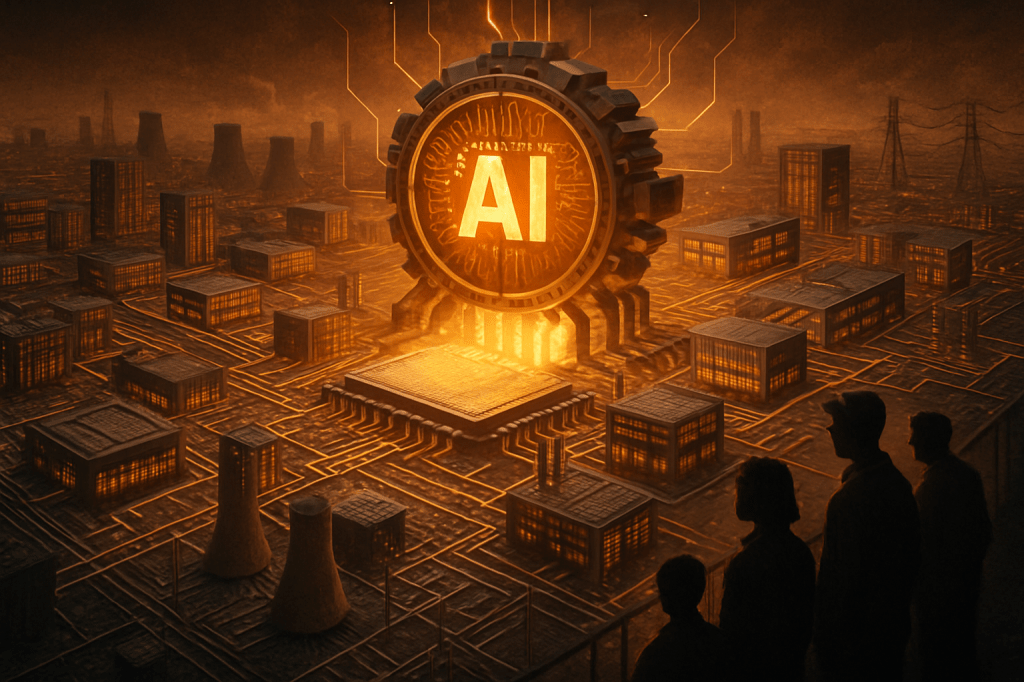
While the daily headlines often dissect AI’s surgical precision in automating specific tasks or its creeping influence on creative professions, a recent Axios report shifts the lens dramatically. On August 4, 2025, Axios dropped a piece titled “The AI super-stimulant,” presenting a macro-economic view that demands our attention, even as we grapple with the micro-realities of our own disrupted careers.
This isn’t about AI subtly optimizing a spreadsheet or writing a passable first draft. This is about AI as a colossal economic engine, injecting unprecedented capital into the U.S. economy. Axios characterizes it as a “super-stimulant,” and the numbers back up the intensity. We’re talking about a flood of investment directed squarely at the foundational pillars of AI: advanced semiconductor manufacturing, the relentless expansion of data centers, and the energy infrastructure required to power this computational beast.
The Capital Deluge and Its Beneficiaries
Giants like Nvidia, Microsoft, and Alphabet aren’t just dabbling; they are channeling truly staggering resources into AI development and deployment. This isn’t just R&D; it’s tangible, physical infrastructure being built out at a pace that frankly, few predicted even a year ago. It’s the kind of investment boom that, according to Axios, is providing a significant, perhaps even singular, boost to an otherwise shaky U.S. economy. The parallels drawn to past industrial revolutions—from steam power to the internet—are compelling, suggesting a fundamental reshaping of our economic landscape is already well underway.
Consider the implications:
- Infrastructure Transformation: Entire new industries, or vastly scaled-up versions of existing ones, are emerging to support AI’s appetite for processing power and data. This means construction, energy production, specialized manufacturing, and logistical networks are seeing a gold rush.
- Concentrated Wealth: The primary beneficiaries are, unsurprisingly, the technology behemoths and their shareholders. This surge of capital is consolidating power and wealth at an alarming rate at the very top of the economic pyramid.
- A Counter-Cyclical Force: In a period where many traditional economic indicators might be faltering, AI-driven investment acts as a powerful, almost independent, growth driver. It’s a new kind of economic resilience, but one with a deeply asymmetric distribution of benefits.
The Uneasy Undercurrent: Who Gets Left Behind?
Here’s where the “super-stimulant” starts to feel more like a potent, perhaps even dangerous, cocktail for the average worker. While capital flows freely and corporate profits soar, the Axios piece doesn’t shy away from the critical questions:
- Sustainability of Growth: Is this investment boom sustainable, or are we witnessing the early stages of a speculative bubble, fueled by hype as much as genuine productivity gains? The sheer energy demands alone raise long-term questions.
- Equitable Distribution: This is the core of our concern on “AI Replaced Me.” If AI is driving such immense economic growth, how much of that wealth is trickling down to the workforce, especially those displaced by the very technologies fueling the boom? The report explicitly flags job displacement and increased economic inequality as mounting concerns.
- The Human Labor Question: As infrastructure expands and automation deepens, what is the evolving role of human labor? The report underscores the urgent need for a “balanced approach,” emphasizing policies and strategies that genuinely enable the workforce to adapt and, crucially, to benefit from these rapid advancements.
Beyond Adaptation: Reassessing Value
The call for policies that help the workforce adapt is familiar, but the scale of this “super-stimulant” suggests we need to think beyond mere retraining programs. This is a fundamental reassessment of how economic gains are shared and, more profoundly, what constitutes valuable human contribution in a world where AI handles an ever-larger share of cognitive and physical tasks. The economic engine is roaring, but for many, it sounds less like a promise and more like an approaching storm.
