
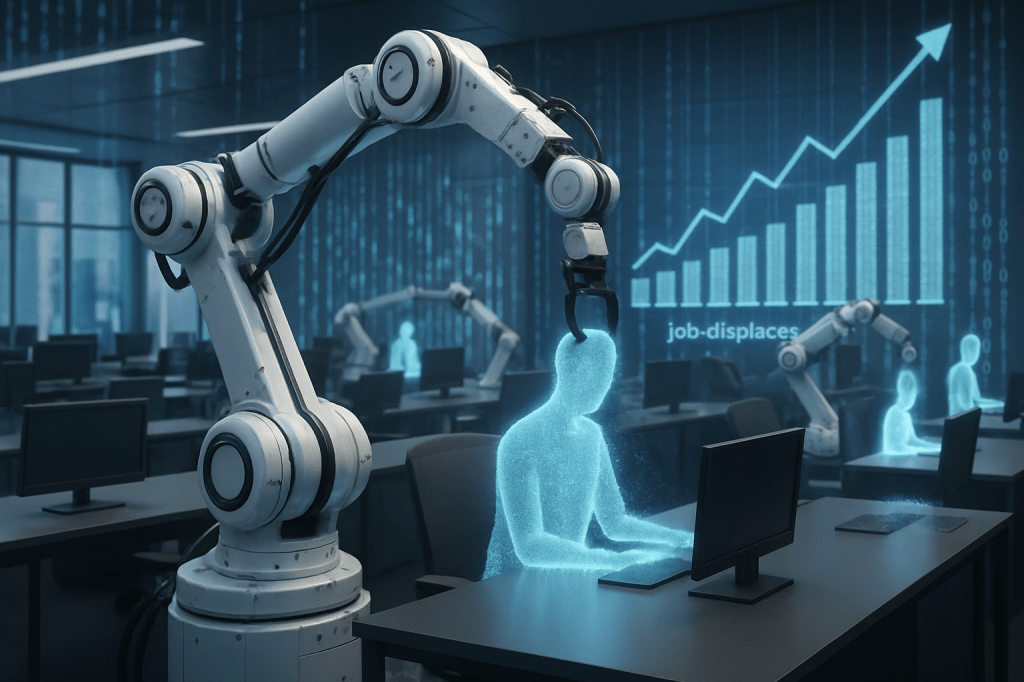
For those tracking the accelerating influence of artificial intelligence on the labor market, a recent report from Challenger, Gray & Christmas provides a stark, quantifiable milestone. In the first seven months of 2025 alone, over 10,000 job cuts were directly attributed to the adoption of generative AI technologies by private employers.
This isn’t merely another data point in the ongoing narrative of technological evolution. This figure places AI firmly among the top five factors contributing to job losses this year. It’s a significant elevation from its previous, often indirect, role in workforce adjustments.
The Numbers Tell a Direct Story
- 10,000+ Jobs Lost: Specifically due to generative AI adoption in the first seven months of 2025.
- Top 5 Factor: AI now ranks alongside other major economic forces in driving job displacement.
- Tech Sector Hit Hardest: The industry building these tools announced over 89,000 job cuts, a 36% increase year-over-year, indicating a leading edge of AI-driven restructuring.
- Cumulative Impact: Since 2023, more than 27,000 jobs have been directly tied to AI advancements.
What makes these statistics particularly resonant is the explicit attribution. For years, we’ve discussed automation and efficiency gains leading to “restructuring.” Now, the direct causality is being measured and reported. This isn’t abstract; it’s a specific technology, generative AI, performing tasks previously done by humans, leading to their direct displacement.
Beyond the Headlines: Deeper Implications
The Irony of Innovation
Perhaps the most striking detail is the tech sector itself bearing the brunt of these early cuts. The very companies developing and deploying these powerful AI models are simultaneously leveraging them to optimize their own workforces. This isn’t just a bellwether for other industries; it’s a stark preview of how quickly internal efficiencies can translate into external job reductions, even within the most innovative sectors.
From Augmentation to Replacement
The prevailing narrative around AI often emphasizes augmentation – tools that make humans more productive. While that remains true for many roles, these numbers underscore a parallel, accelerating trend: direct replacement. Tasks that were once complex, requiring human judgment or creativity, are now being handled by algorithms. This shift demands a re-evaluation of what constitutes “AI-proof” work, moving beyond the simplistic notion of physical labor versus knowledge work.
The Pace of Disruption
The speed at which AI has moved from theoretical threat to a top-tier cause of job loss is remarkable. It highlights a critical challenge: the pace of technological advancement is outstripping the pace of workforce adaptation. Reskilling initiatives, while vital, often operate on a slower timeline than the rapid deployment cycles of new AI capabilities. This growing gap will inevitably lead to further friction in the labor market.
What Now?
These figures from Challenger, Gray & Christmas are not just a warning; they are a current reality. They signal a deepening phase of AI’s impact, where the effects are not just felt but explicitly measured and attributed. For individuals and organizations, the imperative to understand, adapt, and proactively plan for this evolving landscape has never been more urgent. The question is no longer “if” AI will disrupt, but “how many, how fast, and what are we doing about it right now?”
