
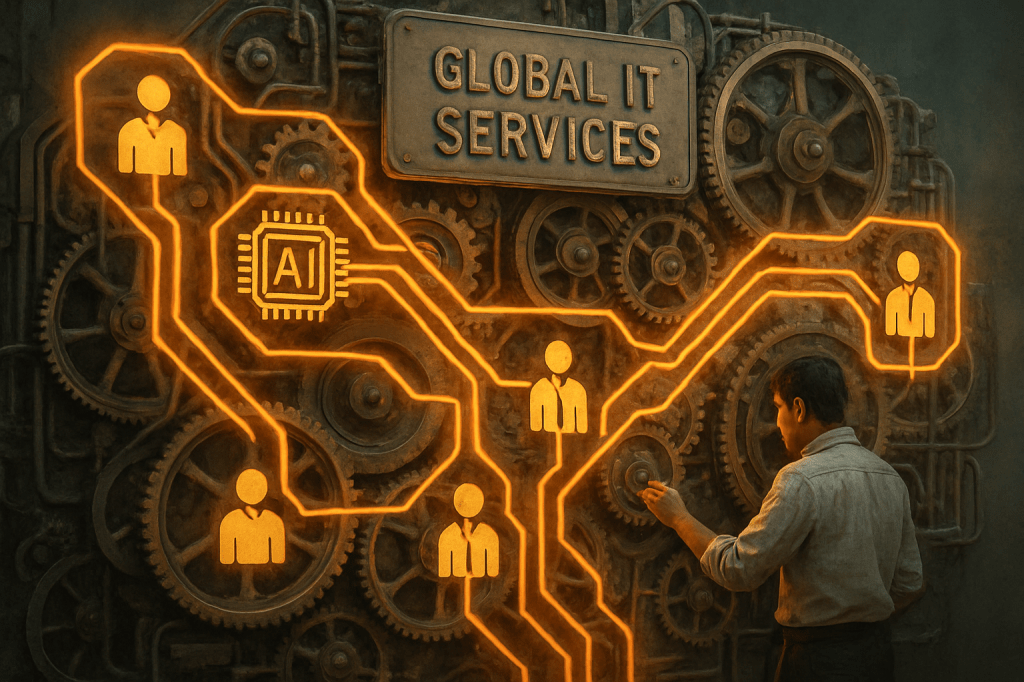
The engine room of global IT services is undergoing a profound re-engineering. A recent Financial Times report detailed the escalating challenges confronting India’s massive IT sector, directly attributable to AI’s deepening integration. This isn’t merely about incremental efficiency gains; it signals a fundamental restructuring of an industry built on scale and human capital.
India’s IT services industry, a colossal contributor to its national GDP and a global outsourcing powerhouse, is now grappling with the very technology it helps deploy for others. The report highlights that AI is systematically automating tasks traditionally handled by a vast human workforce, particularly in back-end service roles. This erosion of traditional demand forces a reckoning for firms that have long relied on a labor arbitrage model.
The Shifting Sands of Service
For decades, the global IT services landscape was defined by the ability to deliver complex, often repetitive, tasks at competitive costs. India mastered this model. Now, the competitive edge is shifting from human-driven scale to algorithmic precision. AI’s capacity to execute these tasks with greater speed, accuracy, and often lower long-term cost, fundamentally alters the value proposition.
- Automation of routine processes, reducing the need for large human teams.
- Pressure on traditional service contracts and pricing models.
- A forced re-evaluation of the core competencies required for future IT services.
The Foundational Gap
Compounding the challenge is a critical strategic vulnerability: India’s relative lag in developing foundational AI technologies. While Indian firms excel at implementing and integrating AI solutions for clients, the report suggests a deficit in originating the core algorithms, models, and research that drive the leading edge of AI development. This isn’t just an academic point; it has profound implications for global competitiveness.
A nation that primarily consumes and deploys AI, rather than innovates at its core, risks becoming a follower in the global tech race. This limits its ability to shape the future of the industry, create proprietary advantages, and maintain a leading position as AI continues its rapid evolution.
Beyond Reskilling: A New Industry Blueprint
Top Indian IT firms are not standing still. Their response involves significant efforts:
- Aggressive Reskilling: Investing heavily in training their existing workforce for higher-value, AI-centric roles, moving away from commoditized services.
- AI Solution Investment: Pouring capital into developing and integrating AI tools and platforms into their own operations and client offerings.
- Client Re-education: Engaging with clients to recalibrate expectations, emphasizing the long-term strategic benefits and cost efficiencies of AI adoption over traditional service models.
However, these initiatives, while crucial, represent more than just an operational pivot. They signify the urgent need to redefine what an IT service company means in an AI-dominated future. It’s no longer just about optimizing existing processes; it’s about pioneering new ones.
The Global Echo
India’s predicament serves as a potent microcosm for any economy or industry heavily reliant on outsourced, human-intensive services. The forces at play here are not unique to one geography; they are a clear signal of AI’s pervasive reshaping of the global labor market. The question for every business and every worker isn’t merely “Will AI take my job?” but “How will AI fundamentally alter the economic bedrock upon which my industry, or even my nation, has thrived?” The answers emerging from India offer a stark, early glimpse.
