
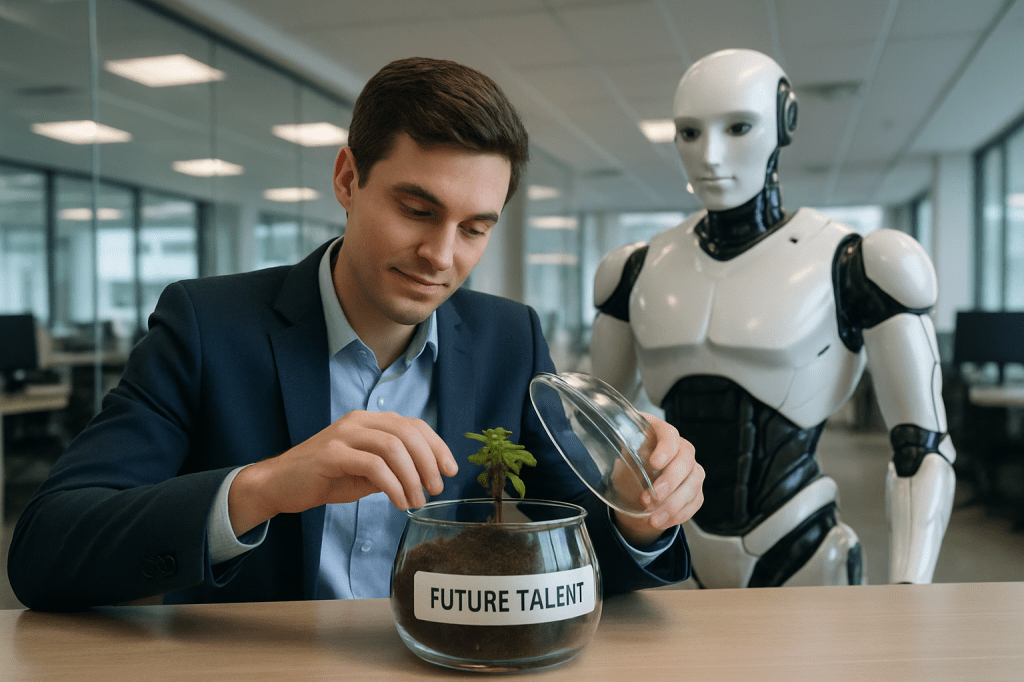
When a leader at the forefront of the AI revolution declares a specific application of the technology “the dumbest thing I’ve ever heard,” it’s worth dissecting. This isn’t just another opinion piece from a pundit; it’s a direct, almost visceral, rejection of a prevalent AI strategy from someone whose company directly profits from AI adoption.
The Unexpected Rebuke from AWS
The statement came from Matt Garman, CEO of Amazon Web Services (AWS), on August 21, 2025. His target? The idea of replacing entry-level staff with artificial intelligence. Garman didn’t mince words, calling the notion utterly misguided. His reasoning was layered, cutting through the usual efficiency-driven narratives that often dominate discussions around AI deployment.
Why It’s “Dumb”: Beyond Immediate Cost Savings
Garman’s critique hinges on several crucial points, which collectively paint a picture of strategic oversight rather than mere technological limitation:
- Cost-Effectiveness Redefined: Junior employees, Garman argued, are inherently cost-effective. This challenges the simplistic view that AI will always be cheaper. The implied cost calculation here extends beyond salary to include the value of human adaptability, learning curves, and the often-underestimated cost of integrating and maintaining complex AI systems for tasks that humans can do with relative ease and flexibility.
- Engagement with Emerging Tech: Far from being digital laggards, entry-level staff are often the most fluent and engaged with new technologies, including AI itself. They are the early adopters, the experimenters, and the ones who can most readily integrate AI into their workflows in novel ways. Eliminating them means losing an organic, bottom-up source of innovation.
- The Collapsing Talent Pipeline: This is perhaps the most profound implication. Garman directly questioned the long-term viability of an organization that systematically removes its entry points for new talent. “How’s that going to work when ten years in the future you have no one that has learned anything?” he asked. This isn’t just about today’s headcount; it’s about the future leadership, institutional knowledge, and skill development that forms the backbone of any sustainable enterprise.
A Strategic Warning, Not Just a Philosophy
Garman’s remarks are more than a philosophical stance on human-AI collaboration; they represent a strategic warning from a core AI enabler. AWS sells the computational power and the AI services that companies use to automate. For their CEO to actively caution against a seemingly obvious application of that technology suggests a deeper understanding of its true value proposition and its potential pitfalls.
This isn’t about AI failing to perform tasks. It’s about AI failing to perform the *role* of a junior employee – which includes learning, growing, making mistakes, building networks, and evolving into future leaders. An AI might process data faster, but it doesn’t learn how to navigate corporate politics, mentor a new hire, or identify an emergent market trend based on subtle human cues.
The conversation around AI and the workforce has often focused on displacement, efficiency, and the “future of work” in abstract terms. Garman’s intervention grounds it firmly in the practical, long-term health of an organization. It’s a powerful reminder that while AI can amplify human capabilities, it struggles to replicate the organic, developmental aspects of human capital that are essential for long-term growth and innovation.
Beyond the Hype: Re-evaluating AI’s Role
For companies currently grappling with AI strategy, Garman’s blunt assessment should serve as a critical checkpoint. Are we merely chasing short-term cost reductions, or are we building a resilient, adaptable, and forward-looking workforce? The notion of AI “replacing” entry-level roles might seem appealing on a spreadsheet, but as the head of one of the world’s most influential tech companies suggests, it might just be the most shortsighted move a business can make.
The future isn’t just about *what* AI can do, but *how* intelligently we choose to integrate it into the human ecosystem of our organizations. And sometimes, the smartest move is to recognize where human potential, even at its earliest stages, remains irreplaceable.
