
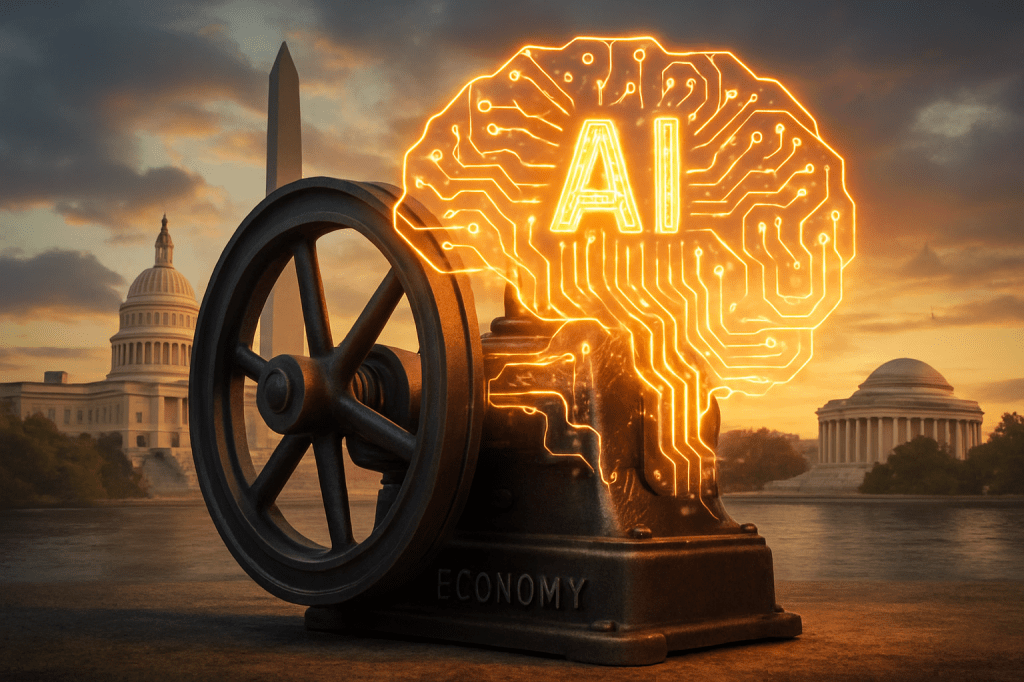
Treasury vs. Fed: Is Washington’s Economic Engine Underestimating AI?
The conversation about artificial intelligence’s economic weight just received a significant upgrade, moving from the tech sector’s projections directly into the heart of U.S. monetary policy. Yesterday, U.S. Treasury Secretary Scott Bessent launched a direct challenge to the Federal Reserve, arguing that the nation’s central bank is potentially overlooking the transformative power of AI, much as it initially did with the internet in the 1990s.
In a pointed Fox Business interview, Bessent not only emphasized AI’s imminent potential for significant productivity gains – anticipating their materialization by early 2026 – but also suggested that a robust U.S. economy, coupled with AI’s rise, could benefit from decreasing interest rates. This isn’t just a difference of opinion; it’s a high-stakes disagreement over the fundamental drivers of future economic growth and, by extension, the appropriate calibration of monetary policy.
The “Internet Moment” Parallel: A Provocative Comparison
Bessent’s analogy to the Fed’s initial skepticism regarding the internet’s economic impact is more than just a historical anecdote; it’s a strategic rhetorical move. It frames the current situation as a potential repeat of a critical misjudgment, implying that the Fed risks stifling a nascent, AI-driven boom by adhering to an overly cautious stance. If AI indeed unlocks the kind of productivity growth Bessent foresees, then the traditional models for inflation, employment, and interest rates may need a radical re-evaluation.
- Monetary Policy at a Crossroads: If Bessent is correct, a Fed holding steady or raising rates might be inadvertently applying the brakes to an economy poised for an AI-fueled acceleration. The implications for investment, particularly in AI infrastructure and applications, are immense.
- Beyond Tech Hype: This isn’t a Silicon Valley CEO hyping their latest product. This is the Treasury Secretary, signaling that AI’s potential has matured into a top-tier macroeconomic factor demanding immediate consideration from the highest levels of economic governance.
The Productivity Paradox, Reloaded: A Crucial Counterpoint
Yet, Bessent’s optimistic forecast isn’t without its immediate counter-narrative. The very real-world application of AI has, in some recent studies, failed to deliver the substantial business returns that many anticipated. This isn’t to say AI isn’t powerful, but rather that the journey from technological breakthrough to widespread, measurable productivity gains is often complex and protracted.
This raises critical questions:
- Is Bessent mistaking early-stage hype for imminent, widespread economic impact, or is he accurately predicting the tipping point?
- Are the current studies simply capturing the “implementation dip” – the period where new technologies require significant investment in training, integration, and process redesign before their benefits fully materialize?
- Or is there a more fundamental mismatch between the capabilities of current AI and the measurable, bottom-line productivity improvements businesses are seeing?
Deep Implications for the AI-Driven Economy
For those of us tracking the AI revolution, this high-level debate underscores the profound uncertainty that still surrounds AI’s true economic timeline and impact. If Bessent’s vision of an AI-driven boom by early 2026 holds true, it could mean a rapid acceleration in automation, job transformation, and the creation of entirely new economic sectors. Conversely, if the Fed’s more measured approach proves warranted, we might be looking at a slower, more incremental integration of AI, with productivity gains arriving on a longer horizon.
The stakes are not merely academic. They involve the trajectory of interest rates, the flow of capital, the pace of innovation, and ultimately, the speed at which AI reconfigures our entire economic landscape – including the very nature of work itself. Washington’s economic engines are now openly grappling with AI’s future, and how they resolve this debate will shape the next chapter of our AI-altered world.
