
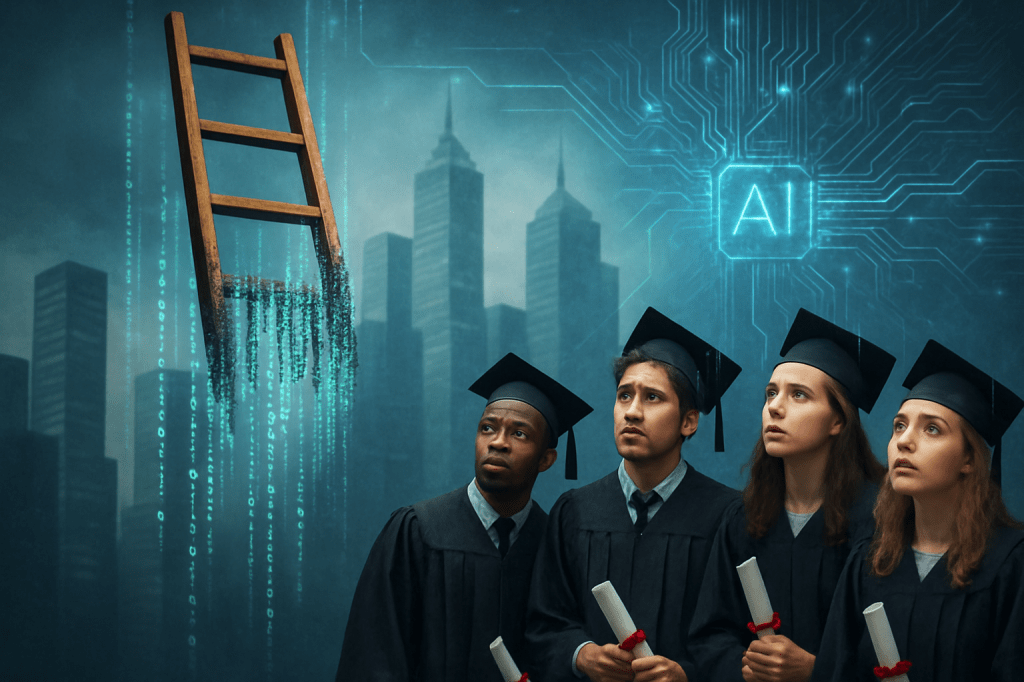
The latest data out of the UK paints a stark picture for its newest graduates. It’s not just a tough market; it’s a landscape increasingly defined by a profound disconnect between aspiration and opportunity, where the traditional rungs of the career ladder seem to be disappearing before they can even be grasped.
The Vanishing Entry Point: A New Graduate Reality
The Financial Times recently laid bare the grim reality for the class of 2025: “It’s been a terrible year to graduate and find a job.” This isn’t merely a cyclical downturn. While economic uncertainty, inflation, and post-Covid hiring retrenchment all play their part, there’s a more insidious, structural shift underway. Lurking beneath the surface of these familiar headwinds is the growing, undeniable specter of AI’s impact on those very entry-level roles that have historically served as the crucible for new talent.
Consider Rose Agbaw, a graduate whose story echoes across countless LinkedIn profiles and hushed conversations in university career centers. Despite a robust CV brimming with qualifications and experiences, Rose finds herself in a relentless cycle of applications – dozens submitted, precious few responses. This isn’t a failure of individual merit; it’s a symptom of a system in flux, where the conventional pathways to professional stability are increasingly obscured, forcing many into further studies or precarious part-time work simply to stay afloat.
The Data Don’t Just Speak; They Scream
- High Fliers Research reports graduate hiring success at a historic low. Only 27% of final-year students secured a role by February, a significant drop from 33% just two years prior. The average student is now submitting over 21 job applications, often into a void.
- Indeed data corroborates this, showing a sharp decline in graduate job postings, particularly in sectors that were once reliable entry points: HR, marketing, and accounting. These are precisely the domains where AI, through automation and enhanced efficiency, is rapidly redefining basic tasks and, consequently, the need for human input at the foundational level.
- Alarmingly, nearly half of top UK employers reduced their graduate intakes in 2024 and signal intentions to continue this trend. This isn’t just a temporary pause; it’s a strategic recalibration of talent pipelines.
The Invisible Handshake and the AI Factor
The implications extend beyond mere job scarcity. The report highlights a disturbing trend: recruiters are increasingly relying on personal networks and offline methods to source talent. While this might seem like a reversion to old-school tactics, in an AI-permeated world, it creates a new layer of disadvantage. If AI is automating the initial screening and basic tasks, what’s left for human recruiters is often the more nuanced, relationship-driven aspect – a domain where those from lower-income backgrounds, lacking established professional networks, are inherently disadvantaged.
Compounding this, students already burdened by escalating debt and crippling living costs find it increasingly difficult to invest in the extracurricular experiences, internships, or advanced certifications that could enhance their employability. It’s a vicious cycle: the cost of entry to a competitive job market rises, while the traditional returns diminish, and the very nature of “entry-level” work morphs under the influence of intelligent systems.
Is the Degree Still a Golden Ticket?
While graduates, on average, still fare better in employment and earnings compared to non-graduates, the value proposition of a university degree is undeniably being questioned. The pathways to stability are less clear, and the initial investment – both financial and temporal – is becoming a heavier gamble.
This isn’t just about economic cycles or post-pandemic adjustments. This is about a fundamental re-evaluation of human capital at the entry level, accelerated by AI. When basic analytical, administrative, or communicative tasks can be performed by algorithms, the definition of what constitutes a valuable “first job” shifts dramatically. It forces us to confront uncomfortable questions: Are we educating a generation for jobs that AI is systematically erasing? And if the traditional on-ramps to professional life are being dismantled, what new architectures of opportunity will emerge, and who will be left behind in the transition?
