
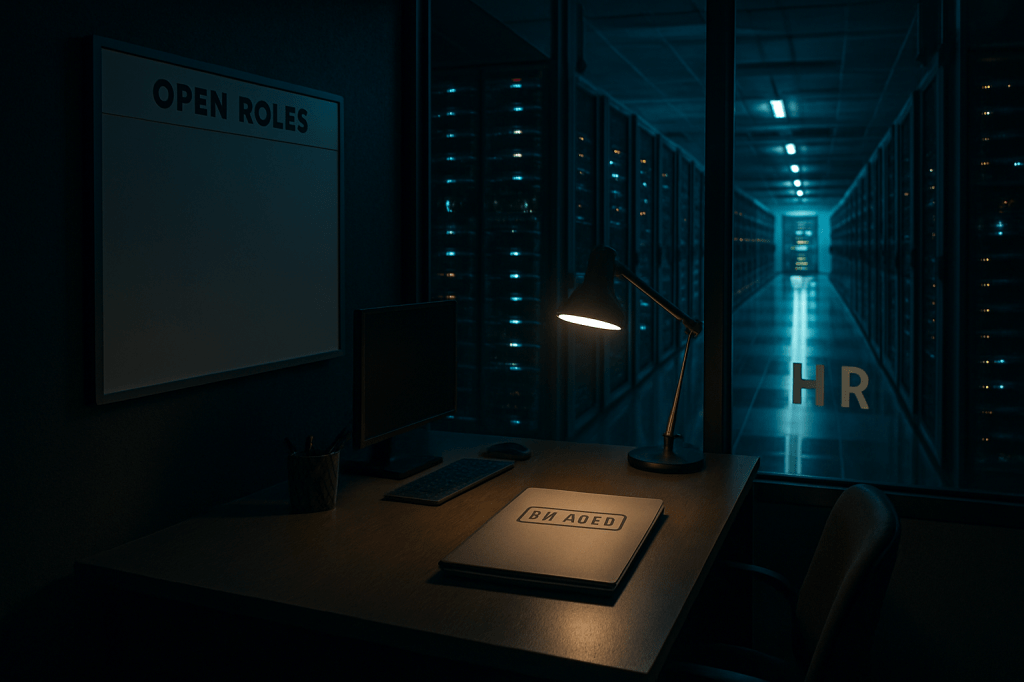
When the jobs report went dark, a different signal lit up
On a Friday when Washington’s data spigot was turned off, markets reached for anything that looked like a compass. The official September jobs report was withheld by the federal shutdown, leaving traders, policymakers, and employers staring at a blank page. Into that quiet stepped the Wall Street Journal’s Greg Ip with a narrative that made sense of the contradiction many of us have felt all summer: output is humming while the labor market feels heavy. His question was blunt, and overdue: are early gains from generative AI the force that’s letting companies do more with fewer new hires?
The puzzle: strong output, soft labor
The macro picture has refused to line up with old playbooks. The Atlanta Fed’s GDPNow model had third-quarter real growth near a 3.8% annualized pace as of October 1—solid by any standard. Yet payroll signals have been subdued. A private estimate from ADP suggested September private employment slipped, and hours worked stagnated through the summer. In an economy that usually needs more people to make more things, the divergence looks like a missing piece. Ip proposes that productivity is that piece, and that AI is doing at least some of the lifting.
An invisible labor force made of tokens
Two numbers anchor the argument. First, a sustained uptick in measured labor productivity: roughly 2% annual gains across the last two years, compared with the pre‑pandemic trend of 1% to 1.5%. That’s not a blip; it’s the kind of move that changes earnings calls and Fed debates. Second, the behavioral shift inside firms. Gallup finds about 19% of U.S. workers now use AI at least a few times a week—an adoption curve that looks less like novelty and more like fabric. If those tools are shaving minutes from emails, hours from reports, and days from coding and customer support, then the macro math starts to reconcile. You can grow output without growing headcount, not because demand is weak, but because digital help is finally material.
The capital wall is already going up
Behind the screens is steel and silicon. The surge in spending on data centers, power, networking gear, and accelerators has been unmistakable, and banks like Citi have already tallied AI equipment outlays since 2023 as a meaningful share of GDP. The parallel to the 1990s is more than nostalgia. Then, telecoms and server rooms looked like sunk costs before they reorganized entire workflows; today, inference clusters and model tooling play the same role. Capital deepening usually shows up in productivity before it shows up in employment. That’s the mechanism Ip points to: the build happens first, the labor mix adjusts later.
Hiring freezes are the first macro symptom
It’s easier to see how this lands on a manager’s desk than in a spreadsheet. If a team’s throughput rises because drafts, summaries, QA checks, and basic analytics are handled by AI, then incremental demand no longer forces a new requisition. Vacancies stay unposted, backfills take longer, hours don’t extend at the margin. That shows up as softness even when sales are fine. The effect is especially strong in cognition-heavy, repeatable tasks—support, marketing operations, compliance prep, finance closes, and the broad middle of software work. Nobody needs a layoff to move the aggregate numbers; a quiet freeze does the job.
Don’t get carried away
The column doesn’t declare victory for AI. Adoption is uneven, returns are noisy, and many pilots are just that—pilots. Some studies show modest gains or none at all. Attribution is also messy: post‑pandemic normalization, better supply chains, and capital intensity outside AI all help productivity. Ip’s point is subtler. The pattern we’re seeing—a gap between robust output and tepid hiring—fits a story in which AI is already good enough to compress labor demand at the margin, even if the full productivity dividend is years away.
Pricing power in a tight world
Even if AI lifts productivity, don’t expect a rerun of the late 1990s disinflationary glide. Demographics are older, immigration has been lower, and trade flows are less frictionless than a generation ago. Those structural forces keep labor markets tight and could keep price pressures sticky. The path where companies get more efficient without passing all of it through to lower prices is not only plausible; it’s the baseline many CFOs are pursuing. That decoupling matters for the Federal Reserve: higher trend productivity is welcome, but it may not buy as much inflation relief as it once did.
The 1990s are a guide—and a warning
The historical rhyme is tempting for good reason. In the IT wave, investment soared before the payoff was obvious, then the payoff broadened suddenly as processes and organizations reconfigured around the new tools. AI could follow that arc. But the cautionary part of the rhyme also applies. Not every dollar of capex earns its keep, and timing is lumpy. Power constraints, model fragmentation, and talent bottlenecks can all slow diffusion. The risk is not that AI fails; it’s that the benefits remain concentrated in certain tasks and firms for longer than the macro conversation assumes.
What this means for workers and managers now
If Ip is right, the near‑term labor market story is not a pink‑slip wave but a stall in the creation of new roles that used to be automatic. The entry ramp narrows; midlevel ladders get fewer rungs; generalists are asked to become systems integrators of people, process, and models. For managers, the scoreboard shifts from “How many did we hire?” to “How much did output per person rise?” For workers, the safest ground is complementarity: being the human who designs the workflow, verifies the output, and owns the judgment—because those are the parts automation hands back when it’s confident about the rote steps.
The takeaway
On a day when the government’s gauges went blank, the cleanest story of the moment came from private signals: solid growth, scant new jobs, and widespread AI use. Put together, they look less like a paradox and more like the first chapter of a productivity revival that shows up as a hiring pause before it shows up as new kinds of work. If the 1990s are any guide, the macro gains can arrive before the labor market re-expands around them. In other words, AI didn’t replace you today—it replaced the job opening that would have been posted tomorrow.
