
Congress Asked an AI How Many Jobs It Could Take—Then Wrote a Playbook to Rewrite Work
Washington did something odd yesterday. It didn’t just publish another warning about automation; it used the very tool in question to size up the threat. The Senate HELP Committee’s Democratic minority, led by Bernie Sanders, released a report with a number designed to rearrange attention: up to 97 million U.S. jobs could be displaced within a decade by what it calls “artificial labor.” The headline traveled quickly because it converts a decade of fuzzy forecasts into a single, blunt possibility—and because it revealed a new habit in policymaking: lawmakers are now letting large language models read the economy.
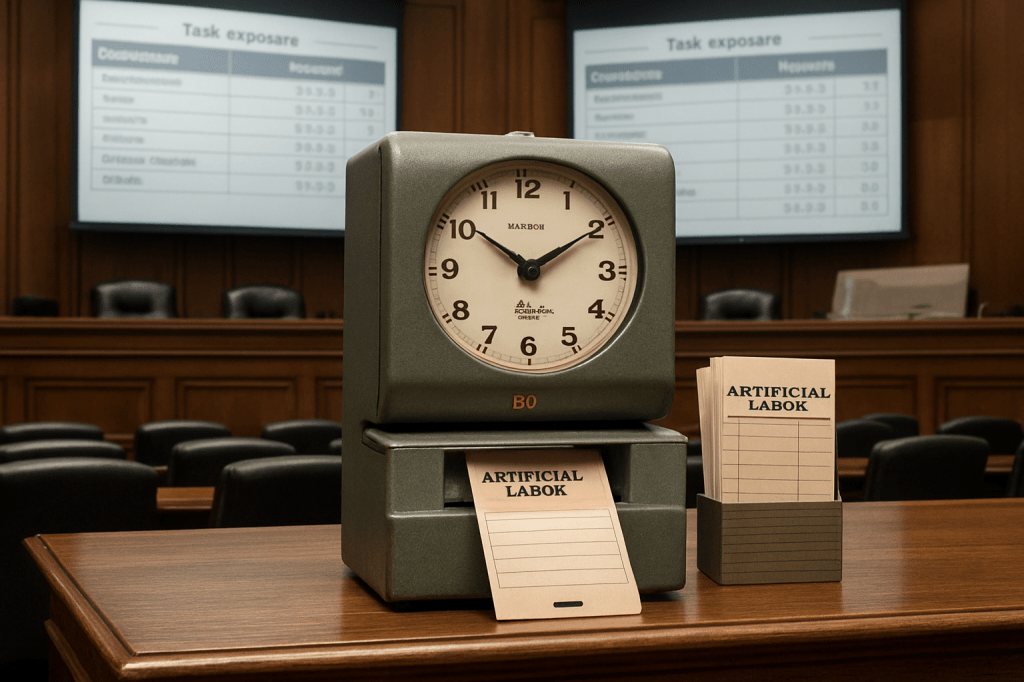
The report’s term choice matters. “Artificial labor” reframes AI from software to a competitor on the shop floor and in the back office. Tools don’t demand shorter workweeks; workers and their representatives do. By naming AI as labor, the report clears conceptual space for policies that treat productivity gains as negotiable income and time, rather than as private margin expansion. It’s a rhetorical shift with legislative downstreams: you don’t regulate a spreadsheet the way you regulate a workforce, but you might regulate “artificial labor” with the latter in mind.
The number behind the number
The committee staff turned to O*NET, the federal database of job tasks, and then to ChatGPT to evaluate task-level exposure to automation. That is not a footnote; it’s the instrument that generated the urgency. The model scored tasks, the staff rolled those judgments up to occupations, and out came sector snapshots that feel uncomfortably specific: fast-food and counter service with exposure up to 89%, accounting at 64%, trucking at 47%. No one reading this needs a lecture on exposure versus elimination; what gives this estimate more bite is not mathematical novelty but proximity to cash flows. The report pairs exposure with a second observation: major firms are already guiding investors to expect payroll reductions tied to AI. When Amazon, Walmart, UnitedHealth, or JPMorgan talk that way on earnings calls, complementarity arguments lose altitude, at least in the short run.
There’s irony and risk in letting an LLM referee which tasks are replaceable. Prompting becomes a tacit form of policy. Model version, temperature, and wording could swing exposure scores in ways economists aren’t used to defending. But the inversion is also telling: if Congress uses AI to assess jobs, it signals that AI has crossed from research into institutional practice. Yesterday’s document marks the moment when the measurement of labor itself became partially automated—a move that will shape how we argue about everything from training budgets to unemployment insurance.
The swift pivot from diagnosis to distribution
Sanders didn’t stop at the count. He stapled the estimate to a program that reads like an attempt to convert computational productivity into human prosperity without waiting for trickle-down alchemy. A 32-hour workweek with no loss of pay. Profit-sharing and worker seats on boards. A federal bank to scale employee ownership. A tax focused on firms that substitute machines for people. Reinforced union power via the PRO Act. Guaranteed paid leave. A return to defined-benefit pensions. A ban on stock buybacks. There’s a throughline here: if “artificial labor” compresses the need for human hours, reduce the hours rather than the pay, and cut workers into the equity-like upside they’ve historically been denied.
Will that set survive contact with macro reality? A shorter week without wage cuts depends on AI raising output per hour fast enough to hold prices in place. Profit-sharing aligns incentives but can collapse into accounting games if not standardized. Robot taxes sound clean until you try to distinguish substitution from augmentation at the task level—something even the report’s own method admits is fuzzy. An Employee Ownership Bank has precedent in smaller programs, but scaling it would test whether broad-based equity can counterbalance consolidation in a platform economy. Ban buybacks and capital will hunt for other signals; keep them, and buybacks will continue to be the painless channel for distributing AI-enabled windfalls to shareholders. None of these are reasons not to try; they’re reminders that the implementation is the policy.
The political geometry is set
Axios captured the immediate divide: Democrats framing AI as a power-concentrating force that demands redistribution and guardrails; Republicans warning that those guardrails could dull the U.S. edge and hand momentum to China. The report takes a shot at Trump-era policy as deregulation in tech clothing. That fight is familiar, but the terrain has shifted. In past automation waves, politicians could argue about long-run net job effects while the underlying technology moved slowly. Here, CFOs are already threading AI into their guidance. The debate is no longer academic; it’s about who captures a very near-term margin expansion.
What the estimate misses—and why it might not matter
Any task-based model risks overstating substitution because jobs mutate. When generative systems take over reconciliation in accounting, the remaining work leans harder on judgment and client trust; trucking’s exposure is more likely to arrive first in dispatch, routing, and compliance than in a driverless interstate; quick-service restaurants will automate ordering long before they replace the human who can calm a lunch rush. But the ladder problem is real: if entry-level tasks are automated, the apprenticeship path narrows. Firms can run lean with a thin layer of seniors and a slurry of AI prompts, which is a subtle form of displacement even without pink slips. Markets reward that posture. Workers can’t bargain against a spreadsheet; they bargain against a plan to replace the spreadsheet with a model that writes its own macros.
That’s why the most novel thing about yesterday isn’t the 97 million figure. It’s that Congress quietly introduced a new kind of evidence into the legislative bloodstream: LLM-derived exposure scores. That invites scrutiny and gaming, but it also means the argument is now legible to the very systems reorganizing work. Policymaking will start to look like software specification—definitions, edge cases, tests—and the quality of the prompts will matter as much as the passion of the speeches.
For readers here, the signal isn’t fear; it’s tempo. Companies are using AI to narrate their future headcounts. Unions will chase the 32-hour week into contract talks. Committees will translate yesterday’s package into markup text, and the lobbyists will show up with their own models in hand. If “artificial labor” is the frame that sticks, then the central question of the next few years is straightforward: how much of its output accrues to time, how much to wages, how much to ownership, and how much to nobody you know. Yesterday’s report, whatever its methodological wobble, forces that allocation out of the footnotes and into the agenda.
