AI Impact on the Job Market – News (October 3, 2025 to October 10, 2025)
Remember when “the cloud” was just a fluffy metaphor and not a sprawling network of data centers sucking up power and reshaping local economies? This week, the AI job market news felt a bit like that: the abstract anxieties are colliding with concrete realities in unexpected ways. It’s not just about algorithms replacing coders; it’s about electricians wiring the AI revolution, and the financial instruments used to fund it. Let’s dive in.
The “AI-Centric Reshuffle”: Layoffs and the Capital Wall
This week brought a stark reminder that the AI revolution isn’t just about whiz-bang demos; it’s about cold, hard cash. Consulting giant Accenture trimmed over 11,000 employees globally, and insurance brokerage Acrisure is laying off roughly 400 accounting staff. The culprit? “Advancement and use of technology and automation.” It’s a trend reflected across the tech sector, with over 181,000 job cuts this year, a significant portion directly linked to AI. But here’s the twist: many aren’t directly AI *performing* the jobs. Instead, it’s an “AI-Centric Reshuffle,” where companies slash costs to unlock billions for AI infrastructure and research. Think of it as a digital land grab, where payroll budgets are sacrificed to finance the next generation of data centers.
Why is this important?
It’s a wake-up call. The initial impact of AI on jobs isn’t necessarily robots taking over tasks, but rather a strategic reallocation of resources. Companies are betting big on AI, and that means tough choices about existing workforce. This also means there is more pressure on companies to actually make AI pay off, or the layoffs might just be a temporary measure that will be followed by another round of layoffs.
The White-Collar “Job-pocalypse” Arrives (Maybe)
Hold onto your hats, knowledge workers. Klarna CEO Sebastian Siemiatkowski warned of a “massive shift” in employment, highlighting translators as an example where human roles are diminishing. Klarna themselves shrunk their workforce from 7,400 to 3,000 while *growing* revenue, thanks to leveraging technology. Anthropic CEO Dario Amodei went even further, predicting a potential “white-collar bloodbath,” with AI potentially eliminating up to 50% of entry-level white-collar jobs within five years. Echoes of this sentiment came from Amazon and Walmart, who anticipate shrinking corporate workforces due to AI-driven efficiencies. A BSI study added fuel to the fire, revealing that 41% of business leaders are already using AI to reduce headcount. Nearly a third now explore AI solutions *before* considering a human hire.
Why is this important?
The message is clear: entry-level white-collar roles are increasingly vulnerable. The traditional path of learning the ropes through junior positions is narrowing, potentially creating a “ladder to nowhere”. The entry ramp is getting steeper, and the skills required to even get on that ramp are changing rapidly.
The Counter-Narrative: Not So Fast, Job-pocalypse
But before you start prepping your doomsday bunker, there’s a dissenting voice. A Yale University study found *no* evidence of a widespread AI-driven jobs crisis in the U.S. labor market since ChatGPT’s launch. The researchers argue that any major transformation will likely unfold over decades, not months, and that AI might be a convenient “scapegoat” for layoffs driven by traditional cost-cutting. LinkedIn CEO Ryan Roslansky argues that AI literacy is becoming more valuable than traditional degrees, emphasizing adaptability and embracing AI tools. A KPMG report even found that 92% of CEOs plan to *increase* headcount in the next year, with a focus on AI and tech skills. Even India’s NITI Aayog predicts millions of new jobs in tech and customer experience, despite automation.
Why is this important?
It’s a reminder that the AI revolution is complex and multifaceted. The immediate impact might be less dramatic than some predict. However, the emphasis on skills and adaptability is crucial. The future belongs to those who can work *with* AI, not against it. This also means that there is a need to re-think education and training programs to prepare workers for the changing job market.
From Software to Solder: AI Needs Electricians, Plumbers, and Concrete
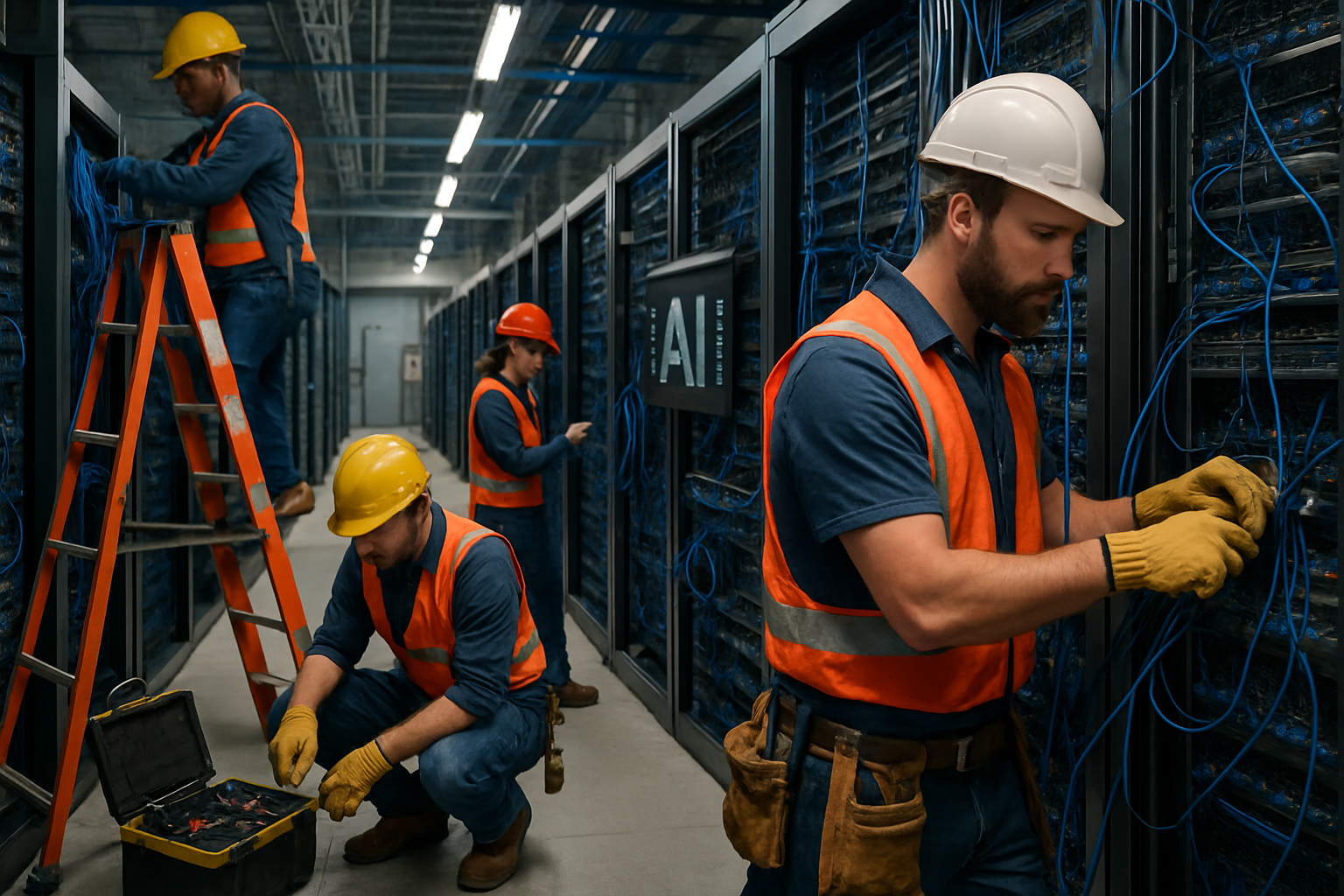
Nvidia’s Jensen Huang threw a curveball into the narrative, declaring that the *winners* of the AI boom might be the people who build, wire, cool, and maintain the physical infrastructure where AI lives. Forget prompt engineering; think soldering and concrete dust. AI, for all its digital wizardry, has a brutalist physical appetite: square footage, megawatts, water, steel, chillers, switchgear. The fastest-growing bottlenecks in AI aren’t code issues; they’re job sites and interconnection queues. The limiting factor in enterprise AI scale might be a missing journeyman crew, not a missing algorithmic trick.
Why is this important?
- It highlights a critical, often overlooked, aspect of the AI revolution: the *physical* infrastructure.
- It creates new job opportunities in skilled trades, providing a potential pathway for workers displaced by automation.
- It shifts the focus from abstract anxieties to concrete needs, like apprenticeship programs, permitting timelines, and power grid upgrades.
The Fed Weighs In: It’s the Term Premium, Not the Chatbot (Yet)
Minneapolis Fed President Neel Kashkari offered a dose of monetary realism, arguing that the AI boom is a capital cycle with monetary gravity. The surge in data center spending puts upward pressure on long-term interest rates, potentially squeezing rate-sensitive hiring in other sectors. The threat, in this telling, is not a model sitting down at your desk; it’s the cost of money reshaping where jobs get created. AI didn’t replace you this week; the data center did, by replacing your future employer’s borrowing capacity.
Why is this important?
It’s a reminder that the AI revolution is intertwined with broader economic forces. Financing conditions can significantly impact job creation, even if AI adoption is still in its early stages. It also underscores the need for policymakers to consider the macroeconomic implications of AI investment.
The Back Office Becomes a Product: Acrisure’s Bold Move
Acrisure made headlines by announcing that AI will replace roughly 400 accounting roles starting in 2026. But here’s the twist: they’re also commercializing the AI platform that’s automating those jobs, offering it to small businesses as a subscription service. This signals a new equilibrium for back-office functions: once a process can be reliably automated at scale, it transforms from a cost center into a potential software business.
Why is this important?
- It demonstrates a concrete example of AI-driven job displacement in a specific industry.
- It highlights the potential for companies to monetize their AI investments by selling automation solutions to others.
- It suggests that back-office functions are increasingly vulnerable to automation.
The Missing Entry-Level: AI Eats the Apprenticeship
A BSI study revealed a concerning trend: companies are edging out junior hires with AI. Forty-one percent of executives said AI is enabling them to reduce headcount, and nearly a third now search for an AI answer before posting a role. This quiet reroute is unravelling the apprenticeship model, where entry-level tasks provide crucial training and experience. The senior-only orgs are accruing a training debt that will compound over time.
Why is this important?
It’s a fundamental shift in how careers start. If AI absorbs entry-level tasks, it also swallows the on-ramp. The consequences could be significant: a shrinking middle class, wage compression, and a lack of institutional knowledge. This also means that there is a need to rethink education and training programs to prepare workers for the changing job market.
Chambers’ Warning: Reinvent or Vanish
John Chambers, former Cisco CEO, issued a stark warning to executives: if you don’t reinvent quickly, AI won’t just change your business; it will erase it – and many of you with it. He estimates that as many as half of Fortune 500 companies could vanish in the AI transition, and roughly half of current executives could lose their chairs. The unit of disruption is not the task or even the team—it’s the firm and the fabric of leadership that holds it together.
Why is this important?
It’s a reminder that the AI revolution is not just about technology; it’s about leadership and organizational agility. Companies that can’t adapt quickly to the changing landscape risk becoming obsolete. The challenge for executives is to transform their organizations into AI-first companies, where data drives decisions and continuous deployment is the norm.
Congress Asks AI About Jobs: A Playbook for the Future of Work
The Senate HELP Committee’s Democratic minority released a report estimating that up to 97 million U.S. jobs could be displaced within a decade by “artificial labor.” The report used ChatGPT to assess task-level exposure to automation, highlighting sectors like fast-food, accounting, and trucking. Sanders proposed policies like a 32-hour workweek, profit-sharing, and a robot tax.
Why is this important?
It signals that policymakers are taking the AI job market seriously and are exploring potential solutions. The report also highlights the need for a broader conversation about how to distribute the benefits of AI-driven productivity gains. However, there are also concerns that overregulation could stifle innovation and hand momentum to other countries.