
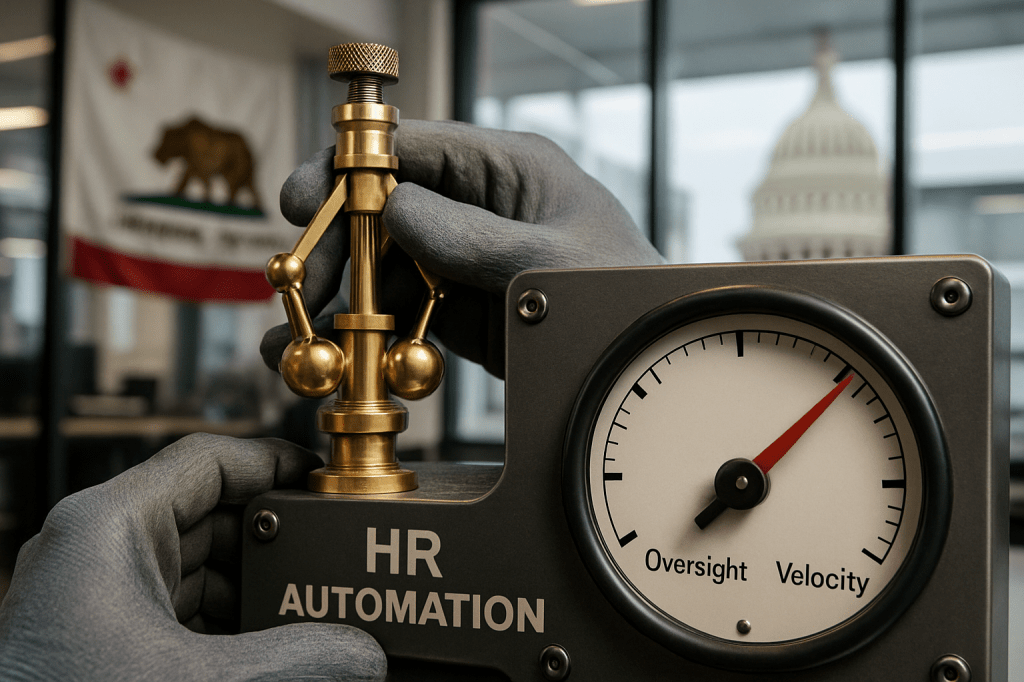
California’s Pause on Robo-Boss Rules Just Reshaped the Near Future of Work
The email hit inboxes mid-morning on October 17, the kind of client alert that quietly redraws the map. In a few clipped paragraphs it translated a veto from four days earlier into a new operating reality: California’s “No Robo Bosses Act” was dead this session, and with it the state’s most ambitious plan to force human oversight back into AI-driven hiring and management. What replaced it wasn’t nothing—civil rights law and fresh regulations from the Civil Rights Department remain in force—but it wasn’t the regime many expected. The message to employers was unmistakable: proceed, but mind the rails.
SB 7 had promised a very particular kind of oversight. It didn’t ban algorithmic management; it domesticated it. Employers could have used automated decision systems, but not as the solitary voice deciding who is hired, promoted, disciplined, or let go. The bill would have converted “human in the loop” from a design choice into a statutory obligation. It would have made inferring protected traits or union activity through AI off limits. And it would have converted the black box into a paper trail, demanding notices before automated tools were deployed, explanations after adverse decisions, and retention of the records needed to reconstruct the logic when challenged.
For the state that exports management software along with wine and chips, this was a statement: algorithmic authority over workers is permissible only if humans stay accountable. The Legislature said yes on September 12. The Governor did not. In his veto message, Gavin Newsom labeled the bill overly broad, the notification scheme unfocused, and the compliance burden indifferent to the difference between a resume sorter and an innocuous scheduling script. He pointed toward the California Privacy Protection Agency’s upcoming rulemaking as a better venue to target risks without sweeping in every tool that carries a whiff of automation.
That veto didn’t just halt a bill; it set the tone for a year of experimentation. The October 17 commentary from law firms and advisors cemented what insiders already suspected: California will not require human oversight or standardized worker notices for AI employment decisions—at least not yet. In the meantime, the guardrails are lighter and more general. Employers must still navigate discrimination law and new Civil Rights Department regulations that took effect October 1. Those CRD rules close predictable loopholes: automated tools can’t short-circuit individualized assessments, they constrain medical and psychological inquiries conducted by or through AI, and they force retention of AI-related employment records. But they stop short of dictating how much power an algorithm can have in day-to-day people management or how transparently its use must be disclosed to the worker on the other side of the screen.
That gap matters because it changes pace. SB 7 would have introduced friction—documented oversight, mandatory pre-use notices, and after-the-fact disclosures that make adverse decisions reconstructable and therefore contestable. Friction slows things, and in HR operations, speed is strategy. When the oversight mandates vanish, the calculus shifts. Talent acquisition leads can push deeper automation into screening and ranking without rewriting process flows to accommodate formal reviews. Workforce managers can expand algorithmic scheduling and performance flagging without triggering a cascade of notices or explanations. CFOs, eyeing efficiency targets, can pressure-test reductions or reorganizations driven in part by algorithmic scoring without the audit trails that a statute would have made routine.
The result isn’t a free-for-all. It’s a permission structure for rapid iteration, bounded by discrimination risk rather than prescriptive AI governance. That distinction matters for outcomes. Discrimination law punishes harmful effects, but only after the fact and often after litigation. A human-oversight statute would have required prospective safeguards and continuous documentation, effectively throttling the most aggressive forms of automation in sensitive decisions. With the veto, California is choosing to police consequences more than mechanisms, at least for now.
Employers will use the room. Expect the quiet normalization of automated shortlists in high-volume hiring, of machine-prioritized assignment choices in shift work, and of performance nudges that escalate to discipline with minimal human touch unless a threshold is crossed. The winning internal argument will be familiar: keep humans on the escalation path, but don’t force them to rubber-stamp every ranking or schedule. And because the CRD rules require record retention but not universal notification, the evidentiary record will exist without signaling to workers when and how an automated system influenced the outcome. That asymmetry—data for the file, opacity for the person—tilts power toward management until a complaint, a discovery request, or an agency inquiry surfaces the underlying logic.
Newsom’s pointer to the CPPA is not a shrug; it’s a bet on a different institution. The CPPA’s privacy orientation will frame “bossware” through data flows and risk controls more than labor process mandates. That could yield narrower, technology-specific obligations—impact assessments, sensitive data prohibitions, and opt-out rights—without dictating governance patterns inside HR. If that’s the path, it will protect against certain abuses while leaving the fundamental question of human authority unresolved: who must actually own a decision about someone’s livelihood, and when?
The politics aren’t settled. SB 7 had labor’s backing when it advanced through the Legislature. It will almost certainly return in reworked form, slimmer and more targeted, once the administrative agencies mark their territory. In the interim, unions and civil rights groups will move to where the leverage is: agency rulemaking comment dockets, enforcement petitions under the CRD regulations, and municipal ordinances that can sprint where the state jogs. The outcome could be a patchwork of process duties that approximate parts of SB 7 without its statewide mandate, which is precisely the kind of complexity large employers are built to absorb.
For workers, the immediate change is subtler but profound. Without standardized notices, it becomes harder to understand when a scoring system—not a manager’s judgment—set the path that led to rejection, a pay plateau, or a shift loss. That obscurity blunts organizing strategies that rely on surfacing patterns and contesting the rules of the game. It also means the first wave of case law will be driven by the rare instance where an explanation leaks, a pattern can be inferred from retained records, or a regulator takes an interest. In other words, correction arrives episodically, not structurally.
For product teams building HR tech, the veto is oxygen. They can pursue more ambitious “decision support” features that border on decision automation, so long as they avoid the obvious legal traps: proxies for protected traits, medical inference, and brittle models that can’t withstand basic disparate impact testing. Clever design will keep humans nominally involved—confirmations, overrides, and exception queues—while moving the throughput of decisions to algorithms. This is the design space that generates real headcount savings, and the state just removed the most imminent speed bump to deploying it at scale.
There is a contrarian read worth entertaining: by delaying a comprehensive statute, California may end up with a more technically precise and enforceable framework. The first drafts of AI governance often confuse categories—tools that rank resumes versus systems that predict attrition—and impose disclosure duties that inundate workers without clarifying anything. If the CPPA and CRD can produce rules that differentiate risks and target controls, a narrower 2026 bill could harden those into law while avoiding the “notify everyone about everything” trap. The cost of that path is what we’ll live through over the next year: a period of aggressive deployment where the line between assistance and authority is negotiated inside companies rather than in public rules.
The near-term playbook, whether we admit it or not
California’s largest employers will map their automated decision systems against CRD requirements, tweak policies to maintain the veneer of individualized review, and expand the scope of algorithmic triage in recruiting and performance management. Compliance teams will document, quietly, because retention is now mandatory. Worker advocates will redirect energy to agency enforcement and city councils. Vendors will emphasize “support, not decide” in marketing while designing for one-click human ratification. And unless something goes badly wrong—an egregious harm that crystallizes the risks—the equilibrium will hold until the CPPA and Legislature return with a scalpel.
That’s the practical consequence of a veto that looked procedural but changed tempo. California didn’t decide whether algorithms can be bosses. It decided to let the workplace answer the question first.
