
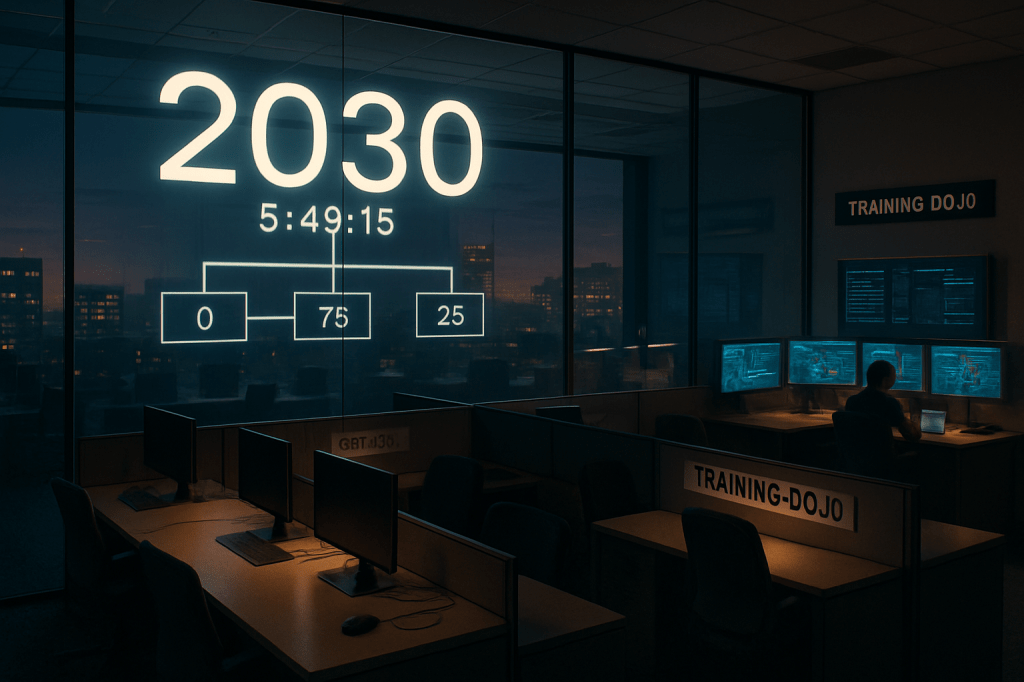
Orlando put a date on the end of unassisted IT work
The ballroom lights dimmed, the soundtrack faded, and Gartner did the rarest thing in a foggy market: it named a number. By 2030, the share of IT work done without AI will be zero. Not less. Zero. In one slide, the keynote converted years of hand‑waving into a staffing blueprint—75% of work executed by humans augmented with AI, 25% handed off to AI alone—drawn from a mid‑year survey of hundreds of CIOs. The room of 7,000 stared at a clock that had quietly started years ago and is now ticking loudly enough to plan headcount against.
The operating model hidden inside 0/75/25
It’s tempting to read the split as theater. It isn’t. It’s a hiring spec masquerading as prophecy. A world of 75% human‑plus‑AI means most teams shift from “builders who occasionally use tools” to “system conductors who encode judgment, constraints, and oversight into toolchains.” That last 25%—AI alone—marks the tasks organizations are willing to certify as self‑serve, wrapped in monitoring and rollback. The zero is what matters most: no requisition, role, or project should presume AI abstinence by decade’s end. If you still write a job description without the augmentation context, you’re planning for an operating reality Gartner says won’t exist.
The hiring pause that avoids the word “freeze”
Gartner’s guidance didn’t hide behind the usual reskilling platitudes. Daryl Plummer told CIOs to restrain new hiring for low‑complexity tasks and move incumbents toward revenue‑generating work. That is a direct instruction to protect the core and starve the bottom of the ladder. Help desk queues, routine ops, ticket triage, and other task‑heavy pools have been the entry ramps for a generation; they now become the first places leaders will stop adding seats. The market signal to early‑career candidates is blunt: the door narrows, and the apprenticeship you expected will be replaced by deliberate internal mobility for those already inside.
The returns reality forcing the redeployment play
Behind the bravado of “AI everywhere” sits a sober balance sheet. Most CIOs say their AI programs are breaking even or worse, and every tool drags along a caravan of hidden costs—governance, evaluation, change management, training, re‑platforming, incident response—before value compounds. Add to that a frank admission that accuracy and agentic systems aren’t production‑ready in many domains, and you get the near‑term posture: fewer external hires, heavier internal retraining, smaller experiments that actually ship. It’s not austerity; it’s a cash‑flow alignment. Organizations will spend, but they’ll spend to bend current teams toward measurable revenue rather than continuously enlarging payrolls in roles AI is already eroding.
Human readiness is the new backlog
The keynote’s most useful reframing wasn’t the slide with the split. It was the admission that AI‑readiness—the tools and plumbing—is outrunning human readiness. Companies are discovering that competence decays when routine is outsourced to automation. If you never troubleshoot without a copilot, your diagnostic instincts soften; if you never write clean code by hand, your reviews become ornamental. Gartner’s counsel to test and maintain core capabilities acknowledges a coming audit culture: leaders will need evidence that people can still operate in manual mode when the system misbehaves. Think of drills that intentionally remove assistance, rotations that force deeper engagement with the stack, and proficiency checks that anchor promotions to retained skill, not just throughput boosted by a model.
The apprenticeship vacuum
This is the quiet crisis hiding in the 25% automation bucket. The tasks that train juniors—the repetitive tickets, the predictable playbooks, the glue work—are the first to be handed to machines. Without intervention, you get a mid‑level hollowing: five years from now, you’ll want seasoned engineers and operators who never got the repetitions that build judgment. That’s why “restrain hiring” must be paired with intentional practice environments. Sandboxes, simulated incidents, shadow pipelines, and evaluation ops aren’t perks; they’re the new dojo. If you don’t manufacture experience, the market won’t magically supply it.
From tech rollout to workforce program
Gartner explicitly framed AI adoption as a people program with governance, behaviors, and mindsets at its center. That elevates HR and learning from support functions to core delivery partners. It also changes incentives. If talent moves from routine ops into revenue work, compensation plans, career ladders, and performance metrics must evolve to reward problem framing, product sensibility, and model oversight—not just tickets closed. The organizations that treat this as culture change rather than tool deployment will spend less time explaining why their “AI pilots” never paid back.
Short‑term churn, long‑term expansion
The forecast sketches a two‑act labor story: neutral net job effects through 2026 as roles are redesigned and teams reshuffled; then outsized growth later as AI‑enabled lines of business reach scale, contributing to hundreds of millions of new human jobs worldwide by the mid‑2030s. That expansion is not guaranteed. It assumes today’s retraining investments compound into new revenue engines. The uncomfortable bridge between now and then is narrower entry‑level hiring and higher standards for those who stay—an economy where mobility is earned through measurable capability, not tenure.
What to do with a countdown
When a respected forecaster says the share of IT work done without AI will be zero by 2030, it isn’t a dare; it’s a planning constraint. For employers, that means stop backfilling low‑complexity roles by default, move your best people closer to revenue, and institutionalize skill maintenance so augmented teams don’t forget how to operate. For workers, it means build the muscles AI cannot replace: problem selection, system thinking, evaluation, and accountability. The tools are ready. The question is whether the humans will be.
