
AI Impact on the Job Market – News (October 24, 2025 to October 31, 2025)
Remember when everyone thought self-driving cars would be delivering our groceries by now? Turns out, predicting the future is harder than teaching a machine to parallel park. This week in “AI Replaced Me,” we’re navigating a similarly bumpy road, separating hype from reality in the AI job market. Buckle up; it’s a wild ride.
The Great Layoff Wave of ’25: Is AI to Blame?
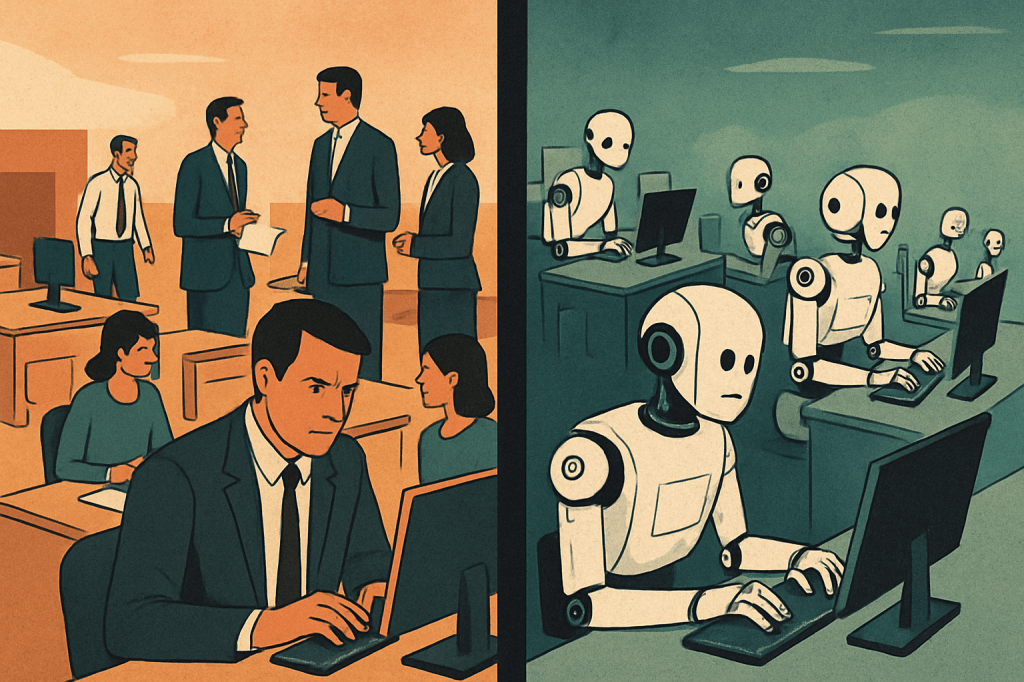
October 2025 has been a tough month for many. Major corporations like Amazon, Meta, UPS, and Chegg have announced significant layoffs, and the shadow of AI looms large. Amazon is cutting 14,000 corporate jobs, with CEO Andy Jassy explicitly stating that AI-driven efficiency gains are a key factor. He framed the layoffs as a “cultural reboot,” aiming to make Amazon “leaner, flatter, and faster.” Meta is restructuring its AI division, Meta Superintelligence Labs (MSL), letting go of approximately 600 employees as part of a broader streamlining effort. UPS is reducing its operations workforce by a staggering 34,000 employees, citing technologies like machine learning that automate specific tasks. Online education company Chegg is downsizing by 45% (388 employees), blaming the “new realities” of AI and decreased website traffic.
Why is this important? These aren’t isolated incidents. These are major players openly attributing job cuts, directly or indirectly, to AI. It’s a clear signal that companies are actively restructuring their workforces with AI capabilities in mind. The fear is no longer theoretical; it’s playing out in real time. Other big companies such as Intel, Microsoft, and Nestle have also announced significant layoffs in October where AI has been a contributing factor.
What does this *really* mean? It means the “augmentation” phase is evolving. For two years, white-collar workers were told AI would augment them. However, Amazon made a statement by removing the ambiguity. Augmentation, when it compounds, reduces the number of people needed to run the same machine. Amazon didn’t just adopt AI, it rewrote the social contract for its headquarters. Others will follow because now they can point to a precedent and call it prudence.
What impact could this have? The impact could be far-reaching. If companies continue down this path, we could see a significant shift in the job market, with fewer opportunities for certain roles and a greater emphasis on AI-related skills. This could lead to increased income inequality and a growing skills gap.
Yale Says “Hold Your Horses!” (But Should We Listen?)
Amidst the layoff announcements, a recent Yale University study offers a counter-narrative. Researchers claim that the widespread anxiety over AI’s effects on the labor market is “largely speculative.” They found no discernible disruption in the broader labor market since ChatGPT’s release, concluding that the data reflects “stability, not major disruption at an economy-wide level.”
Why is this important? It’s a reminder that macro-level data can sometimes mask the micro-level pain. While the overall economy might appear stable, specific sectors and roles are already being impacted. The Yale study offers a broader perspective, but it doesn’t negate the experiences of those who have lost their jobs due to AI.
What does this *really* mean? It means we need to be cautious about drawing sweeping conclusions. The impact of AI on the job market is likely to be uneven, with some sectors experiencing disruption while others remain relatively stable. It also suggests that the full impact of AI may not be immediately apparent, and that it could take time for the effects to ripple through the economy.
What impact could this have? The Yale study could lead to complacency, with policymakers and business leaders underestimating the need for proactive measures to address the potential challenges of AI-driven job displacement. It’s crucial to remember that even if the overall impact is not catastrophic, specific individuals and communities will still need support and resources to adapt to the changing job market.
Salesforce Draws a Line: AI for Support, Humans for Sales
In a year of AI hype, Salesforce CEO Marc Benioff took a definitive stance: automate support, expand sales. The company plans to hire 3,000 to 5,000 more sales reps, aiming for around 20,000 account executives. Benioff’s rationale is that selling is a “contact sport.” AI can assist with research and follow-ups, but it can’t build trust or take responsibility when things go wrong.
Why is this important? It highlights a crucial distinction between tasks that can be easily automated and those that require human interaction and judgment. It also demonstrates that AI can create new opportunities, even as it eliminates others.
What does this *really* mean? It means that the future of work is likely to be a hybrid model, where humans and AI collaborate. AI can handle routine tasks and provide valuable insights, but humans will still be needed for roles that require creativity, empathy, and critical thinking.
What impact could this have? This approach could lead to a more balanced job market, with opportunities for both technical and non-technical skills. It also suggests that companies should invest in training and development to help employees adapt to the changing demands of the workplace.
“Not Real Work”: When a Headline Becomes a Weapon
A recent headline featuring a quote from OpenAI CEO Sam Altman – “Not real work” – ignited a firestorm of controversy. The quote, taken out of context, was interpreted as a dismissal of obsolete jobs, sparking outrage and debate about the meaning of “work.”
Why is this important? It demonstrates the power of language and framing in shaping public opinion. It also highlights the need for nuanced discussions about the future of work, rather than simplistic pronouncements.
What does this *really* mean? It means that we need to be careful about the language we use when discussing AI and its impact on the job market. Words matter, and they can have a significant impact on people’s perceptions and attitudes.
What impact could this have? The controversy surrounding the “Not real work” quote could lead to increased resistance to AI adoption and more stringent regulations. It’s crucial for business and technology leaders to communicate clearly and empathetically about the changes taking place in the workplace.
Amazon Turns Implied Cuts Into Explicit Policy: HR Feels the Bite
Amazon’s recent announcement of corporate job cuts, explicitly linked to AI-driven efficiency gains, is a watershed moment. The company is targeting corporate functions, including HR, operations, and even parts of AWS. This is not just a hiring freeze; it’s a deliberate downsizing driven by AI.
Why is this important? It’s the first Fortune 5 example at true scale where AI isn’t just part of a productivity narrative; it’s the rationale attached to immediate white-collar headcount decisions. Executives across the S&P now have a reference case to point at in board decks. The permission structure has been built for them.
What does this *really* mean? It means that AI is no longer just a promising technology; it’s a cost-cutting tool. Companies are actively looking for ways to reduce their workforce by leveraging AI capabilities. This could lead to a significant shift in the job market, with fewer opportunities for certain roles and a greater emphasis on AI-related skills.
What impact could this have? Other companies will follow Amazon’s lead, accelerating the trend of AI-driven job displacement. This could lead to increased income inequality and a growing skills gap. It’s crucial for policymakers and business leaders to address these challenges proactively.
Gartner’s Reality Check: AI Saves Time, But Where Does It Go?
At the HR Symposium in Orlando, Gartner presented a startling statistic: 88% of HR leaders say they haven’t realized significant business value from AI tools. Employees are using AI and say it saves them time, but the ledger of business results is thin. What happened to all the productivity?
Why is this important? It highlights the importance of workflow redesign and governance. AI doesn’t just automate tasks; it changes the sequence and ownership of work. Without rewriting the choreography, you just have faster soloists performing to yesterday’s score.
What does this *really* mean? It means that companies need to focus on redesigning workflows to take full advantage of AI’s capabilities. They also need to track the “time dividend” and reassign freed capacity to revenue-generating activities.
What impact could this have? Companies that fail to redesign their workflows and governance structures will miss out on the potential benefits of AI. This could lead to a competitive disadvantage and ultimately, job losses.
The “Leaner Normal” Becomes Policy: White-Collar Jobs in the Crosshairs
The Wall Street Journal has officially declared it: “the leaner normal.” Tens of thousands of white-collar roles are disappearing, and executives are openly attributing the cuts to AI. This is not a one-off correction; it’s a fundamental shift in the staffing model across industries.
Why is this important? It signals a long-term trend of AI-driven job displacement in the white-collar sector. Companies are now pointing to AI as the mechanism that lets them hold smaller headcounts without strangling output.
What does this *really* mean? The message is clear: build the thing, sell the thing, or run the bottleneck. Pure coordination is exposed. For everyone else, the on-ramps will not look like analyst programs; they’ll look like hybrid roles, short-cycle credentials, and proximity to operations.
What impact could this have? The “leaner normal” could lead to a more polarized labor market, with fewer opportunities for middle-skill workers and a greater emphasis on high-skill and low-skill jobs.
AI Tries to Get Hired (and Mostly Fails): The Remote Labor Index
The Center for AI Safety and Scale AI conducted an experiment called the Remote Labor Index (RLI), testing whether AI agents could perform real, paid work. The results were sobering: the top-performing agent automated just 2.5% of the available work at an acceptance-worthy level.
Why is this important? It provides a realistic assessment of AI’s current capabilities. It reframes the automation debate from “can models do X in principle?” to “will someone pay for what they produce?”
What does this *really* mean? It means that AI agents are not yet ready to replace human workers in most remote, freelance-style knowledge work. Tool-augmented humans remain the profit center; fully agentic replacements remain boutique.
What impact could this have? The RLI provides a dose of realism in a world saturated with AI hype. It suggests that the near-term displacement picture is likely to be task-specific and opportunistic rather than sweeping.
So, what’s the takeaway from this week’s AI job market rollercoaster? It’s messy, complex, and constantly evolving. There’s no single answer, no easy solution. But one thing is clear: adaptation is key. Whether you’re an employee, employer, or policymaker, you need to be prepared to navigate the changing landscape and embrace the opportunities that AI presents. Or, at least, learn how to prompt it *really* well.
