
AI Impact on the Job Market – News (November 7, 2025 to November 14, 2025)
It’s funny how quickly “cutting-edge” becomes “old news” in the AI world. Just last week, everyone was breathlessly predicting AI would automate *everything*. This week? We’re staring at hard numbers, grappling with the messy reality of implementation, and, surprisingly, talking about job creation *around* AI. Buckle up, because the “AI taking over” narrative just got a whole lot more nuanced.
AI Layoffs: The Numbers Don’t Lie (But They Don’t Tell the Whole Story)
Let’s start with the grim stuff. October 2025 was a bloodbath for job cuts, with over 153,000 layoffs announced. According to Challenger, Gray & Christmas, AI was directly responsible for over 31,000 of those job losses. That’s a *lot* of people packing up their desks. But before you start stockpiling canned goods, consider this:
- Deepwatch, a cybersecurity firm, laid off nearly a third of its staff explicitly to invest in AI and automation. CEO John DiLullo’s statement, “aligning our organization to accelerate our significant investments in AI and automation,” is the sound of the future. Or at least, *a* future.
- The “AI-Related Job Impacts Clarity Act”, a bipartisan bill introduced by Senators Hawley and Warner, aims to track these AI-related layoffs. This isn’t just about counting bodies; it’s about creating a “common ledger” (as one of our daily posts put it) to hold companies accountable and inform policy. This bill would force companies to report AI-related layoffs to the Department of Labor, which would then publish the data.
Why is this important? For too long, companies have used “AI efficiencies” as a vague excuse for layoffs. This bill forces them to put numbers on the board, making it harder to hide behind buzzwords and easier to see the real impact of AI on the workforce. As Senator Hawley said, “The American people need to have an accurate understanding of how AI is affecting our workforce, so we can ensure that AI works for the people, not the other way around.”
What does this *really* mean? It means the “euphemism phase” of AI layoffs might be ending. Washington, is at least, signaling that it’s time for line items, not vibes. It also means that if this bill becomes law, CFOs and CHROs will need to align their narratives with their filings, or accept the reputational risk of discrepancies.
The Re-Hiring Paradox: AI Isn’t a Perfect Replacement (Yet)
Here’s where things get interesting. Remember all those companies that gleefully replaced workers with AI? Some of them are now sheepishly re-hiring those same people. Data from Visier shows a rising rate of laid-off employees being brought back, because, surprise, AI has limitations. An MIT study backs this up, finding that 95% of companies haven’t seen meaningful financial returns from their AI investments.
Why is this important? It’s a reality check. AI isn’t a magic bullet. It’s a tool, and like any tool, it needs human oversight and expertise to be effective. It also highlights the importance of human oversight. It shows that some companies that laid off staff with the expectation of AI filling the gap are now rehiring those workers.
What does this *really* mean? The initial wave of AI enthusiasm might be giving way to a more pragmatic approach. Companies are realizing that AI can automate tasks, but it can’t replace human judgment, problem-solving, and adaptability. It could also mean that AI is not a catastrophe, it’s a fact. It’s sometimes an opportunity for humans and companies to find new ways to thrive and grow.
The Rise of the “AI-Adjacent” Job: Autonomy Needs a Support System
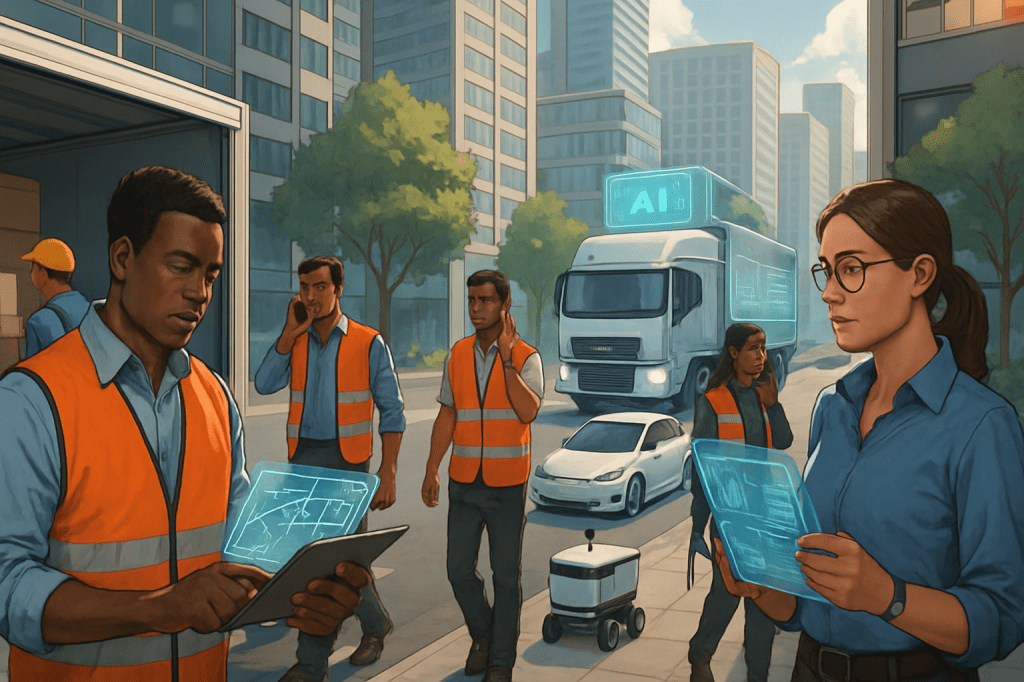
The narrative isn’t just about job losses; it’s about job *shifts*. Tesla’s robotaxi project offers a glimpse into this future. They aren’t hiring drivers, they’re hiring:
- Fleet operations specialists to coordinate the robotaxi fleet.
- Logistics managers to handle charging and cleaning.
- Remote assistance teams to handle edge cases.
- Site leads to stitch it all together.
Why is this important? It demonstrates that AI creates new types of jobs, even as it eliminates others. The labor story isn’t abolition; it’s reconfiguration. These are logistics and operations roles, meaning compensation gravitates toward warehouse-and-hub pay bands, not the high-variance, tip-influenced earnings familiar to ride-share.
What does this *really* mean? The future of work isn’t just about AI *doing* the work; it’s about humans *managing* the AI. The dignity of the work moves from service persona to safety protocol—less small talk, more checklists. As one of our daily posts put it, “If you want to know when AI truly arrives in a sector, watch for the moment companies start staffing the midnight hour. That’s when experiments become operations, and when jobs change hands.”
Meta’s $600 Billion Bet: AI as a Job Creation Engine (For Some)
Meta’s massive $600 billion investment in US AI infrastructure is a game-changer. They’re framing it as an employment and local-economy play as much as a compute strategy.
Why is this important? It shifts the narrative from AI as a job destroyer to AI as a job *creator*, at least in specific sectors. Meta points to a track record: data center projects since 2010 have supported more than 30,000 skilled-trade construction roles and 5,000 ongoing operations jobs, and the company says it is already routing more than $20 billion to subcontractors across steel, electrical, piping, fiber, and other trades.
What does this *really* mean? AI got good before it got physical. The last breakthroughs were downloadable: models scaling across cloud clusters, inference sliding into apps. The $600 billion era is different. It has a smell—of cut concrete, oiled cable, and transformer varnish. It occupies land, so it requires land-use approvals. It draws power, so it must be negotiated with utilities that move at civilizational speed. And it takes hands—many of them—to bring it online.
The UK’s Reality Check: 17% Expect AI to Shrink Staff
Across the pond, the UK’s Chartered Institute of Personnel and Development (CIPD) dropped a bombshell: 17% of employers expect AI to shrink their workforce in the next 12 months. This isn’t speculation; it’s a forward-looking signal from HR professionals who are actively planning their 2026 budgets.
Why is this important? It’s a concrete number, not just a vague feeling. It’s a forward-looking signal from the HR body that central bankers and ministers read before breakfast. It was gathered from more than two thousand employers between late September and mid-October, a period when budgets for 2026 are being locked.
What does this *really* mean? The roles most at risk are the connective tissue of modern organizations: clerical, administrative, junior managerial, and certain professional jobs. Not factory floors. Desktops. Calendars. Dashboards. The layer that routes information, compiles reports, drafts summaries, checks compliance boxes, and keeps the machine aligned. As the CIPD points out, this could create a “vanishing rung” problem, where junior positions are eliminated, disrupting the ladder for future senior staff.
Gartner’s “Jobs Chaos”: Get Ready for Constant Change
Gartner isn’t predicting a jobs apocalypse. They’re predicting something arguably more disruptive: “jobs chaos.” They estimate that around 2028-2029, the enterprise will be in a constant state of renovation, with roles being rewritten at an industrial scale.
Why is this important? It shifts the focus from job *losses* to job *evolution*. They gave the tempo in two daily beats: roughly 150,000 roles evolving through upskilling and another 70,000 being rewritten outright. Blend that across a year and you get more than 32 million jobs reshaped, not as a headline about layoffs, but as an operating reality of redesign, task splintering, and role fusion.
What does this *really* mean? Role design becomes a standing function, not an occasional reorg. Expect job families to be defined as task portfolios, versioned like software, and refreshed every quarter. Compensation will start to account for “AI leverage”—how effectively a person compounds output and reduces error with the systems around them—rather than only tenure and title.
Holiday Hiring Hangover: Retail’s Automation Infusion
The holiday hiring season is usually a reliable indicator of economic health. This year, it’s telling a different story: retailers are planning the leanest holiday hiring since 2009, thanks to automation and AI.
Why is this important? It’s a visible, time-bound proof point that AI’s labor effects aren’t confined to white-collar roles or pilot projects. It’s happening at the checkout lane, at curbside pickup, and in the aisles where managers once trained seasonal hires by the dozen.
What does this *really* mean? Retailers are leaning on automated checkout, AI-assisted service tools, and robot-rich fulfillment centers to handle the holiday rush without a surge in hiring. Walmart, for example, plans to hold its workforce steady for the next three years, even during peak season. This is a template for an “AI-enabled peak”: stretch existing teams with software, lean on flexible pools, and add net-new headcount only when demand breaches modeled scenarios.
Singapore’s AI Finance Blueprint: A Regulator Takes Charge
Singapore’s central bank, MAS, is taking a proactive approach to AI in finance. They’ve released a “Generative AI Jobs Transformation Map” that outlines how specific jobs will change and identifies the new roles that will be needed.
Why is this important? It’s a regulator actively shaping the labor market for AI. It names how specific jobs in finance will change, whether they are mainly augmented—same responsibilities, fewer manual steps, faster throughput—or redesigned, where workers inherit new tasks that sometimes leap across existing job families.
What does this *really* mean? Instead of AI showing up and workers adapting in its shadow, the workers—and the jobs they’ll grow into—are being planned first, with models expected to fit the shape of the human system. For once, the org chart isn’t the last thing to change.
So, what’s the takeaway from this week’s AI job market rollercoaster? The robots aren’t *necessarily* coming for your job, but your job *is* changing. The key is to adapt, learn new skills, and be ready to navigate the “jobs chaos” that Gartner predicts. And maybe, just maybe, start looking into a career in AI-adjacent fields like data center construction or robotaxi fleet management. You never know!
