
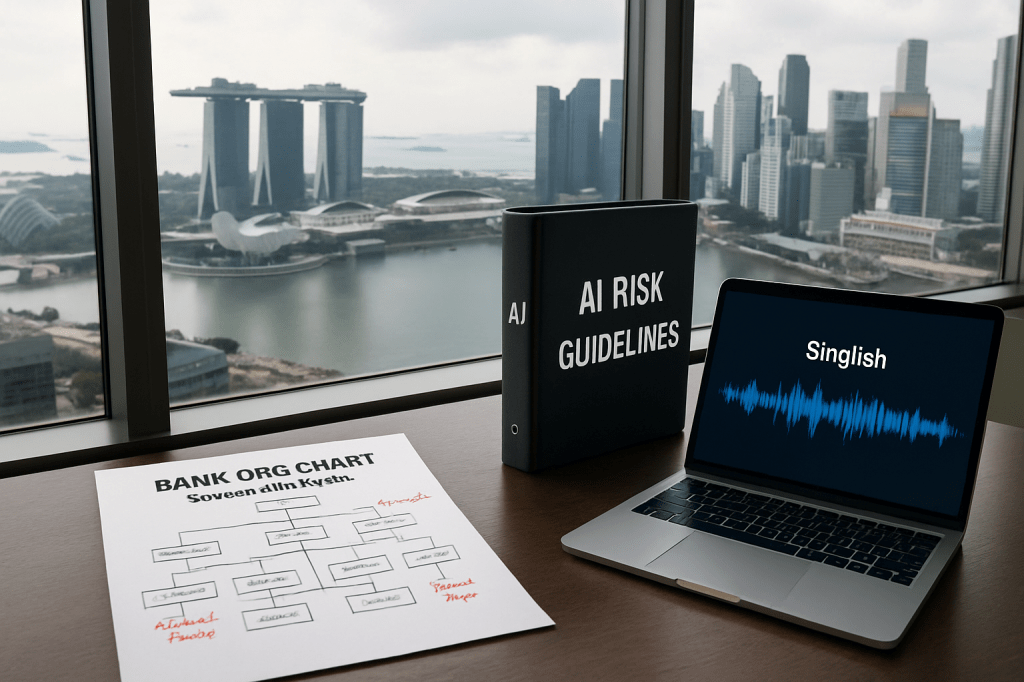
Singapore’s Central Bank Just Drew the Org Chart for AI Finance
The hall at the Singapore FinTech Festival was heavy with the usual product demos and promises. Then MAS managing director Chia Der Jiun walked on stage and did something different: he talked about people. Not in the abstract—about roles, tasks, career ladders, and the new jobs that will exist because generative AI is no longer a speculative pilot but a production system inside banks and insurers. The announcement wasn’t another report to skim. It was a map with directions, and the regulator held the pen.
At the center was the Generative AI Jobs Transformation Map, a collaboration with the Institute of Banking & Finance and Workforce Singapore. The map does what most strategy decks dodge. It names how specific jobs in finance will change, whether they are mainly augmented—same responsibilities, fewer manual steps, faster throughput—or redesigned, where workers inherit new tasks that sometimes leap across existing job families. It also calls out what’s missing in the headcount: AI strategy leads, AI product managers, and trust and model-risk specialists who will give executives the confidence to scale without lighting a fuse under operational risk.
Framing a workforce plan might have been enough, but MAS paired it with proposed AI risk-management guidelines. That pairing matters. In most markets, compliance lives in one document and workforce lives in another, and the gap between them is where transformation efforts stall. MAS effectively bound them together: if you’re adopting GenAI for sales, software engineering, customer service, or risk, here is how you are expected to govern the models—and here is how you are expected to equip the humans who will be accountable for them.
From department rumor to operating doctrine
The map takes on a practical problem: diffusion. A few star teams can always turn AI into an advantage; the challenge is spreading capability across thousands of employees without chaos. IBF says MAS and IBF are already working with a first cohort of ten major institutions—global and local banks and insurers—on pilots pinned to concrete use cases. Next to those pilots sits PathFin.ai, a peer-learning hub built to compress the distance between “it worked over there” and “we run it here.” That’s not a vanity portal; it’s infrastructure for institutional memory, designed to lower the cost of copying what works and to make job redesign a repeatable, auditable process rather than a thicket of bespoke experiments.
There is a second, telling signal: an industry project to build a speech model that understands Singlish for frontline service. That’s not just local flavor. It telegraphs an intent to rebuild customer-facing work around AI rather than treat it as headcount to trim. If your voice bot speaks the language customers actually use, you aren’t experimenting; you’re changing the service architecture. And if you change the service architecture, you change the work. The job is no longer “answer calls,” it’s “orchestrate AI-assisted conversations, monitor model drift, escalate exceptions, and feed the system new edge cases.” The map’s taxonomy of augmented and redesigned roles becomes a lived reality, not a label.
The hidden lever: literacy at scale
Every institution has a long tail of roles that interact with AI indirectly—relationship managers summarizing calls, compliance analysts triaging alerts, operations staff validating outputs. MAS pushes basic fluency into that tail: prompt design, GenAI principles, responsible use. This is not a coding bootcamp; it’s a language requirement for modern finance. When an entire sector shares a baseline vocabulary about how models behave and fail, you get fewer brittle deployments and fewer governance theatrics. You also get more grounded feedback loops from the edge back to the teams that tune and monitor the models.
Regulators as workforce architects
The novelty isn’t that a regulator cares about AI risk. It’s that MAS is using its convening power to choreograph the labor market that AI requires. In a systemically important industry that employs armies in client service, risk, operations, and software, this is not a memo—it’s a labor allocation mechanism. By naming new roles and spelling out the skills that incumbents should acquire, MAS is seeding the supply side of talent while signaling the demand side to budget for it. Other financial hubs can copy the template precisely because it connects governance to execution: guidelines to keep you out of trouble, and a workforce plan to make the transformation stick.
The upside—and the trap
There are two futures nested in this move. In the first, banks retool job families, lift literacy, stand up model-risk talent, and keep humans in the loop where it actually matters. Productivity rises, customer experience changes shape, and the sector’s AI maturity stops being uneven. In the second, firms treat the map as a checkbox, rebadge staff without redesigning workflows, and turn “AI trust” into a ceremonial function that blesses deployments it never influenced. The difference won’t be in the speeches; it will be visible in how quickly redesigned roles gain new performance metrics and career paths, and in whether the Singlish model and its cousins are wired into service recovery, compliance logging, and training data pipelines rather than showcased on a stage and forgotten.
What to watch next
If this is truly policy-adjacent action, the milestones will be blunt: the number of roles formally redesigned, the volume of staff completing foundational training and moving into AI-governance and engineering tracks, the rate at which PathFin.ai case studies graduate from pilot to scaled deployment, and whether the proposed risk guidelines close the loop with model validation practices that auditors can actually test. Singapore just made AI workforce planning a matter of public policy in finance. That turns the usual story inside out. Instead of AI showing up and workers adapting in its shadow, the workers—and the jobs they’ll grow into—are being planned first, with models expected to fit the shape of the human system. For once, the org chart isn’t the last thing to change.
