
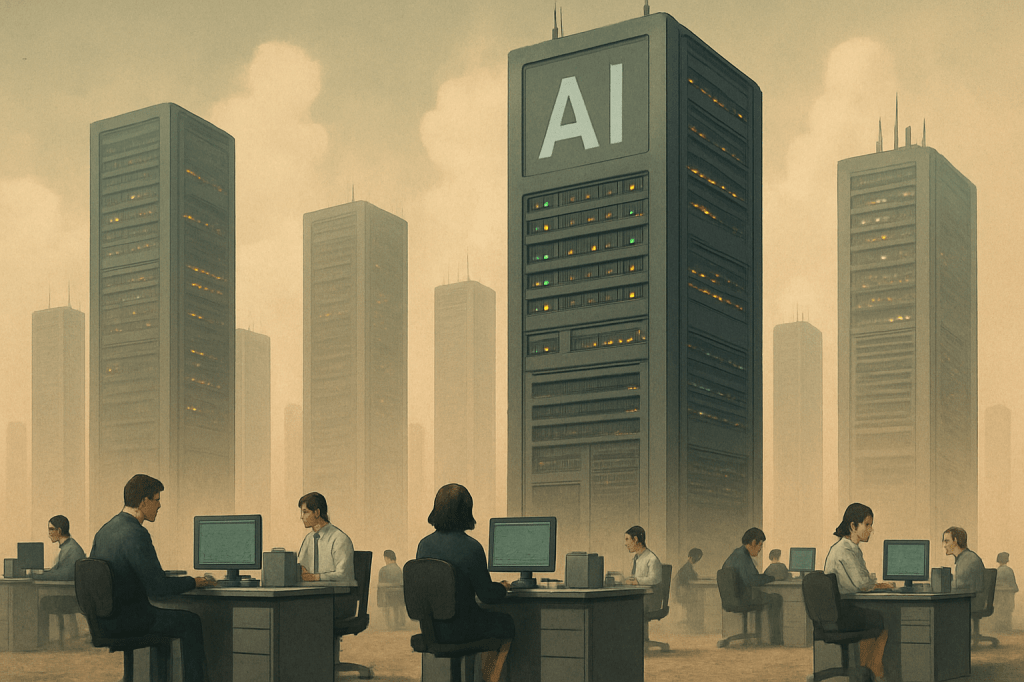
AI Impact on the Job Market – News (November 14, 2025 to November 21, 2025)
Ever notice how everyone suddenly becomes an expert on a topic *after* it starts impacting them directly? It’s like realizing you need a fire extinguisher only *after* the kitchen’s ablaze. This week, the AI job market situation got real, with major players weighing in and the impact starting to hit closer to home.
The C-Suite Crystal Ball: From Optional Work to Obsolete CEOs
Tech leaders this week offered a wild range of predictions about AI’s impact on employment, a spectrum so broad it’s hard to reconcile. Let’s break it down:
- Elon Musk: Foresees a future where work is “optional” within a couple of decades, thanks to AI and robotics. He even thinks poverty could be eliminated. Ambitious, to say the least.
- Sundar Pichai: Thinks the role of CEO might be ripe for AI takeover. This echoes Sam Altman’s sentiment that he’d be thrilled if AI could do his job better. Is this genuine humility or a sign they know something we don’t?
- Jensen Huang: In stark contrast, believes AI is nowhere near replacing workers in complex roles. He thinks AI has “no possibility of doing what we do.” Talk about a vote of confidence in humanity!
- Dario Amodei: Offers a more sobering view: AI could wipe out *half* of all entry-level white-collar jobs within 1-5 years. This is the prediction that should be keeping recent grads up at night.
Why is this important? Because these aren’t just random opinions. These are pronouncements from the people shaping the technology that’s reshaping the job market. The sheer divergence highlights the uncertainty and the high stakes. It also demonstrates the need to be prepared for multiple potential futures, not just the rosy, utopian one. In short, hope for the best, but plan for Amodei’s scenario.
“AI Efficiency” as the New Layoff Euphemism
While no single massive layoff was *solely* blamed on AI this week, the trend of “AI restructuring” is undeniable. The numbers are stark: nearly 50,000 job cuts in the U.S. this year have cited AI, with over 31,000 in October alone. Federal Reserve Chair Jerome Powell is paying attention, and so should we.
Remember when companies used to dance around layoff announcements with phrases like “streamlining” or “rightsizing”? Now, it’s all about “AI efficiency.” ServiceNow CEO Bill McDermott’s comment that AI agents “don’t need any lunch and they don’t have any healthcare benefits” is brutally honest. Amazon, after cutting 14,000 corporate roles, pointed to “AI efficiency gains” and “organizational restructuring”. Salesforce directly replaced 4,000 customer service jobs with AI agents, a move Benioff openly acknowledged would lead to “fewer” human employees.
The plot twist: Some companies that rushed to lay off workers in anticipation of AI replacement are now *rehiring* them. This suggests that the reality of AI implementation is more complex than the hype, and that human expertise is still crucial, at least for now. It also highlights the “flywheel risk” – cutting too deep, too fast, can lead to brittle customer experiences and loss of institutional knowledge.
The New Merit Badge: “Powered by AI” Layoffs
The narrative around layoffs is shifting. It’s no longer about weakness; it’s about demonstrating the “courage” to implement AI at scale. Companies are being rewarded by investors for showing they’re not “waiting” to automate. This has turned layoffs into a “signaling device,” a way to project managerial discipline. Announcements now explicitly link automation milestones with headcount reductions, making the cuts tangible proof that the AI is delivering savings.
The impact: White-collar corporate functions are the initial target. Generative AI is swallowing routine analysis, templated communications, and forecast-to-report cycles. This thins the org chart in the middle, as a single manager can supervise larger teams with AI handling the base work.
The danger: The incentive to find more AI-linked layoffs could lead to overshooting. Not every role is modular, and not every process shrinks cleanly. Companies that compress too quickly risk customer experience failures and knowledge loss.
The Graduate Job Market: AI vs. AI
The graduate job market is becoming a battleground of algorithms. Students are using AI to perfect their resumes and cover letters, while employers are using AI to screen those same applications. As one King’s College London student put it, “There is so much more competition now because everyone has amazing CVs and cover letters thanks to AI. Not using it will only make me fall behind.”
Marco Amitrano, head of PwC’s U.K. practice, notes that “AI is reshaping roles, global markets remain volatile, and graduate intakes everywhere are under pressure.” The result? A new paradox where individual merit struggles to stand out in a sea of AI-generated perfection.
The Year the Entry-Level Job Went Missing?
The entry-level job market is facing a potential crisis. Senator Mark Warner warned that recent college graduates could face unemployment as high as 25% within two to three years. He called it “unprecedented social disruption,” pointing to families who spent years optimizing for a diploma that may no longer unlock a first job.
Warner’s argument: AI changes the production function most cleanly at the entry level. Generative models excel at tasks previously assigned to juniors, like drafting, summarizing, and reconciling. Firms are tempted to skip apprenticeship costs and pair senior talent with machines. This has led to weakened recruiting cycles in tech and business roles.
The danger: When the bottom rung disappears, it severs the pipeline that produces the next generation of leaders. Organizations become rich in veterans and tools but poor in apprentices.
The solution? Warner and Senator Josh Hawley proposed the AI-Related Job Impacts Clarity Act, which would compel companies and federal agencies to report AI-related layoffs, retraining, and hiring to the Labor Department for public release. This would provide a baseline for targeted interventions.
Texas Courts the AI Substrate: Data Centers as Job Engines
Google’s $40 billion commitment to Texas isn’t just another announcement about “jobs created”; it’s a blueprint for where the physical backbone of machine intelligence will live. Google is planting three new data center campuses in rural counties, deliberately scattering AI operations work beyond the coastal grids.
The impact: Six-figure infrastructure jobs and mid-skill operations roles will pop up in unexpected places. The near-term hiring surge will look like a construction site: electricians, HVAC techs, ironworkers, and concrete crews. Then the baton passes to operations technicians, reliability engineers, and facilities specialists.
The long game: The project includes apprenticeships and training for college students and electrical apprentices. This focuses on scarce and valuable skills like licensed electrical talent, high-voltage expertise, and industrial refrigeration.
The takeaway: Texas isn’t just landing data centers; it’s landing a workforce architecture for the AI era. The beneficiaries are not just the PhDs writing models, but the apprentices wiring switchgear and the technicians tuning chillers.
AI: A Tool for Tasks, Not a Guarantee for the Future?
A recent Fox News poll revealed a telling attitude gap. While a narrow majority of employed voters (51%) called AI a good thing for their *current* job, that optimism dips when they look at the *long-term* career (43%) and the *economy* (only 10% expect AI to create more jobs than it eliminates). The psychology is familiar: “I’m fine – everyone else is in trouble.”
The message: Workers are living with AI as a tool today and preparing for it as a job eliminator tomorrow. This means that AI rollouts inside companies need to focus on credible productivity wins and skills ladders, not abstract promises about transformation.
The operating lesson: Make the assistive value of AI obvious, measure the gains, and reinvest them in visible upskilling. For policymakers, pair targeted training dollars with transparent metrics and time-limited support in sectors already bracing for displacement. The key is to acknowledge the dual reality – productivity now, pressure later – and build a bridge between the two.
Ultimately, this week’s news highlights a period of significant transition. The long-term effects of AI on the job market remain a subject of intense debate, but the immediate impact is becoming clearer as companies restructure their workforces and individuals adapt to a new technological landscape. The key is to stay informed, adapt quickly, and remember that the future of work is being written in real time.
