
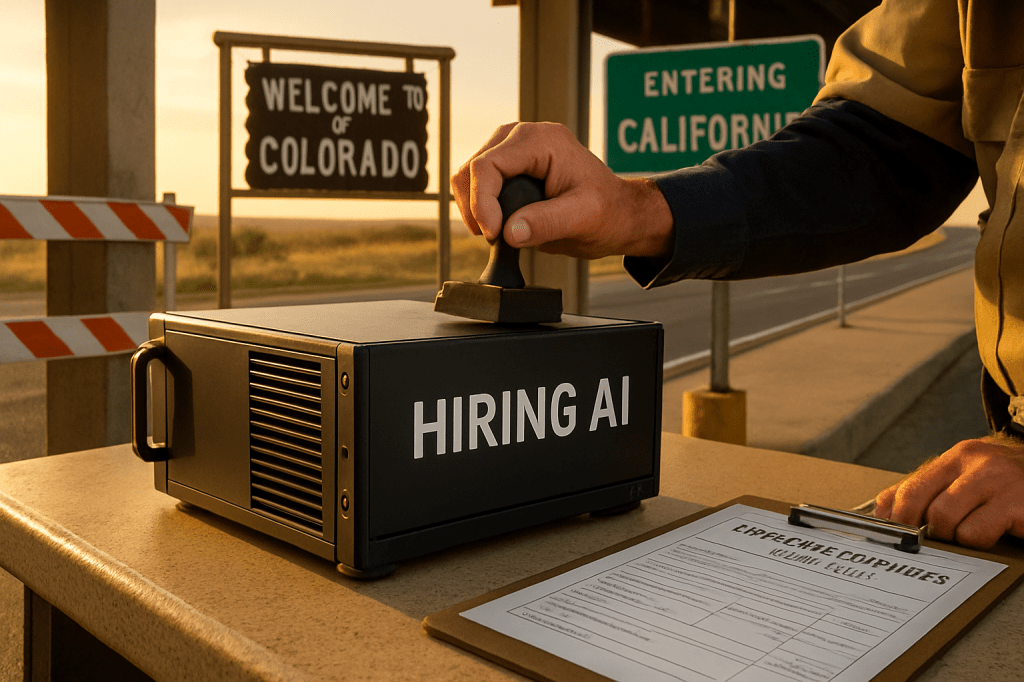
When the States Drew a Line Around Workplace AI
Yesterday’s most important employment story didn’t come from a courtroom or a lab. It came in the form of a letter. Thirty-five state attorneys general, joined by D.C., told Congress in plain language: do not wipe out state AI laws. New York’s Letitia James led the coalition and warned of “disastrous consequences” if Washington preempts state rules. The subtext was sharper than the stationery—this fight is about who decides how algorithms judge people at work, and whether local safeguards survive the push for a single national standard.
For a year, the political energy around AI has orbited big abstractions: safety thresholds, frontier model risk, geopolitical competition. Yesterday narrowed the lens to something far more immediate and intimate: the software choosing who gets hired, who advances, and who is shown the door. The AGs framed their case as a defense of state power to protect residents, but the practical effect is concrete. If they prevail, employers and HR tech vendors will live with state-level obligations that are not theoretical and not distant—they are arriving on a timetable that maps to current product roadmaps and 2026 headcount plans.
The fight is not about models; it’s about management
Reuters’ write-up made it clear: this is an employment story. The AGs defended state authority specifically over AI systems that shape consequential workplace decisions. That framing matters because it pulls the dispute out of the realm of generic tech policy and plants it in the middle of HR operations. A state-led approach means developers and deployers will face duties to test, document, disclose, and answer for algorithmic effects on people’s livelihoods. It also means variance—compliance that changes at the border and sometimes at the city limit—will be a feature, not a bug.
The federal government has been edging toward the opposite vision. After a 99–1 Senate vote against halting state AI laws signaled how politically sensitive preemption has become, the administration explored other routes, including inserting preemption into the National Defense Authorization Act and even an executive order instructing DOJ to challenge state statutes. Parts of the tech industry have cheered for a single standard, arguing that fragmented rules inflate costs and stifle deployment. But that national “clarity” would likely flatten the most aggressive state experiments in employment protections. Yesterday’s letter is the states saying they won’t surrender that terrain.
Two jurisdictions already writing your implementation plan
Colorado is the clearest marker. Its Anti‑Discrimination in AI Law takes effect February 1, 2026, and it does something simple but powerful: it requires both developers and deployers of “high‑risk” AI—explicitly including employment decisions—to exercise reasonable care to prevent algorithmic discrimination. That phrase is backed by obligations that product and compliance teams can’t hand-wave away: risk‑management programs, impact assessments, disclosures, and notices that include adverse‑action explanations and human‑review rights. If the AGs hold the line, these duties will not be paused or preempted; they will mature right on schedule.
California has already moved. New FEHA regulations, effective October 1, 2025, require anti‑bias testing for automated decision-making tools across recruitment, hiring, promotion, training, and termination. They also cement recordkeeping obligations and clarify how liability is shared between employers and vendors. Layer on California’s developer‑facing transparency law for frontier models (SB‑53) beginning in 2026, and you get a stacked regime: workplace testing and documentation on the deployer side, and disclosure and risk‑mitigation duties on the developer side. In other words, operating in California will not be the same as operating elsewhere.
If preemption wins, or if the states do
Imagine Congress tucking preemption into the NDAA or the White House moving by executive order. The immediate outcome would be litigation, and likely motions to freeze state rules while federal courts decide what “preemption” actually covers. That limbo would offer short-term relief to companies facing near-term compliance deadlines, but it would also produce whiplash: audits started, audits stopped, vendor contracts rewritten, then rewritten again. And a uniform federal framework, if it arrives quickly, is liable to be a floor that feels like a ceiling—cleaner to administer, possibly weaker on protections.
Flip the scenario. If the AGs’ position holds, the states continue to run their own experiments. Employers will have to treat AI in HR as a regulated product, not just an internal tool. That means governance programs that are jurisdiction‑aware by design: bias testing keyed to local metrics and definitions; impact assessments that can be produced on demand; adverse‑action notices that cite model logic in human‑readable terms; and human‑review pathways that actually reverse decisions. Vendors will be forced to ship configurability as a feature, offering policy toggles, report templates, and audit logs mapped to Colorado and California requirements rather than to a single national template. Procurement will change too, with buyers insisting on indemnities, data access for audits, and service‑level commitments for remediation when tools drift.
The federalism wager employers are making right now
This is not a distant constitutional debate. It is a product and process question on a one‑year clock. Colorado’s rulemaking and effective date, California’s enforcement under FEHA, and any executive action from the White House will determine how your 2026 hiring stack is built. Betting on preemption invites a wait‑and‑see posture that could leave teams scrambling if the courts don’t deliver relief. Building to the strictest common denominator—Colorado plus California—costs more up front but buys resilience against policy shocks and makes future federal standards easier to absorb.
There’s also a strategic upside to the state‑led route that rarely gets airtime: it creates real‑world feedback. When different jurisdictions require different tests, different disclosure artifacts, and different human‑review workflows, organizations generate comparative evidence about what reduces bias and what doesn’t. That evidence can harden into best practices faster than a one‑size‑fits‑all statute negotiated in the abstract. Uniformity is tidy; learning is messy. Yesterday’s letter embraced the mess.
What to watch next
The tells are straightforward. Does preemption language appear in the NDAA text? Does an executive order task DOJ with suing the states, and how quickly do those cases move? Do courts issue injunctions that freeze Colorado’s runway or California’s new employment rules? If none of that materializes in time, February 1, 2026, becomes a real deadline, not a theoretical one, and the HR tech market will pivot accordingly—toward tools that can explain themselves, produce audit‑ready artifacts, and hand decisions back to humans when the law says they must.
The bottom line
Yesterday, the nation’s attorneys general didn’t just defend state power; they put a stake in the ground for how AI will govern work. If they succeed, employers will navigate distinct, enforceable guardrails on algorithmic hiring and evaluation. If they fail, a federal preemption push could sweep those guardrails aside. Either way, the architecture of AI compliance in U.S. workplaces for the next 12 to 24 months was shaped by that letter. The smart money prepares for the stricter path—and treats federal relief, if it comes, as a bonus rather than a plan.
