
When the layoff warning learned a new word
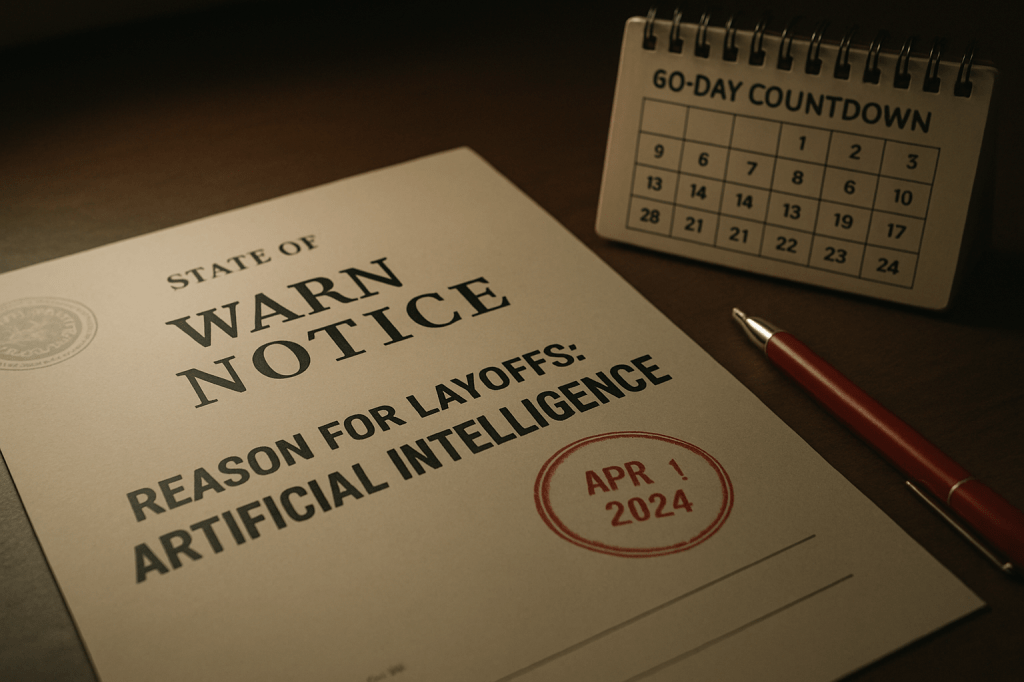
Somewhere in a corporate back office, an HR director filled out a form that used to be grim but routine. This time, the form spoke back. The WARN notice—the bureaucratic smoke alarm for mass layoffs—didn’t just ring; it said why. Alongside tariffs and softening demand, AI was written plainly into the rationale. Not as a euphemism or a buzzword-padding slide, but as a reason. If you’ve been listening to earnings calls all year, you could hear this coming. Yesterday it showed up in ink.
The leading indicator grows a voice
WARN notices are not headlines; they are timestamps. Large employers have to tell the state, and by extension workers, that the clock has started—sixty days, then jobs go. Because not every reduction requires a warning, WARN is a partial lens. But it is an early one, and it just sharpened. According to Goldman Sachs analysis summarized by the Economic Times, WARN filings climbed to their highest level since 2016, excluding the pandemic spike. That would matter on its own. The twist is that companies are now explicitly naming artificial intelligence as part of the logic for restructuring. The subtext graduated to subject line.
From efficiency whisper to headcount plan
For most of 2025, AI lived in the comfortable ambiguity of “productivity.” Managers promised margin expansion via automation while keeping job impacts hypothetical. That detour is over. When a WARN notice cites AI, it converts a management storyline into an operational plan. The legal notice does something slides don’t: it binds the narrative to dates, locations, and people. It also signals to investors that the cost takeout won’t rely on natural attrition alone. In plain terms, automation is moving from “we’ll be leaner” to “we’re making the team smaller.”
Who stands in the first draft of the blast radius
Because WARN thresholds are high, the first wave concentrates in mid- to large-employer sites. And because generative systems now handle text, tickets, and rules as easily as scripts handled clicks, the earliest exposure sits in shared services and back-office work: customer support tiers that resolve predictable issues, finance ops that reconcile and route, HR operations that process changes, compliance functions that standardize reviews, marketing ops that produce and repurpose collateral. The old automation boundary—structured inputs only—has widened to include much of corporate routine. Where the process is consistent and the stakes are moderate, the models are ready enough and the CFO is impatient.
The calendar math into early 2026
WARN is a metronome. Notices filed now generally mature into separations about two months later, which points the impact bar into early 2026. AI is not the sole cause of this cycle, but it is an accelerant: it turns a cost-control impulse into a credible execution plan. If the notices convert as they usually do, state rapid-response teams will race to triage reskilling and placement just as budgets reset. The cadence matters for workers plotting transitions and for teams about to lose institutional memory in a single quarter.
The investor translation layer
Markets prize a clean bridge from “AI investment” to “lower SG&A.” Citing AI in WARN filings is a promise to make that bridge real. The risk is that a rapid cut harvests short-term margin while seeding long-term operating debt: elevated error rates, hallucinated data, eroded service quality, and the quiet cost of humans cleaning up after models in places no KPI detects. Some leaders will thread the needle with careful role redesign and measured automation. Others will rediscover that headcount was also a quality control system, and that models still need scaffolding built by people who are no longer on payroll.
The missing pixels in the picture
This surge is signal, not a census. WARN excludes many smaller or distributed reductions and sometimes overstates cuts that never happen if conditions improve. Off-notice tactics—hiring freezes, contractor roll-offs, role redefinition—don’t show up at all. But when a legally required early indicator jumps and the rationale includes AI, the direction is hard to misread: automation has crossed from background efficiency to foreground cause.
What to do while the clock runs
If your work produces standardized outputs from repeatable inputs, assume that AI is now embedded in the business case reviewing your role. The asymmetry is timing: organizations flip the switch faster than people can pivot. The counter is to make yourself the switch—own the tooling, the prompts, the guardrails, and the exception paths. Leaders face a mirror problem: cost saves booked today must be paired with measured-quality dashboards tomorrow, or the savings leak back through churn and remediation. The firms that win this cycle won’t just automate tasks; they’ll automate with traceability and teach humans to supervise systems with judgment rather than perform tasks by rote.
The story underneath the story
For years we debated whether AI would “replace jobs” or “augment workers.” Yesterday’s data point says the debate is over in one dimension and still open in another. Replacement is now an operational claim showing up in statutory paperwork. Augmentation remains a strategic choice that determines whether the savings endure. If this is the new normal, the frontier of employability shifts from doing the task to governing the system that does it. WARN is telling us when the old roles end. The scramble ahead decides which new ones begin.
