
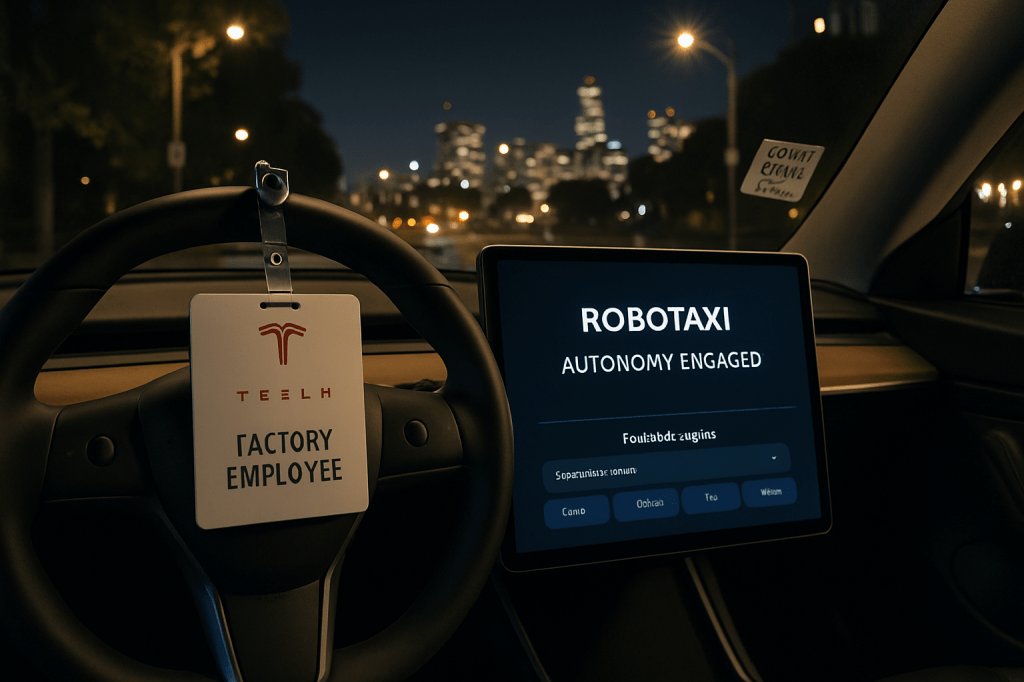
The day Tesla turned its factory inside out
On Sunday, Tesla quietly redrew the boundary between manufacturing and mobility. Notices went up inside California facilities inviting production associates, material handlers, and even members of the sales floor to clock in after hours for a different kind of shift. Same badge, different seat. The job title was new but instantly legible to anyone tracking autonomy: AI operator. The work is to sit behind the wheel while Full Self-Driving is engaged, pilot the handoff between machine and human when needed, greet riders, and record the granular, context-heavy feedback that models crave. The pay runs about $25 to $30 an hour, with referral bonuses sweetening the pitch, and the chairs do not cool—Tesla is staffing the role in 24/7 rotations as it tries to widen the aperture on its Robotaxi pilot.
The move, first reported by Business Insider, isn’t just about filling cars. It is Tesla reaching back into its own workforce to solve the most old-fashioned problem in on-demand transport: not enough supply where and when people want a ride. Since the Robotaxi app opened to the public in the Bay Area this fall, riders have seen wait times spike—sometimes north of 40 minutes. You can scale software overnight; you cannot conjure vehicles, route density, or on-the-job experience the same way. By deputizing factory and showroom staff as in-car AI operators, Tesla gains a lever it controls completely: it can add hours, expand coverage windows, and harvest richer operational data immediately, without waiting for the policy universe to catch up.
The regulatory container
California has made the shape of this stopgap very explicit. Tesla’s service is not licensed as a driverless passenger program; it runs under a CPUC charter-party permit that requires a human driver in the seat. As of late 2025, the CPUC told outlets it had registrations for 1,655 vehicles and 798 drivers tied to Tesla’s service. Those figures signal approved capacity, not a live fleet count, but they hint at the ceiling—and the choke point. Tesla does not hold permits to charge the public for driverless rides in the state, which means someone must be present to answer both to the model and to the rules of the road. Elsewhere, the constraints rhyme even when the statutes differ. Tesla says it is operating or preparing services in places like Arizona, where it holds a transportation network company permit, and in Austin; in both cases it still relies on human safety operators, and Austin officials told Insider they had no date from Tesla for a driverless rollout despite Elon Musk’s public optimism. The product may be software-first, but right now the deployment is policy-bounded and human-mediated.
The labor experiment hiding in plain sight
What looks like a logistics fix doubles as an employment story with teeth. The automotive industry has hired safety drivers for years, but typically at arm’s length through contractors and specialized vendors. Tesla is formalizing the role inside the house. That changes incentives. It creates a pathway for overtime, cross-training, and internal mobility, shifting some labor from the line and the showroom onto public streets where the company’s models learn. It also collapses the feedback loop: the person who understands how parts come together or how customers complain about lane selection is now the person teaching the model what to do at a tricky merge. In a world where autonomy progress depends on targeted data, this is not a side gig—it is an on-road data operation with a steering wheel.
There is a deeper inversion here. Automation usually arrives draped in promises to remove humans from repetitive work. Tesla’s program does the opposite in the short run: it pulls more people into the loop to make the automation work. The car becomes a mobile annotation studio, and the operator an instrumented critic, charged with catching edge cases, narrating them in detail, and feeding that back into a system that is supposed to need them less and less. You could call it a learning flywheel with payroll. Every hour on a shift is not just a service delivered; it is training budget for a model that must improve while under real economic and regulatory pressure.
This also says something about the flavor of work AI is creating in the interim. Instead of a platform pushing risk onto contractors, Tesla is paying employees to embody the company’s risk, judgment, and compliance obligations in real time. There are pragmatic reasons for that: consistent quality, easier coordination, better data discipline, and a workforce already covered by corporate policies. But it subtly shifts the social contract. A carmaker is now an employer of drivers for its own AI, not merely of assemblers for cars that someone else will drive. For the near term, it means jobs that blend customer service, machine supervision, and field research—roles that many workers did not train for but can learn quickly, because the core skill is still attention under uncertainty.
The medium-term fork
If Tesla keeps expanding under human-in-the-loop constraints, it will need a sizable corps of operators to smooth demand spikes and to collect the high-variance data its models hunger for. That is job growth tied directly to deployment, not to R&D: the busier the service, the more operators you need to both meet rider expectations and sharpen the model. The economics will be watched closely. Paying $25–$30 an hour across 24/7 shifts is not trivial, but the spend buys more than capacity—it buys a faster gradient for learning. Whether that is efficient depends on how quickly the incidents that once required intervention stop appearing with any meaningful frequency.
Of course, the other branch of the fork is well understood. Should California or any other jurisdiction grant broader driverless permissions, the in-car role will shrink. It will not vanish; on-street testing and support will persist. But headcount will likely migrate toward remote operations, fleet maintenance, dispatch, rider support, and city-by-city compliance work. The CPUC’s ongoing rulemaking on autonomous passenger services is the metronome here. Policy cadence will decide when the labor mix flips and how abruptly. Until then, the company will live in a liminal state where model capability, public tolerance, and legal boundaries co-determine staffing plans as surely as rider demand does.
Why this mattered yesterday
Plenty of companies talk about AI as destiny; fewer publish a pay rate and a shift schedule to make it real. Tesla just did. According to Business Insider’s reporting, the company is recruiting across its own ranks, offering overtime and referral bonuses, and seeding a new job category at national scale. It is a clean line from AI ambition to wages, duties, and guardrails, shaped as much by the CPUC’s permit structure and registration counts as by any neural network. The detail that many vehicles on the state rolls are approvals rather than active cars underscores the point: the current bottleneck is not software alone; it is staffing under regulation.
That is why this was the employment story to watch. We are watching an automaker turn its insides outward, sending its people into the field to teach machines how to be better colleagues. The factory does not end at the loading dock anymore; it carries on through intersections, across bridge spans, and into late-night curbside pickups where an employee in a company jacket narrates the world for a model that is almost there. The future, for now, is being hand-delivered—one ride, one log entry, one overtime shift at a time.
