The Year the Budget Starts Saying No
New Year’s Eve stories usually trade in optimism or guilt. This one brought a ledger. In TechCrunch, Rebecca Szkutak gathered a chorus of enterprise investors who are not forecasting so much as describing a plan already in motion: 2026, they say, is when companies stop calling AI a helper and start booking it as headcount. The phrase “year of agents” landed like a status update and a deadline at once—software that doesn’t merely draft emails, but quietly moves work from inbox to archive, from claim to payout, from lead to closed-won, with no human in the middle.
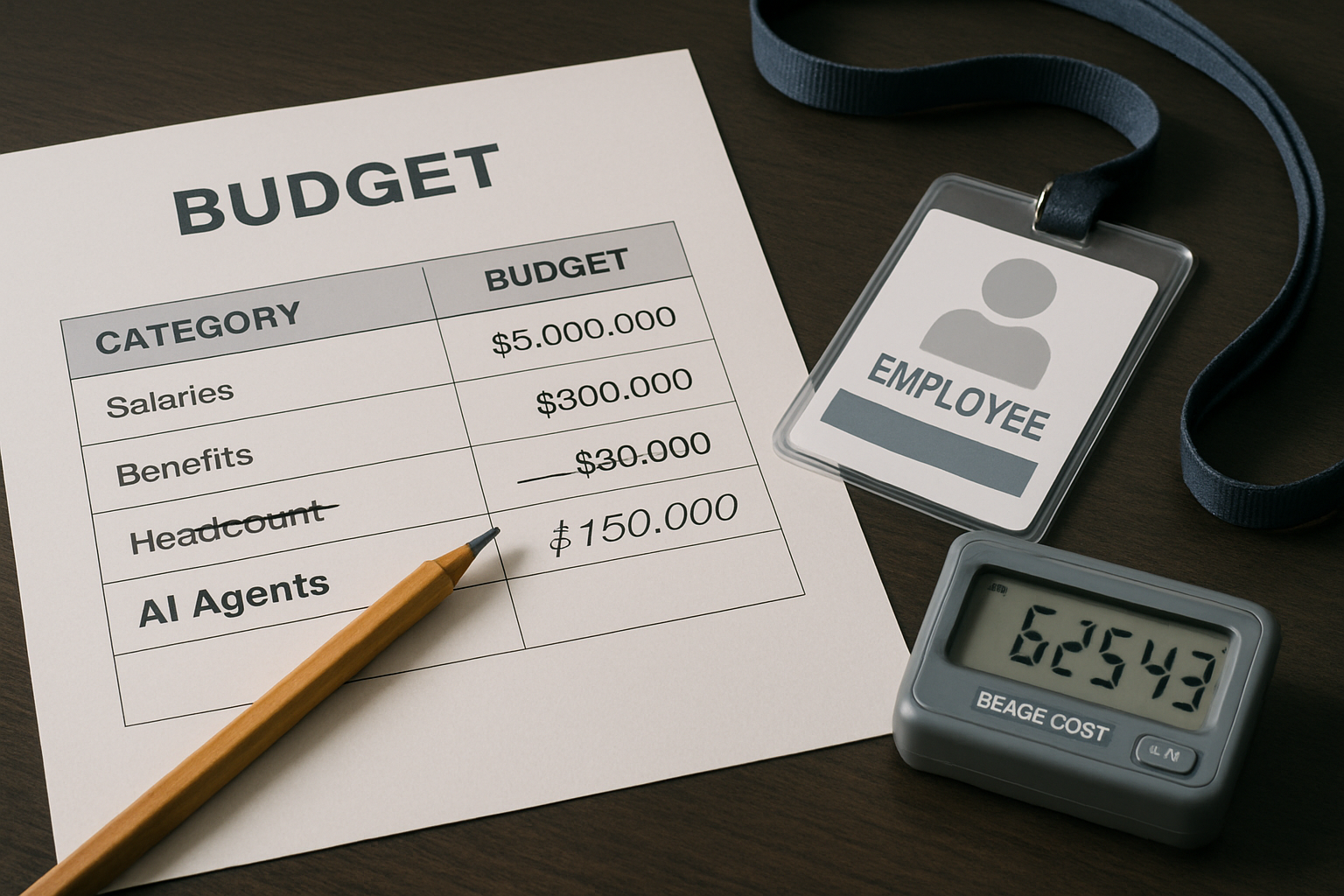
The more revealing detail wasn’t the technology label; it was the accounting. Those investors expect enterprise buyers to pull money from the hiring pool and reallocate it to AI systems. There’s a pragmatic cruelty to that shift. Salaries are commitments; usage-based AI is a meter. A headcount is a promise to a person and a team; an agent is a line item with a cancel button. In a cost center showdown, flexibility wins. If you’re trying to understand how displacement really happens, don’t follow the demos—follow the budget.
Agents stop being a metaphor
“Agent” used to be marketing shorthand for a slightly more autonomous chatbot. In this investor outlook, it’s a workflow object with identity, permissions, and an audit trail—something a compliance officer can live with and a CFO can price. That’s the moment when substitution stops being a philosophical debate and becomes a purchasing decision. The investors Szkutak spoke to are betting that this is the year those objects proliferate: dispatching tickets, reconciling invoices, negotiating freight, triaging claims, onboarding vendors. Not glamorous tasks, but they make up the spine of middle-office employment.
There’s an empirical backstop to the bravado. TechCrunch points to a November 2025 MIT analysis estimating current AI can already perform tasks equivalent to 11.7% of U.S. jobs at competitive cost. The number is a mirror, not a destiny. It doesn’t say 11.7% of workers will be replaced; it says there is enough capability on the shelves to make replacement economically rational in a substantial slice of the task graph. If you give executives a percentile of work that pencils out and the tools to buy it as software, you don’t need an adoption miracle—only a procurement process.
The scapegoat supply chain
The bleakest prediction in the piece isn’t technical. It’s rhetorical. Even when AI isn’t the primary driver of a restructuring, leadership will cite AI. That is more than a messaging trick. Blaming AI smooths friction. It shifts accountability from management choices to historical inevitability. It tells remaining staff the organization is “modernizing” rather than right-sizing for other reasons. It deflects scrutiny from balance-sheet issues, botched expansions, and the cost of money. The casualty is data quality. If every layoff is labeled an AI layoff, policymakers and analysts lose the ability to see what’s actually happening. That fog favors the most aggressive adopters, because scrutiny and nuance slow deals while slogans close them.
How expectations turn into headcount
Venture capital isn’t a pollster; it’s a pressure system. When VCs say “2026 is the year,” they aren’t just reading tea leaves. They’re writing board decks. Portfolio CEOs hear the same message in Q1: show efficiency, show faster cycle times, and show it without backfilling departing staff. That top-down expectation meets a bottom-up technical reality where agents can now chain tools, cite sources, and sign their work in logs. Once those two curves cross—finance wants elastic costs, engineering can offer them—the labor market feels it before productivity statistics do. Hiring slows first. Backfills pause. Contractors don’t renew. Then the headline reductions arrive with AI in the press release, even when the spreadsheet had a louder voice.
The risk that hides inside the promise
Most discourse about “augmentation vs. automation” treats them as moral choices. In 2026 they’ll behave like modes of operation that switch based on error tolerance. Where error bars can be contained by supervision and rollback, agents will run alone. Where errors are expensive or reputationally toxic, humans will stay in the loop longer, if only as exception handlers. This division creates a new asymmetry in work: humans inherit the rare, messy, and high-stakes edge cases, while software consumes the steady flow. That can look like upskilling, but it can also become deskilling, because exposure to the routine is how many workers earn the judgment needed for the hard calls. An enterprise that automates the ramps may find it has fewer pilots later.
What to watch when the story moves from slide to payroll
If this really is the year of substitution, you won’t need a press release to see it. You’ll see it in recruitment dashboards that keep the requisitions open but unfilled. You’ll see it in revenue-per-employee ratios that rise without corresponding margin growth, a tell that software spend replaced salaries. You’ll see it in vendor consolidation as firms prefer agents that already speak their SaaS stack. And you’ll hear it in a new, standardized vocabulary for “autonomy levels” in enterprise workflows, the same way cars adopted levels for driving assistance once the market needed shared definitions to govern blame.
There is a counterfactual worth entertaining. The MIT number remains potential energy until integration, governance, and trust turn it kinetic. If agents stumble in production—hallucinations that slip past guardrails, regulators who demand human sign-off, unions that negotiate “automation triggers” into contracts—the adoption curve could kink. But the investor signal in this TechCrunch piece isn’t about a technological breakthrough tomorrow; it’s about an appetite to reallocate money today. Appetite is often the scarce resource.
Choose your fiction carefully
The investors converge on an unspecific certainty: something big happens to labor in 2026. The danger of vague conviction is that it tolerates any outcome: a few well-publicized agent deployments, some opportunistic layoffs, and the narrative will declare victory. For workers and managers trying to operate inside the fog, the better question is narrower and more measurable: which workflows will be allowed to run without people, and what will be the governance for letting them do so? The answer determines whether “AI replaced me” is a confession, an exaggeration, or a line managers are instructed to use when the budget starts saying no.
On the last day of 2025, the investors didn’t predict science fiction. They predicted accounting. Agents may be the protagonist, but the budget is writing the script.