
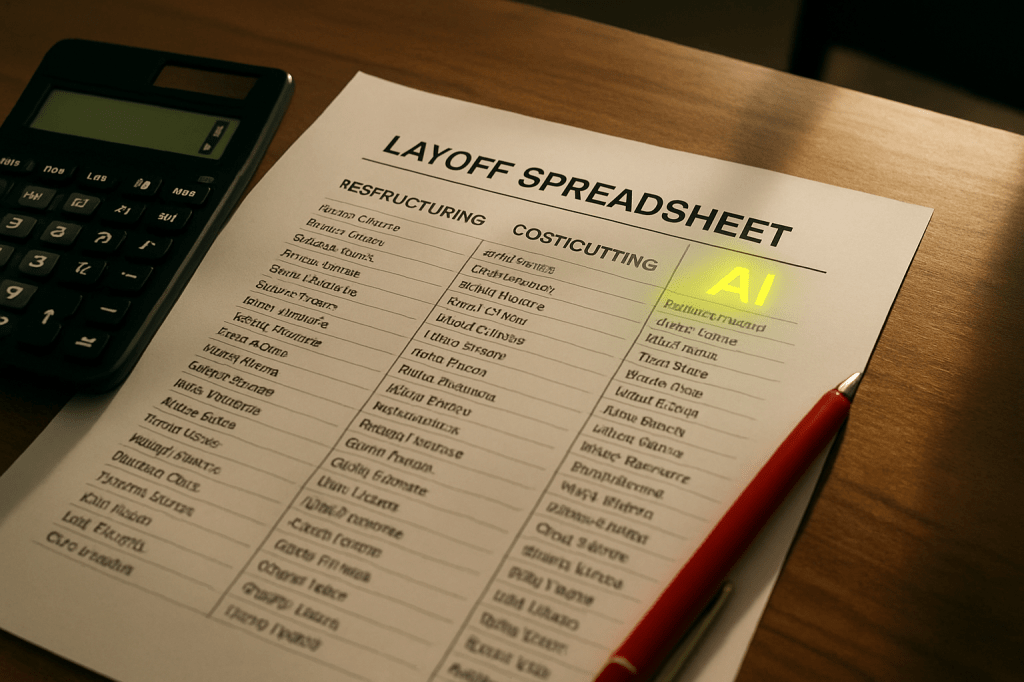
The day the layoff spreadsheet grew a new column
For years, the promise was that artificial intelligence would be a job creator, not a job cutter. Yesterday’s reporting forced a more complicated truth into view. Fortune stitched together Challenger, Gray & Christmas’s year-end layoff census with CEO playbooks from tech’s inner circle and delivered a picture that felt less like hype and more like a ledger. The number staring back was blunt: U.S. employers announced about 1.20 million job cuts in 2025, a 58% jump from 2024 and within arm’s reach of 2008’s 1.22 million. But the real shift wasn’t just magnitude—it was attribution. The spreadsheet finally grew a column labeled “AI.”
AI moves from subtext to line item
Challenger has only been tracking “AI” as an explicit reason for reductions since 2023, and that matters. The firm’s tally shows 54,836 planned cuts attributed to AI last year, 71,825 since the category first appeared. In other words, the technology stopped being a vague, windswept force and became a cited cause in public filings. It’s still a minority of the total—mid-single digits—but that’s precisely the point: companies are now comfortable saying the quiet part on the record. When the reason is listed next to “restructuring” or “cost-cutting,” it stops being a think‑tank projection and becomes part of corporate paperwork.
Two engines, different fuels: government contraction and tech acceleration
The sector map complicates the narrative in a productive way. The largest source of 2025 reductions came from government, driven by Department of Government Efficiency actions that collectively totaled around 315,000. Those are policy decisions more than product decisions. In the private sector, though, technology led with roughly 154,000 cuts—where AI doesn’t just influence budgets; it rewrites workflows. The distinction matters. Public‑sector contraction speaks to fiscal choices. Tech’s contraction, in contrast, looks like a reallocation story: teams hired into a post‑pandemic surge colliding with tools that remove cycles from core tasks, then management compresses headcount to fit the new throughput.
Executives say the quiet part out loud
Signals from the C‑suite now rhyme with the data. Microsoft’s Satya Nadella has said AI writes about 20% to 30% of the company’s code. That’s not a pilot; that’s production. If code is the assembly line of modern software firms, one in three stations are now manned by a nonhuman colleague. Amazon’s Andy Jassy told employees the company will need fewer people for some roles as generative models and agents roll out. Those are the kinds of sentences that, a few years ago, were padded with disclaimers about “augmentation.” Today they arrive alongside actual cuts—about 14,000 reported in 2025, with larger scenarios floated in outside coverage—and a clear managerial stance: if tasks shrink, roles follow.
The claim, and the limits we shouldn’t ignore
Fortune’s core argument is straightforward: despite assurances that AI would be a net creator of jobs, the hard announcements show a surge in planned reductions, with tens of thousands explicitly tied to AI and especially visible in tech. But the piece also carries its own caveats. Challenger counts announced plans, not realized separations, and the AI‑tagged portion is still only a slice of the total. That nuance matters for forecasting. Layoff announcements are the visible part of market adaptation, and visibility is biased toward subtraction. New roles built around AI rarely arrive with press releases; they arrive through quiet hiring, internal transfers, and vendor contracts that don’t show up as “jobs created” on a scoreboard.
The deeper read: timing, measurement, and incentives
What makes this moment consequential is not just that AI shows up as a reason, but where it appears and how management talks about it. The timing gap between automation of tasks and the formal redesign of roles is closing. When a model handles a quarter of the codebase or an agent resolves a tranche of customer tickets, the reorganization doesn’t wait for academic consensus. The measurement gap is stubborn: a laid‑off engineer is counted; a product manager quietly upskilled into prompt‑orchestration isn’t flagged as “AI‑created.” And incentives are unambiguous. If throughput rises and error rates fall, executives face pressure to compress teams and redeploy savings—first in tech, then across functions that live on documents, code, and rules.
Heading into 2026: what this snapshot tells us
The year-end census ties diffuse anxieties to a single page of numbers. It says the pace of AI adoption has crossed a threshold where it not only reshapes how work is done but shows up in how departures are justified. It also says the labor market is running two experiments at once: a fiscal one in government and an automation one in tech. Expect the line between them to blur as agencies adopt the same tools that private firms are standardizing. The headline totals may ebb as the economy cycles, but the new column on the spreadsheet will stay. Once companies learn to cite AI for efficiency gains—and shareholders learn to expect it—the vocabulary becomes policy. The open question for 2026 isn’t whether AI will create jobs somewhere; it’s whether the jobs it creates will be counted, comparable, and accessible to the people whose roles are being compressed today. Until we can see those on the ledger with the same clarity as the cuts, the story will read the way it reads now: automation is visible; replacement is measurable; reinvention is still off‑balance‑sheet.
