
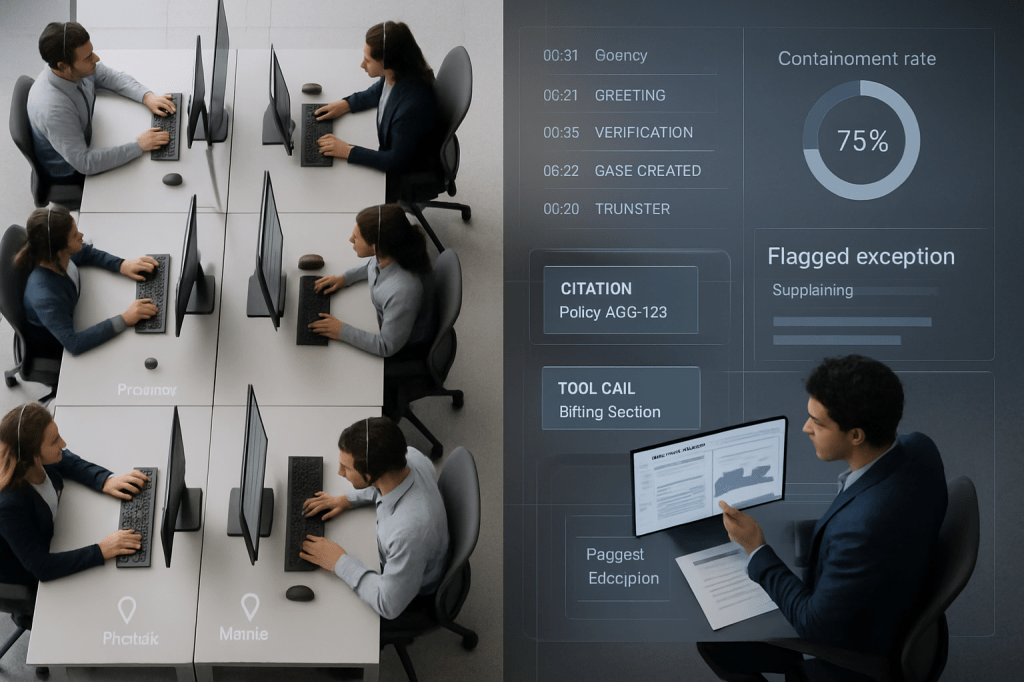
When a CEO Says “Half,” the Room Gets Quiet
The most important number yesterday wasn’t from a quarterly earnings slide. It was a fraction—half—spoken by IBM’s Arvind Krishna about call centers. Not a Thursday-morning layoff, not a headline built for panic, but a sober prediction: modern AI is now good enough to automate a large share of customer service, internal help desks, and the clerical matching that keeps accounts payable and receivable moving. He paired it with an insistence on retraining. The word choice—“over time”—didn’t dull the edge. It simply gave leaders a planning horizon.
Why This Signal Lands Differently
We’ve heard sweeping estimates about automation for years. Krishna’s remark was not that. It was functionally specific, and it sharpened a pattern. In 2023, he telegraphed a hiring pause for certain back-office roles as AI took over routine tasks. In late 2025, he ventured that up to a tenth of U.S. jobs could be affected, concentrated in particular functions. Yesterday’s half-for-call-centers moved from the macro to the blueprint: name the workflow, name the exposure, define the employer response—redeploy and upskill where possible, redesign the rest.
The Technical Truth Behind the Business Claim
Customer contact and internal help desks are built on repeatable choreography. Authenticate the user. Retrieve account context. Follow a branching script. Update a system. Offer a resolution. For years, the brittle part was language and judgment. That brittle part is now softening. Systems can search policy and knowledge bases on the fly, call tools to change a subscription or reset a password, and keep track of multi-turn context without losing the thread. The same pattern holds in finance’s back office: extract, compare, and reconcile fields across invoices, purchase orders, and receipts, then escalate exceptions with evidence. None of this magic is automatic; it demands guardrails, audit trails, and a human backstop. But the core loops—what agents and clerks repeat hundreds of times a week—are squarely within today’s capabilities.
Scale Turns “Interesting” Into Urgent
Customer service representatives number roughly 2.8 million in the U.S., and the government already expects a gradual decline in the occupation as self-service and automation expand. A Fortune 500 CEO attaching “half” to that function doesn’t just nudge the curve; it invites budgeting. If you run contact centers or internal service desks, you heard a mandate to sequence agent-assist now, pilot full automation where policies are clear, and prove that quality, compliance, and customer satisfaction don’t sag as containment rises. The playbook will be judged by evidence—first-contact resolution, error rates, average handle time, and auditability—not by slideware optimism.
Redesign Beats Reduction
It is tempting to translate “half” straight into headcount math. That would miss the point—and the opportunity. The defensible work inside these roles is the work machines still find awkward: exceptions with messy context, relationship repair after a broken promise, judgment that weighs policy against fairness, and coordination across teams when data is incomplete. That’s where displaced workers should be steered, and where training should concentrate. It also suggests how this will likely unfold: fewer new hires, more internal mobility, and attrition doing more of the numerology than pink slips. Krishna’s “over time” is less a dodge than a hint at mechanism.
Back Office: The Quiet Revolution
Accounts payable and receivable rarely make headlines, but the economics are unforgiving. If an AI can lift straight-through processing on routine matches, organizations will push for it. The risk isn’t just false positives; it’s explainability. Finance leaders will demand systems that can show their work—how an invoice was paired with a purchase order, why an exception triggered, and where a human signed off. The winners won’t just read documents; they’ll produce memos to auditors and satisfy internal controls without adding a new layer of manual checking that erases the savings.
The Global Echo
Call centers are a cross-border industry. A credible claim that half of the work can migrate to software will ripple from Phoenix to Manila to Bengaluru. Wages will not be the only variable anymore; latency, data residency, and regulatory exposure will enter the calculus. Expect governments and industry groups to press for transparency when bots handle consumers, and for procurement teams to ask whether safety, bias, and escalation paths are designed in rather than bolted on.
The Clock Starts With Design, Not Layoffs
Because the timeline was left open, the next twelve to twenty-four months will be less about cuts and more about sequencing. First come the copilots that suggest responses and surface context. Then tighter workflow integration that lets the system take actions reliably. Only after leaders trust the guardrails do they push full containment for the most standard journeys. The operational question is no longer “Can this be automated?” but “What fraction can be automated safely this quarter, and what proof will regulators, customers, and the board accept?”
The Bottom Line
Yesterday delivered the clearest executive marker yet on where AI will bite hardest first. Not a blanket prophecy, but a focused callout: customer service, help desks, and document-matching finance tasks are on an automation glide path, with humans pulled toward exceptions and relationships. Employers should be budgeting for redesign and reskilling as much as for savings. Workers should be running toward judgment-heavy work. The fraction that made the room quiet wasn’t just a forecast; it was a to-do list.
