
The Day the Data Refused to Panic
In a hotel ballroom in Washington yesterday, the conversation sounded familiar: AI will raise productivity; the hard part is the transition. Microphones passed between economists, technologists, and lawmakers. People nodded at the right moments. Yet underneath the choreography was a sharper question that wouldn’t sit still: will AI torch old jobs before it lights new ones?
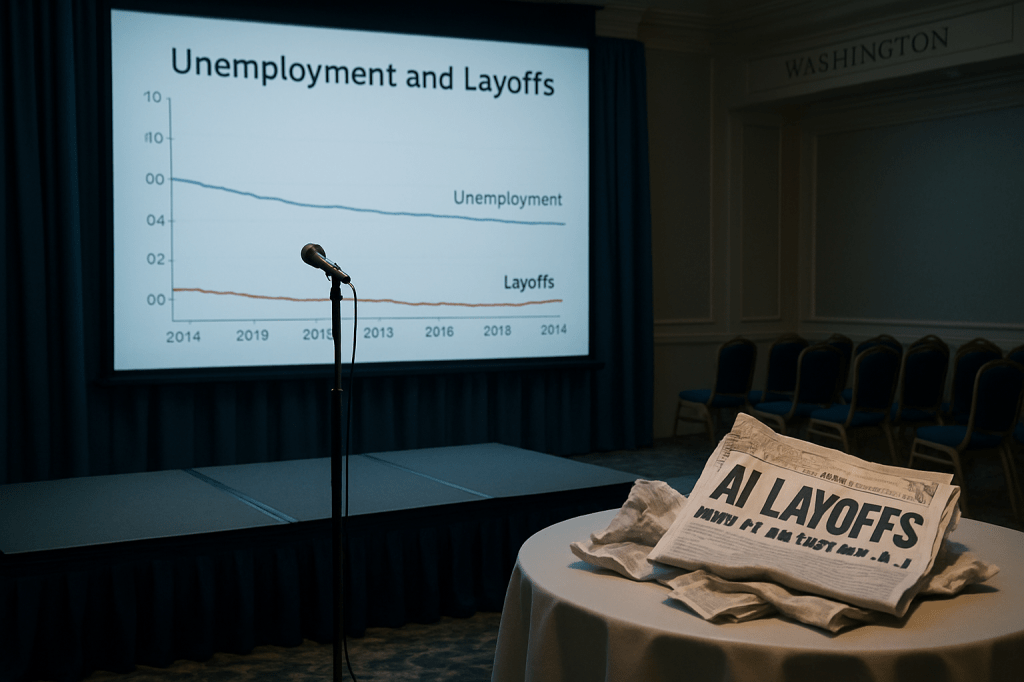
A MarketWatch column distilled the week’s unease into a single frame. Not the far-off question of whether AI changes work—of course it will—but the near-term possibility that displacement could outrun creation. The column’s sharpest move was to separate a story we can feel from a story we can measure. The feeling is everywhere: viral demos, corporate memos, task lists fed to models that reliably outperform interns. The measurement is stubborn: U.S. unemployment hovering around 4.3%, layoffs near historic lows, cooling concentrated in sectors that overshot during the pandemic rather than in the roles most exposed to automation.
This is the paradox of 2026: the tools imagine a future that the spreadsheets won’t confirm. The column didn’t minimize what’s changing. It simply refused to impute a macro crisis from a handful of high-profile announcements. That refusal mattered, because it undercut the easy posture—declare a jobs apocalypse, then look for evidence that fits—and replaced it with a harder discipline: ask the labor market to speak for itself.
The Numbers That Wouldn’t Tell the Scary Story
When a narrative gains speed, data often get recast as supporting players. Yesterday they held the stage. The labor market may be cooler than 2021’s sugar high, but separations are not surging and the aggregate jobs engine is still chugging. In tech, the slowdown reads less like robots replacing staff and more like the invoice coming due for pandemic-era hiring binges. Meantime, the industries that should be first to exhibit AI’s blade—highly codified, routine cognitive tasks—haven’t registered the kind of vacancy collapse or involuntary exit spike that would signal broad substitution.
That divergence between vibes and velocity isn’t comfortable. It invites two temptations: wave away the threat because the indicators are calm, or insist the indicators are blind because the threat feels obvious. The wiser interpretation is less dramatic and more exacting: diffusion takes time, organizations absorb technology unevenly, and macro signals are the last to crack.
History’s Quiet Rebuttal
The Washington room kept returning to history, and not out of nostalgia. From mechanization to the internet, the pattern is maddeningly consistent: tasks migrate, occupations mutate, demand re-expands, and the unemployment rate refuses to anchor the nightmare. That record does not guarantee a gentle ride now. But it does challenge a deterministic script in which software replaces people on a one-for-one basis and the ledger goes red. The current data, inconveniently for doomsaying, still rhyme with that older song.
Notice where the rhyming is strongest: firms are piloting AI in back offices, customer support, code review, and compliance, but they are colliding with bottlenecks—accuracy thresholds, liability, workflow redesign, and integration friction. Much of the productivity upside is real, yet not turnkey. When adoption is lumpy, macro displacement arrives, if at all, in waves, not in a single shock. The column captured this nuance without deflating the urgency to prepare.
What Fear Gets Right
Fear isn’t baseless; it’s early. There are genuine reasons to think the transition could bite faster this time. Unlike past capital deepening, foundation models are deployable as subscription software, not just factory hardware. They target white-collar tasks that were long insulated by tacit knowledge. And the bottleneck is less physical installation and more managerial will. If a credible cost curve bends, CFOs don’t need to wait for a new building to go up.
But even here, the column offered a corrective: “faster to deploy” does not mean “instant to recompute a company’s social graph.” Replacing a reporting line is trivial; replacing a workflow that encodes judgment, context, and accountability is not. The earliest returns suggest a re-weighting of tasks rather than a mass de-staffing, with human attention moving up the stack to exceptions, interfaces, and decisions that carry reputational risk.
Where Proof Would Appear First
If the “fast destruction, slow creation” thesis is right, we should see its fingerprints ahead of a headline unemployment spike. Watch for routine-cognitive postings to fall faster than overall vacancies. Watch for a rise in involuntary separations in roles with highly automatable task maps, not just in firms unwinding pandemic exuberance. Watch for wage compression at the lower end of white-collar salary bands, even as total employment holds up. None of these are yet screaming. A few are whispering. That’s not nothing; it’s just not confirmation.
The Worker’s Play in an Ambiguous Moment
In the absence of proof, the smartest move is asymmetric: position for the upside while insulating against the downside. The column’s practical counsel—lean into adaptation—landed with more bite than the usual platitudes because the evidence leaves room to act. Build AI literacy not as a novelty but as a daily surface area: prompt design, verification habits, data hygiene, and the social skill of explaining model outputs to non-technical stakeholders. Redirect time toward judgment-intensive work: prioritization, exception handling, client framing, and cross-functional translation. For younger workers, the advantage is metabolic—faster feedback loops, fewer sunk costs in legacy process, and fewer identity conflicts when tools refactor status hierarchies. For veterans, domain knowledge remains the scarce substrate that turns generic models into specific value; the trick is codifying it into systems rather than hoarding it in memory.
The Employer’s Dilemma: Don’t Automate the Narrative
Companies face a seduction: dress headcount cuts in the language of transformation and call it strategy. The column’s restraint is a warning against reflex. Early adopters that framed AI as a complement are discovering they can grow throughput per employee, expand product surface area, and speed cycle times without burning institutional memory. Those who slash first often find that the remaining staff must shoulder integration work, exception paths, and quality control—the very tasks that models handle least well alone. If the macro data aren’t yet validating mass displacement, over-rotating to cuts is less “decisive” than it is mispriced risk.
Policy, Calibrated to Evidence
For policymakers, the message is not complacency but proportion. Fund measurement so we can distinguish automation from macro cooling. Target adjustment aid and training at observable dislocations, not hypothetical ones. Update credentialing and procurement to let public agencies buy time with AI where it’s safe and to buy accuracy with humans where it isn’t. The goal is to make the labor market more permeable—quicker retraining, faster matching—so that if displacement accelerates, it translates into transitions rather than exits.
The Signal in Yesterday’s Noise
It’s tempting to read a headline, then adjust beliefs toward drama. Yesterday, the more interesting move was the opposite: hold beliefs accountable to the ledger. The fear that AI will eliminate old jobs faster than new ones appear is coherent, emotionally persuasive, and strategically important to examine. It is also, at scale, unproven. Until the data break, the rational posture is vigilance over doom—invest in adaptation, instrument what matters, and resist outsourcing your judgment to anecdotes.
The MarketWatch column didn’t settle the future. It did something rarer: it slowed the narrative down long enough for the evidence to catch up. In a week when it was easy to trade in predictions, that was the most disruptive act of all.
