
Beijing’s Jobs Gamble: Build the AI Economy, Then Catch the Falling Workers
At this year’s National People’s Congress, Beijing did something rare in the global AI conversation: it chose a side without hedging. Where Washington and Brussels are still arguing over which white-collar roles are next on the chopping block, China’s leadership framed artificial intelligence as a work generator at national scale—an instrument to rewire the labor market fast enough to outrun gray hair and slow growth. Reuters’ analysis ricocheted across outlets because it captured the clarity of the wager: accelerate diffusion now, and worry about stitching safety nets as needed.
The arithmetic behind the optimism
The math is unforgiving. Roughly 300 million Chinese will retire over the next decade. The government set a 2026 growth target of 4.5%–5%, a level hard to sustain if the workforce shrinks and productivity gains stall. If the IMF is right that AI will touch around 40% of global jobs—closer to 60% in richer economies—then the only way to keep output expanding while the dependency ratio worsens is to make each remaining worker dramatically more productive. China is declaring that it won’t wait for the perfect social policy blueprint before deploying the machines that might get it there.
This is not a paean to factory robots. The pitch is broader: push AI beyond manufacturing into services and everyday operations, using industry-specific models and plans to upgrade how hospitals schedule, how logistics coordinate, how customer service resolves, how designers prototype, how state firms modernize. “Advancing AI adoption and capability appears to be a higher policy priority than pre-emptively addressing potential job displacement,” as Shujing He of Plenum put it. That sentence may end up defining a decade of labor policy.
Filling seats before the music stops
There’s an immediate, human-scale pressure point: 12.7 million university graduates are expected to enter China’s job market this year. Human Resources Minister Wang Xiaoping said the country will “actively leverage” AI to absorb them. The subtext is pragmatic. If you can’t conjure enough new firms overnight, you make existing firms more capable of hiring—by equipping them with tools that give small teams large reach and by creating roles around those tools. The curriculum shift underway hints at how: universities like ShanghaiTech are carving out AI micro-majors, and faculties are emphasizing cross-disciplinary skills, critical thinking, and creative synthesis—“skills AI cannot easily replace.” Seen from that angle, education becomes a distribution channel for complementary human capital, not a factory for obsolete credentials.
State-enterprise leaders are telling a similar story inside legacy industries. Changan Automobile’s chair described major restructuring ahead, but cast AI as the mechanism that can turn “sunset” incumbents into “sunrise” employers. The claim is not just rhetorical. If software-defined factories can pivot product lines faster, and if predictive maintenance reduces downtime, then the same physical assets support more innovation cycles—and more adjacent jobs—without equivalent headcount growth in every task.
Guardrails at the edges, friction in the middle
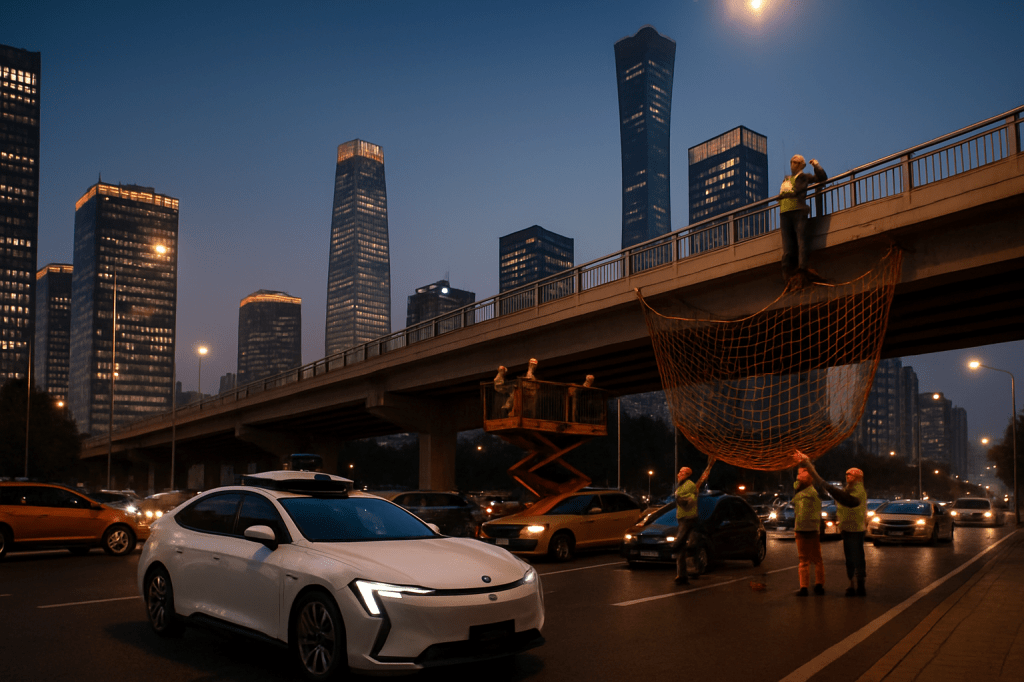
Even so, the contradictions are already visible. A Beijing court ruled that dismissing an employee solely to replace them with AI is illegal—a legal floor under the most direct forms of substitution. Yet robotaxis and autonomous delivery are creeping into urban routines, where displacement is diffuse and hard to litigate job by job. Meanwhile, viral “one-person company” toolchains—stacks of AI agents hooking into e-commerce platforms—have become a cultural meme, and a market signal. They promise entrepreneurial velocity for some and atomization for many, where income is no longer tied to a firm’s payroll but to the thin margins of platform participation.
This is why the choice to push hard on diffusion is both logical and precarious. Diffusion raises average productivity, but it also compresses the middle of the wage distribution if it automates routine abstraction faster than it creates new specializations. China is trying to bend that curve by seeding complementary skills and steering state firms to absorb shocks. The emerging question is whether these buffers can scale as quickly as the tools do.
The dissent that matters
There’s no shortage of skeptics on the inside. Natixis economist Alicia Garcia-Herrero warned that automation could suppress wages and keep youth unemployment stubborn without stronger social protections, floating universal basic income as one option. Labor economist Cai Fang offered the bluntest reminder: “job destruction often precedes and outweighs job creation.” History backs him up. The time lag between substitution and new demand is where households feel the most pain, and where political consensus frays. Human-capital investment and welfare buffers are not luxuries in that window; they are the policy instruments that determine whether diffusion translates into broad-based prosperity or a brittle, two-speed economy.
Note the sophistication of the bet, though. Beijing is not ignoring risk; it’s sequencing it. First, engineer an AI-intensive economy that can plausibly generate new work at scale. Second, put selective legal tripwires around the most egregious forms of replacement. Third, use education and state-enterprise reform to manufacture complements to the technology pipeline. If displacement surges, add income supports later. That ordering may be controversial, but it is coherent with the constraints of demographics, growth targets, and the global tempo of AI competition.
A mirror for other economies
Why does this matter beyond China? Because it is the clearest statement yet from a major economy that the default stance is not to slow AI to save jobs, but to spread AI to make different jobs—fast. Western debates have been consumed by professional redundancy: lawyers, marketers, coders, analysts. China’s message flips the premise. It treats AI as an employment multiplier through sectoral modernization and services uplift, and it is willing to tolerate messy transitions along the way. As Reuters’ analysis propagated through global partners and landed in The Wire China’s roundup, the signal was hard to miss: this is now an openly declared industrial and labor policy, not just a research agenda.
That raises uncomfortable questions for policymakers elsewhere. If China can push AI broadly into services and logistics while keeping headline growth near target, firms in other countries will face a competitiveness squeeze that no content-filter regulation can fix. Conversely, if the displacement shock outruns China’s buffers and wages sag, the world will watch a large-scale stress test of UBI talk and retraining orthodoxy. Either outcome will reset the reference point for what “responsible” AI labor policy looks like.
The calculus under the headline
Strip away the slogans and a more technical calculus emerges. Diffusion works if three conditions hold. First, the complement pool must be thick: enough managers, operators, and domain experts who can wield AI as leverage rather than competition. The curriculum reforms and micro-majors are an attempt to grow that pool quickly. Second, the demand side must be elastic: as costs fall, the market for intelligence-intensive services must expand rather than simply substitute old workers with fewer new ones. That’s where sectoral digitization and state procurement could play a catalytic role. Third, the insurance layer must prevent scarring: people displaced today need income and reskilling pathways before their savings and confidence collapse. The court ruling is a start, not a cushion.
China is writing policy as if these three lines can be moved simultaneously and at speed. The rest of us should resist easy caricatures. This is neither techno-utopianism nor denial. It’s triage under demographic pressure, with AI as the only available multiplier large enough to matter within a five-year plan.
The wager, stated plainly
On March 10, Beijing said the quiet part out loud: we will grow the number of AI-shaped jobs faster than AI displaces the old ones, and if we miscalculate, we’ll fix it later. For a country staring down a retiree bulge and a river of new graduates, there may be no gentler option. For everyone watching, the lesson is sharper: the world’s second-largest economy has chosen diffusion over precaution. If it works, it will redefine where value and wages accrue in the age of machine intelligence. If it stumbles, it will force a rapid rethinking of social insurance and labor power in an automated services economy. Either way, the center of gravity in the AI-and-jobs debate has shifted, and the rest of us will have to recalibrate to it.
