
When a Trillion Sounds Like Work
On Monday in San Jose, the room leaned forward. Jensen Huang had just flipped the keynote cadence from product poetry to procurement math: Nvidia expects at least one trillion dollars in revenue from its current Blackwell chips and the next generation, Vera Rubin, through 2027. It was not a boast about market share or margin. It landed like a construction schedule.
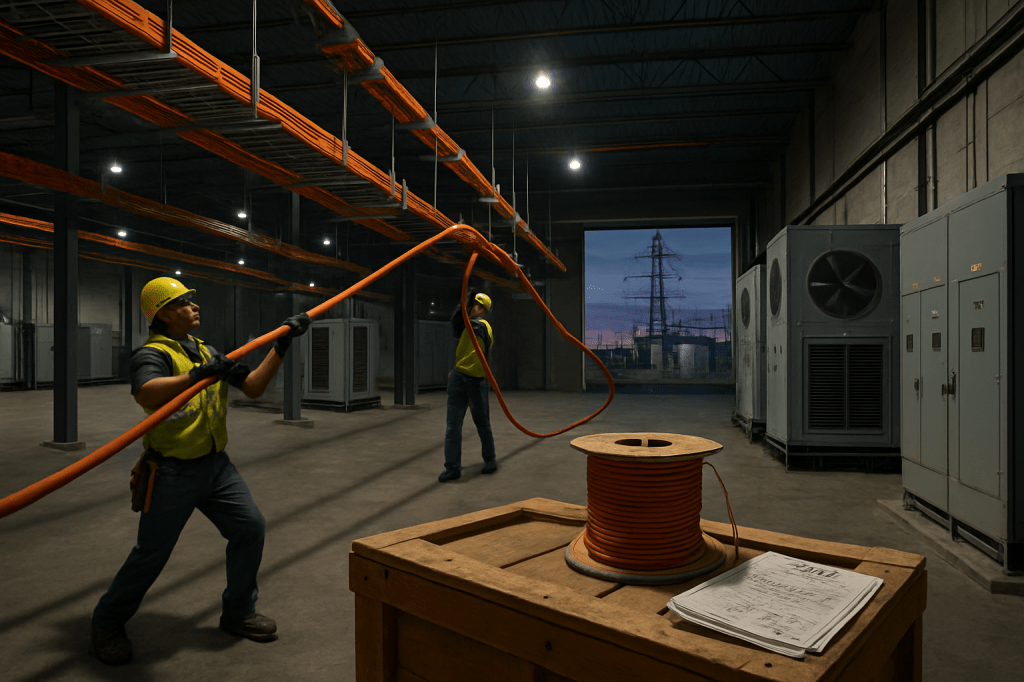
Because if customers truly take delivery of that much compute, they’re not just buying silicon. They’re commissioning the physical world that makes those chips useful—power, cooling, fiber, buildings, logistics. A chip order is a quiet contract with an army: electricians threading conduit, ironworkers setting steel, mechanical crews lifting chillers, utility teams cutting in new feeders, field engineers tuning the heat and the hum until racks purr within spec. Huang’s line was a revenue guide dressed as a labor signal.
The Stack Becomes a Payroll
GTC, by design, maps Nvidia’s “layers”: from GPUs to networking, from CUDA to software frameworks, and up into industry “AI factories” meant to live on-prem inside automakers, drug labs, banks, and media houses. Each layer isn’t just a technology story; it’s an ecosystem with its own suppliers, integrators, certifications, and headcount. When the keynote promises Blackwell now and Vera Rubin next, the roadmap ripples outward into purchase orders for switchgear and evaporative coolers, fiber routes and battery rooms, and the human beings required to design, install, permit, and operate all of it.
That’s why the trillion mattered. It converts hype into a planning horizon. The number implies not a one-off spike but a multi-year, still-accelerating buildout of AI infrastructure—data centers, edge nodes, and on-prem “AI factories”—large enough to anchor entire cohorts of skilled trades and operations roles. For a community that’s spent years gaming out which white-collar roles get automated, the more immediate truth is physical: the frontier of cognition runs on copper and concrete, and that translates into shifts, apprenticeships, and overtime.
Blackwell, Vera Rubin, and the Physics of Hiring
Blackwell and Vera Rubin are chip names, but they might as well be project codes for expanding the grid and refitting buildings. Each tranche of compute drags along its constraints. Power has to be contracted and delivered. Cooling has to be engineered to move heat measured in megawatts, not marketing metaphors. High-voltage equipment—transformers, switchboards, UPS—must be manufactured, tested, shipped, craned, commissioned. Fiber and backhaul can’t be wished into place. Every bottleneck along that path is solved by a person with a tool, a certification, and a calendar.
Huang has been explicit in the run-up to GTC: the AI roadmap is a jobs roadmap, especially in infrastructure and the skilled trades. That framing matters. It turns the trillion into a proxy for how many project managers get staffed, how many apprentices get slotted into the next class, how many integrators expand their backlogs, and how many utilities fast-track interconnects. It also repositions “AI policy” as something as dull—and consequential—as permitting reform, transformer lead times, and community-college lab capacity.
The Near-Term Tell
If the projection holds, the proof won’t be in a benchmark slide; it will be in filings and press releases that smell like dirt and ozone. Expect new data center campuses to surface with utility partnerships attached. Watch integrators announce backlogs stretching quarters ahead. Listen for training centers adding cohorts because the jobs won’t wait for four-year degrees. Much of this choreography tends to reveal itself during GTC week and the weeks that follow, as partners slot themselves into the roadmap unveiled on stage.
The Quiet Rebalancing of “AI Jobs”
Readers of this site know the cognitive displacement story. But the counterweight taking shape is not a think tank roundtable—it’s a hiring pipeline for people who keep electrons and airflow honest. AI may compress headcount in support desks and back offices, yet at the same time it is drafting the largest coalition of hands-on specialists the tech industry has ever required. The irony is sharp: the more software eats the world, the more it feeds a labor market of roles that cannot be remote, copied, or offshored easily.
Bottom Line
Yesterday’s clearest employment signal was a single sentence in a keynote: at least a trillion in chip revenue by 2027. Translate it from finance to physics and you get a surge of on-the-ground work to build and run the places where intelligence now lives. You don’t have to agree with Nvidia’s exact number to see the shape of the next two years: the age of AI will be installed, commissioned, and maintained—shift by shift, permit by permit, paycheck by paycheck.
